

Method of allocating walsh code resource
a walsh code and resource technology, applied in the field of mobile communication system, can solve the problems of low system throughput, poor or poor code efficiency, and deterioration of the code efficiency of the walsh code space, and achieve the effect of efficient use of walsh codes
- Summary
- Abstract
- Description
- Claims
- Application Information
AI Technical Summary
Benefits of technology
Problems solved by technology
Method used
Image



Examples
first embodiment
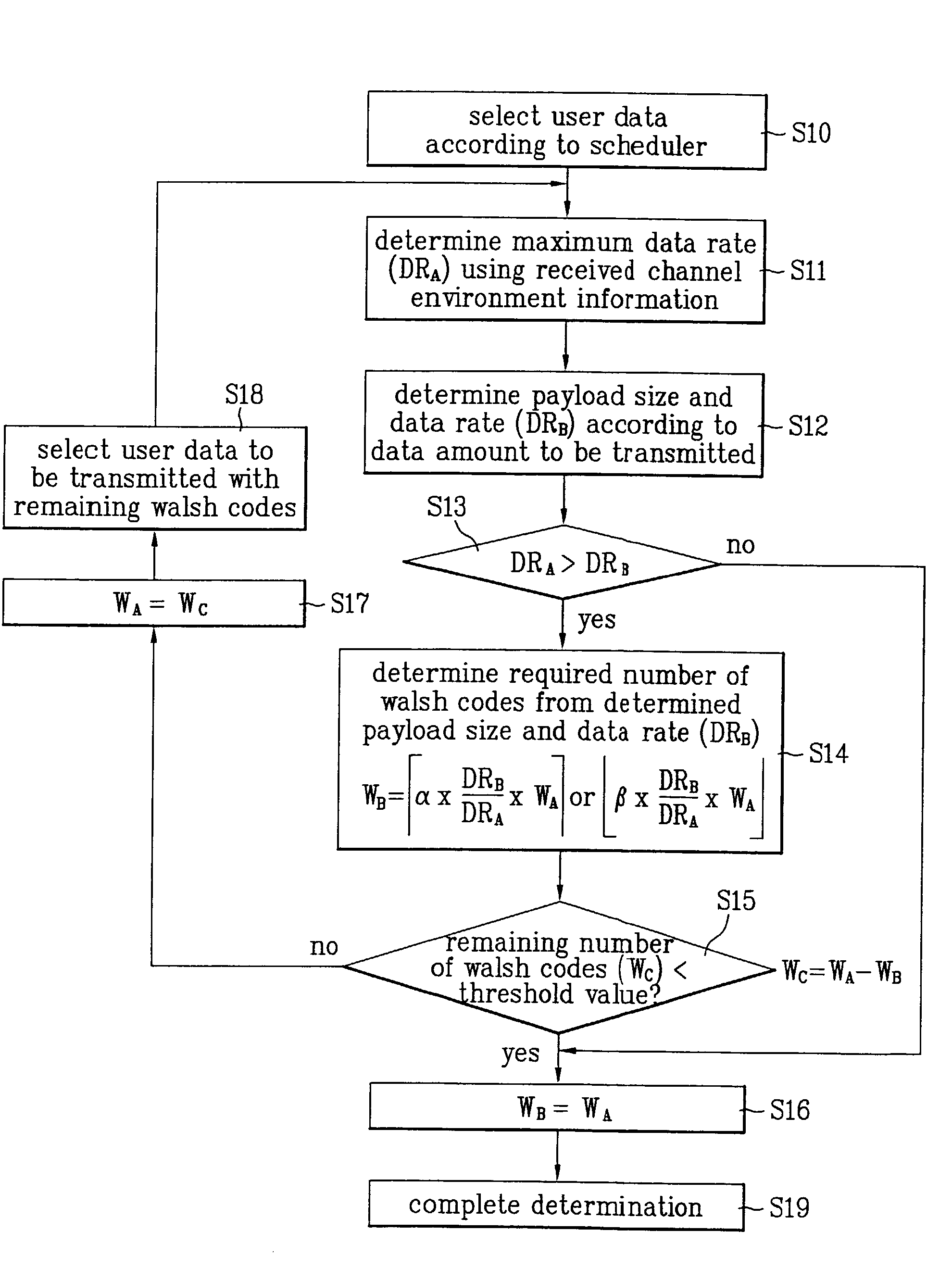
[0044]FIG. 5 illustrates a procedure for selecting a data rate in FIG. 4 and a number of Walsh codes by the data rate.
[0045]A scheduler of a base station selects a terminal for transmitting data in each frame by using channel environment feedback information (C / I) from terminals and transmission data information (step S10).
[0046]When selection of the terminal for transmitting data is finished, the scheduler selects a maximum data rate (DRA) in FIG. 4 by using the C / I from the corresponding terminal (step S11). Here, a number of threshold values which must be compared to determine the DRA are represented by ‘number of slots per packet (4)×payload size (6)’, namely 24. As shown in FIG. 4, some of the 24 data rates are same. Since the same data rates have similar threshold values, they can be grouped. 15 data rates exist in the current system, and thus 15 threshold values exist therein.
[0047]Accordingly, the base station compares the received C / I with the 15 threshold values, thereby d...
second embodiment
[0063]FIG. 6 illustrates a procedure for selecting a terminal, a data rate of the terminal and a number of Walsh codes.
[0064]Referring to FIG. 6, the value ‘I’ that represents the order of terminals (CDM terminals) is set to ‘1’ (step S21). Here, the value ‘I’ is used as a variable for counting the number of terminals that can simultaneously transmit data at the same time point.
[0065]Thereafter, the data rates for the whole terminals are determined by using PWR, NW and CQI information (step S22). At this time, it is presumed that the whole Walsh codes are allocated to one terminal.
[0066]Here, PWR represents the power usable in a forward packet data channel (F-PDCH), NW is the number of 32-chips Walsh codes usable for the F-PDCH, and CQI denotes a channel quality indicator.
[0067]The scheduler allocates priority values to the respective terminals by reflecting the data rates obtained at the step S22 (step S23). Note that priority value can be some number except zero.
[0068]That is, the...
PUM
 Login to View More
 Abstract
Description
Claims
Application Information
 Login to View More