
Wound and ulcer treatment with super-oxidized water
a super-oxidized water and wound treatment technology, applied in the field of oxidant mixtures, can solve the problems of reducing the quality of life of patients, preventing its use in other medical indications, and asthma and dermatitis
- Summary
- Abstract
- Description
- Claims
- Application Information
AI Technical Summary
Benefits of technology
Problems solved by technology
Method used
Image

Examples
example 1
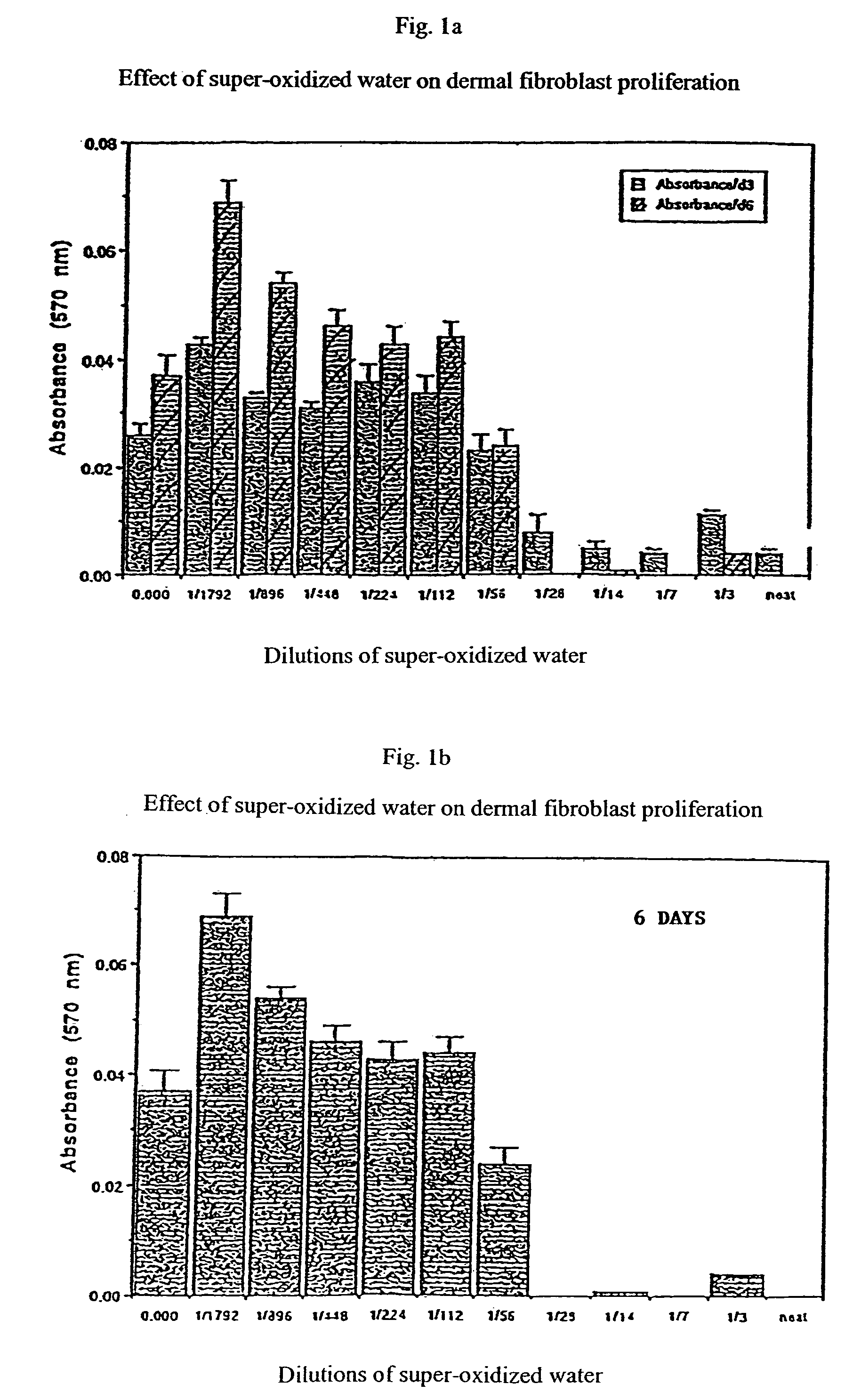
[0045]Fibroblasts are flattened, irregular-shaped, connective tissue cells which are ubiquitous in fibrous connective tissue. They secrete components of the extracellular matrix, including collagen, and play an important role in tissue regeneration.
[0046]Three in vitro trials of super-oxidized water based on hypochlorous acid were carried out on single-layer cell cultures of human dermal fibroblast (HDF) cells to ascertain whether the super-oxidized water affected HDF cell proliferation. A range of dilutions of super-oxidized water at different pH levels was investigated.
Method
[0047]The super-oxidized water used in the trials was the product of the electrolysis of an aqueous saline solution passed over a mixture of proprietary catalysts on titanium electrodes to give a mixture of oxidizing species, particularly hypochlorous acid (HOCl) at a concentration of about 144 mg / l to 400 mg / l available free chlorine (Cl). The super-oxidized water was produced as required for each test; the a...
example 2
[0063]Three in vitro trials were carried out to investigate the cytotoxic effect of super-oxidized water based on hypochlorous acid on HDF cells.
Method
[0064]The super-oxidized water based on hypochlorous acid was identical to that described in Example 1.
[0065]HDF cells were seeded in 10% FCS / DMEM at 5×10³ cells / well. After incubation at 31° C. for 72 hours, dilutions of super-oxidised water were prepared in HBSS and added to the cells. The viability of the cells was ascertained by a standard absorption assay at time intervals of 15 minutes up to one hour from the addition of the super-oxidised water.
Results
[0066]i) Trial 1: HDF cells were incubated with super-oxidized water in a range of dilutions at a pH of 4.3. The dilutions used were: 1, ⅓, 1 / 7, 1 / 14, 1 / 28, 1 / 56, 1 / 112, 1 / 224, 1 / 448, 1 / 896, 1 / 1792 and 0.
[0067]No effect on cell viability was seen in the presence of super-oxidized water at dilutions of 1 / 28 or more at any of the time points. A dilution of 1 / 14 induced mild damage t...
example 3
[0073]In view of the results described in Examples 1 and 2, two in vitro trials were carried out to investigate the effect super-oxidized water on human keratinocyte (HK) cell proliferation. The super-oxidized water used in these trials was identical to that described in Example 1. Keratinocytes are epidermal skin cells that synthesize keratin and, together with dermal fibroblasts, are essential for skin healing.
Trial 1
[0074]HK cells (subcultured, P2, FS, 7 years) were seeded at 8×10³ cells / well and incubated at 31° C. in CLONETICS® (Biowhittaker, US) serum-free medium with complete supplements, hereinafter referred to as keratinocyte growth medium (KGM), in four 24-well plates. After 24 hours incubation the medium in plates 1 and 2 was changed to CLONETICS® (Biowhittaker, US) serum-free medium without complete supplements, hereinafter referred to as keratinocyte basal medium (KBM).
[0075]After a further 48 hours incubation super-oxidized water diluted in KBM at pH 5.4 was added to p...
PUM
| Property | Measurement | Unit |
|---|---|---|
| pH | aaaaa | aaaaa |
| pH | aaaaa | aaaaa |
| pH | aaaaa | aaaaa |
Abstract
Description
Claims
Application Information
 Login to View More