
Thioamide derivatives as progesterone receptor modulators
a technology of progesterone receptor and thioamide, which is applied in the direction of biocide, drug composition, animal repellent, etc., can solve the problem of increasing the risk of uterine cancer
- Summary
- Abstract
- Description
- Claims
- Application Information
AI Technical Summary
Benefits of technology
Problems solved by technology
Method used
Image

Examples
example 1
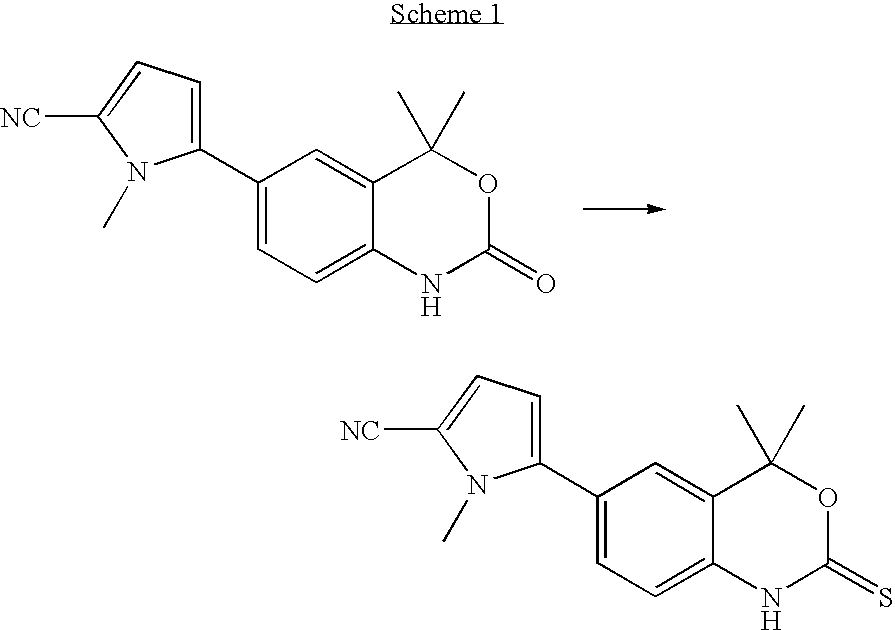
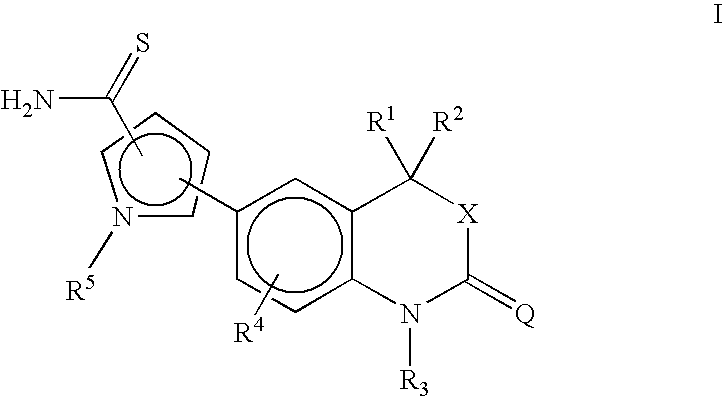
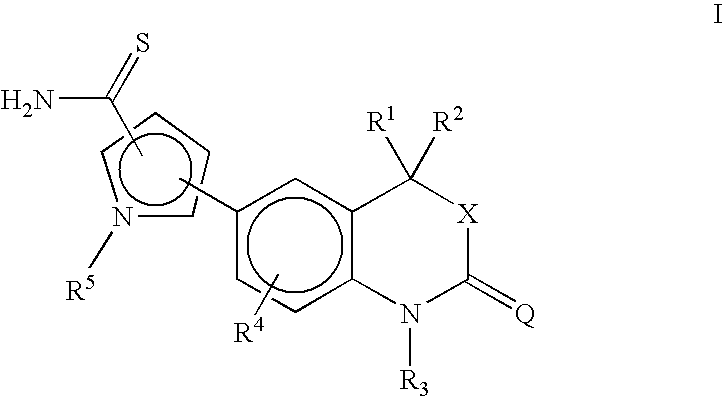
Preparation of 5-(4,4-Dimethyl-2-Thioxo-1,4-Dihydro-2H-3,1-Benzoxazin-6-yl)-1-Methyl-1H-Pyrrole-2-Carbothioamide
[0110]In a 500-mL round-bottomed flask equipped with a magnetic stirrer, thermometer, addition funnel, and a reflux condenser, 5-(4,4-dimethyl-2-thioxo-1,4-dihydro-2H-3,1-benzoxazin-6-yl)-1-methyl-1H-pyrrole-2-carbonitrile (29.3 g, 98.6 mmol) was suspended in 1,2-dimethoxyethane (DME; 200 mL). Hünig's base (1 mL, 0.747 g, 5.75 mmol) was added followed by water (1 mL, 1.00 g, 55.6 mmol) and the mixture was heated to reflux. Diethyl dithiophosphate (49.0 g, 263 mmol, Aldrich, tech.) was added dropwise. The mixture turned homogenous after 15 minutes of heating and reaching 84° C. Eight minutes later, the temperature had reached 90° C. and solids started to precipitate. The high performance liquid chromatograph (HPLC) graph of the liquid phase sampled after 5 hours showed a 20 / 80 ratio of substrate / product. More diethyl dithiophosphate (11.0 g, 59 mmol) was added and the mixtu...
example 2
Preparation of 5-(4,4-Dimethyl-2-Oxo-1,4-Dihydro-2H-3,1-Benzoxazin-6-yl)-1-Methyl-1H-Pyrrole-2-Carbothioamide
[0112]This compound was prepared by following the procedure of Example 1 using 5-(4,4-dimethyl-2-oxo-1,4-dihydro-2H-3,1-benzoxazin-6-yl)-1-methyl-1H-pyrrole-2-carbonitrile (1.45 g) to give 5-(4,4-dimethyl-2-oxo-1,4-dihydro-2H-3,1-benzoxazin-6-yl)-1-methyl -1H-pyrrole-2-carbothioamide (0.79 g, 49% yield). 1H NMR (DMSO-d6, ppm): 9.17 (s, 1H, S═CNH2), 8.93 (s, 1H, S═CNH2).
example 3
Preparation of 5-(2′-Thioxospiro[Cyclohexane-1,3′-[3H]-Indol]-5′-yl)-1-Methyl-1H-Pyrrole-2-Carbothioamide
[0113]This compound was prepared by following the procedure of Example 1 using 5-(2′-thioxospiro[cyclohexane-1,3′-[3H]-indol]-5′-yl)-1-methyl-1H-pyrrole-2-carbonitrile (1.45 g) to give 5-(2′-thioxospiro[cyclohexane-1,3′-[3H]-indol]-5′-yl)-1-methyl-1H-pyrrole-2-carbothioamide (0.20 g, 55% yield). 1H NMR (DMSO-d6, ppm): 9.24 (s, 1H, S═CNH2), 8.96 (s, 1H, S═CNH2).
PUM
| Property | Measurement | Unit |
|---|---|---|
| temperature | aaaaa | aaaaa |
| temperature | aaaaa | aaaaa |
| structure | aaaaa | aaaaa |
Abstract
Description
Claims
Application Information
 Login to View More