
Fault location on a telecommunications network
a fault location and telecommunications network technology, applied in data switching networks, instruments, frequency-division multiplexes, etc., can solve problems such as short circuits between wires, and prone to faults in terminal lines, so as to mitigate errors in average values
- Summary
- Abstract
- Description
- Claims
- Application Information
AI Technical Summary
Benefits of technology
Problems solved by technology
Method used
Image

Examples
Embodiment Construction
[0038]The fault location system and method of the present invention comprises two basic operations. The system provides an arrangement capable of finding the likely location of a fault in a telecommunications system effectively by comparing a test measurement on a line with a reference value and deriving from that comparison the likely location of the fault. Accordingly, the two operations are respectively obtaining one or more reference values to form the basis of the comparison, and carrying out the comparison itself.
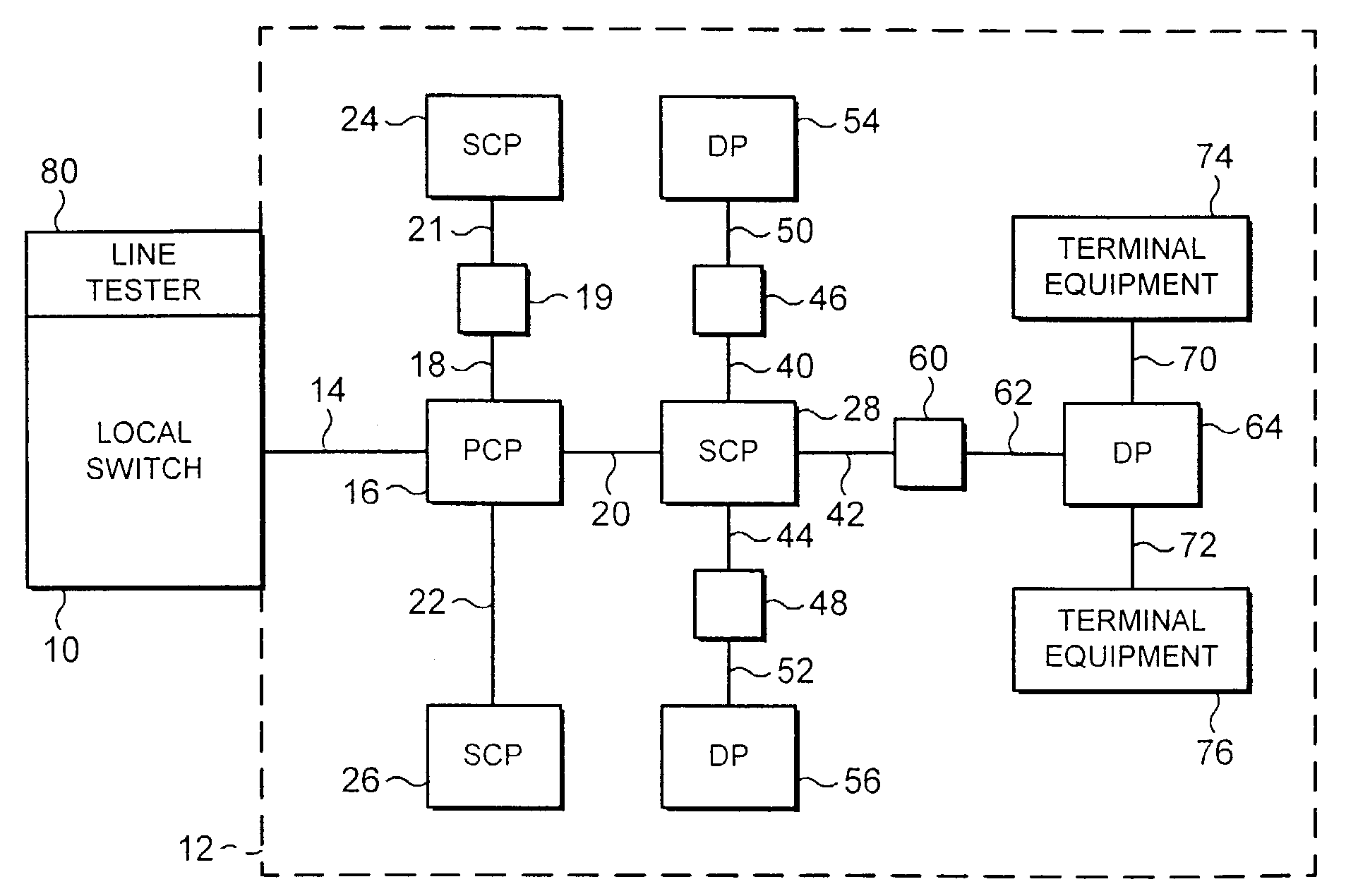
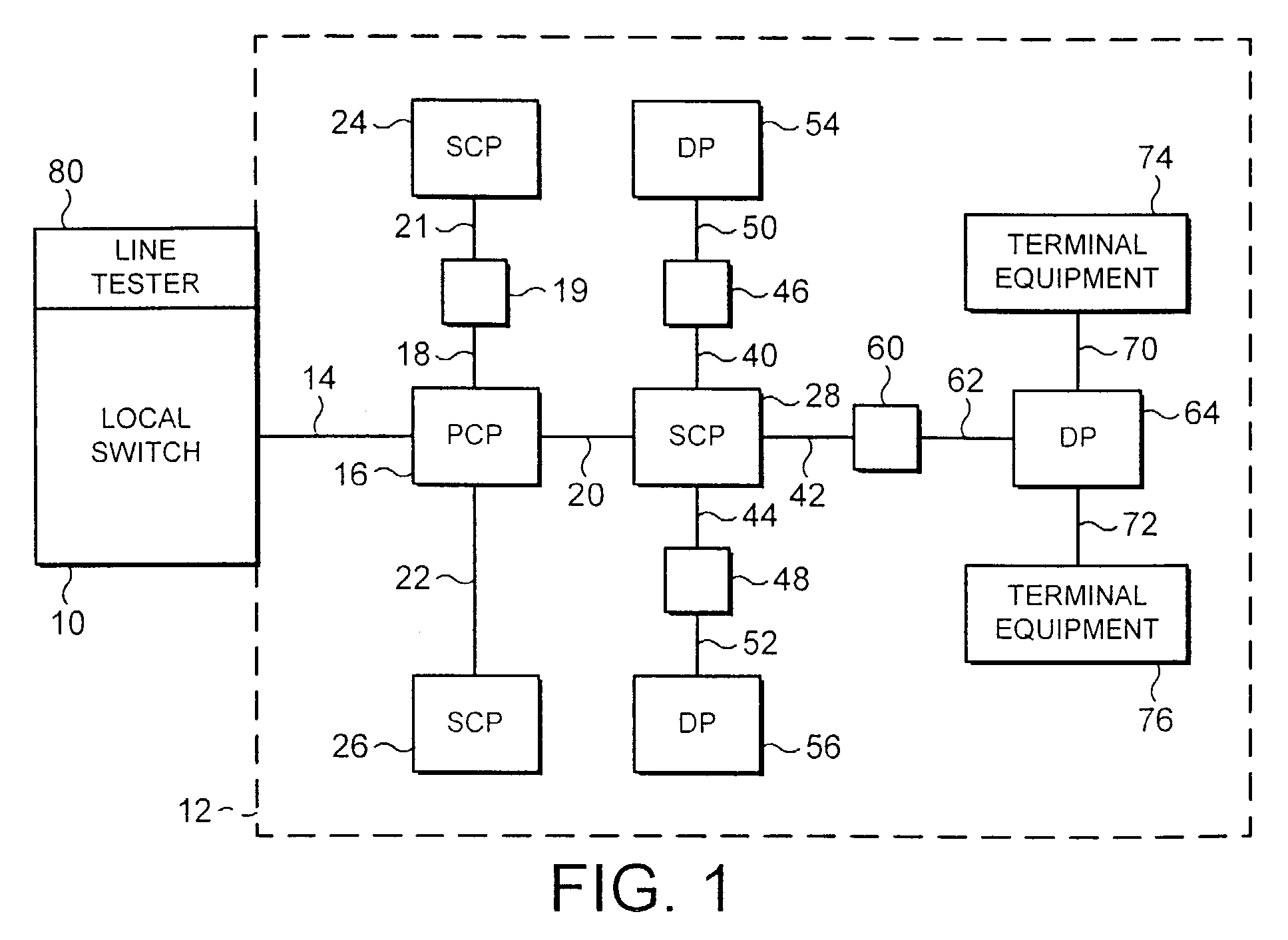
[0039]FIG. 1 illustrates an access network 12 of a conventional telecommunications network connected to a local switch 10. The local switch 10 and the access network 12 form part of a telecommunications network.
[0040]The local switch 10 is connected to the terminating line of the access network 12. Typically, a local switch is connected to several thousand terminating lines. Each terminating line passes through several nodes before reaching its respective terminal equ...
PUM
 Login to View More
 Abstract
Description
Claims
Application Information
 Login to View More