
Article having a birefringent surface and microstructured features having a variable pitch or angles for use as a blur filter
a technology of microstructured features and birefringent surfaces, which is applied in the field of articles having birefringent surfaces and microstructured features having a variable pitch or angle for use as blur filters, can solve the problems of rainbow-like color distortion and other artifacts in the displayed digital image, induced photographic color distortion and color banding in digital imaging,
- Summary
- Abstract
- Description
- Claims
- Application Information
AI Technical Summary
Benefits of technology
Problems solved by technology
Method used
Image

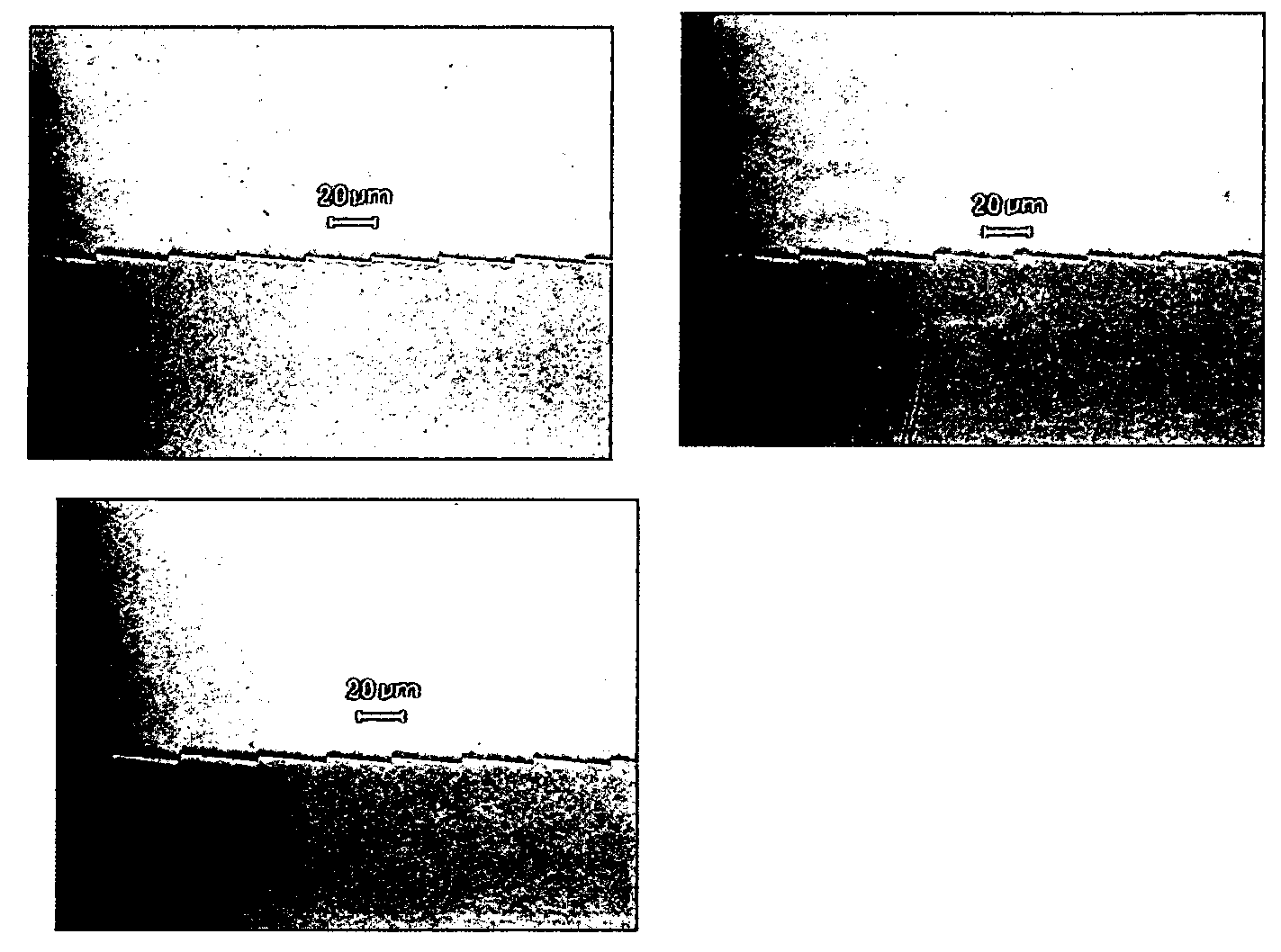
Examples
example 1
Creation of Oriented Microstructured Film
[0171]A polyethylene terephthalate (PET) with an inherent viscosity (I.V.) of 0.74 available from Eastman Chemical Company, Kingsport, Tenn. was used in this example.
[0172]The PET pellets were dried to remove residual water and loaded into an extruder hopper under a nitrogen purge. The PET was extruded with an increasing temperature profile of 232° C. to 282° C. within the extruder and the continuing melt train through to the die set at 282° C. Melt train pressures were continuously monitored and an average taken at the final monitored position along the melt train prior to bringing the die into close proximity to the tool onto which the polymer film is formed simultaneously with the structuring of a first surface of that film against the tool.
[0173]The tool was a structured belt Nickel alloy specific composition unknown, made at 3M, electroformed, welded sections having a negative version of the structured surface formed on the cast film. Th...
example 2
Variable Pitch Blur Filter with White Light Source
[0180]The tooling was cut by diamond turning copper sheeting on a 3M Pneumo. No oil or liquid cooling was used. The diamond used had an 84 degree included angle and was held so as to yield a cut with a 6 degree angle off of horizontal with a vertical facet sidewall. The cut tool was treated with BTA. Unoriented PET cast films were then embossed in a compression molding machine. The process conditions varied depending upon the material being molded. Conditions were chosen such that high fidelity replication was achieved while avoiding crystallization induced haze. If a sample displayed haze that was discernible to the eye that sample was discarded. Sometimes it was found to be helpful to use an ice bath to rapidly cool the film.
[0181]Samples were then cut to size and uniaxially oriented in a commercial lab scale batch tentering machine. Draw conditions varied depending upon the material, the thickness, and the target...
example 3
Variable Pitch Blur Filter with Laser Light Source
[0185]A sample was prepared as explained in Example 2. The film was PET with an embossed 6° sawtooth structure with pitch variation.
Sample Test
[0186]The test set-up was the same as in Example 2, except that a green laser was used as the light source instead of the white light source. When viewing the resulting image, diffractive artifacts were reduced in the 10% random pitch sample and even more reduced in the 100% random pitch sample.
[0187]
Camera Conditions for Example 3Picture 3aPicture 3b(10% random pitch)(100% random pitch)Camera Manufacturer: KonicaCamera Manufacturer: KonicaMinolta Camera, Inc.Minolta Camera, Inc.Camera Model: DiMAGE A2Camera Model: DiMAGE A2Software: DiMAGE A2 Ver.1.10Software: DiMAGE A2 Ver.1.10Date / Time: 2005:06:08 15:56:05Date / Time: 2005:06:08 16:00:22YCBCr Positioning: CenteredYCBCr Positioning: CenteredExposure Time: 1 / 200 secExposure Time: 1 / 200 secF Number: 11.0F Number: 11.0Exposure P...
PUM
 Login to View More
 Abstract
Description
Claims
Application Information
 Login to View More