
Input sensor containing display device and method for driving the same
a display device and input sensor technology, applied in the field of planar display devices, can solve problems such as inability to reliably detect, read speed may create a problem, and marked differences in characteristics (or detection capability) between amplifiers, and achieve the effect of flexible data processing and efficient display data processing
- Summary
- Abstract
- Description
- Claims
- Application Information
AI Technical Summary
Benefits of technology
Problems solved by technology
Method used
Image

Examples
second embodiment
According to Image Pickup System
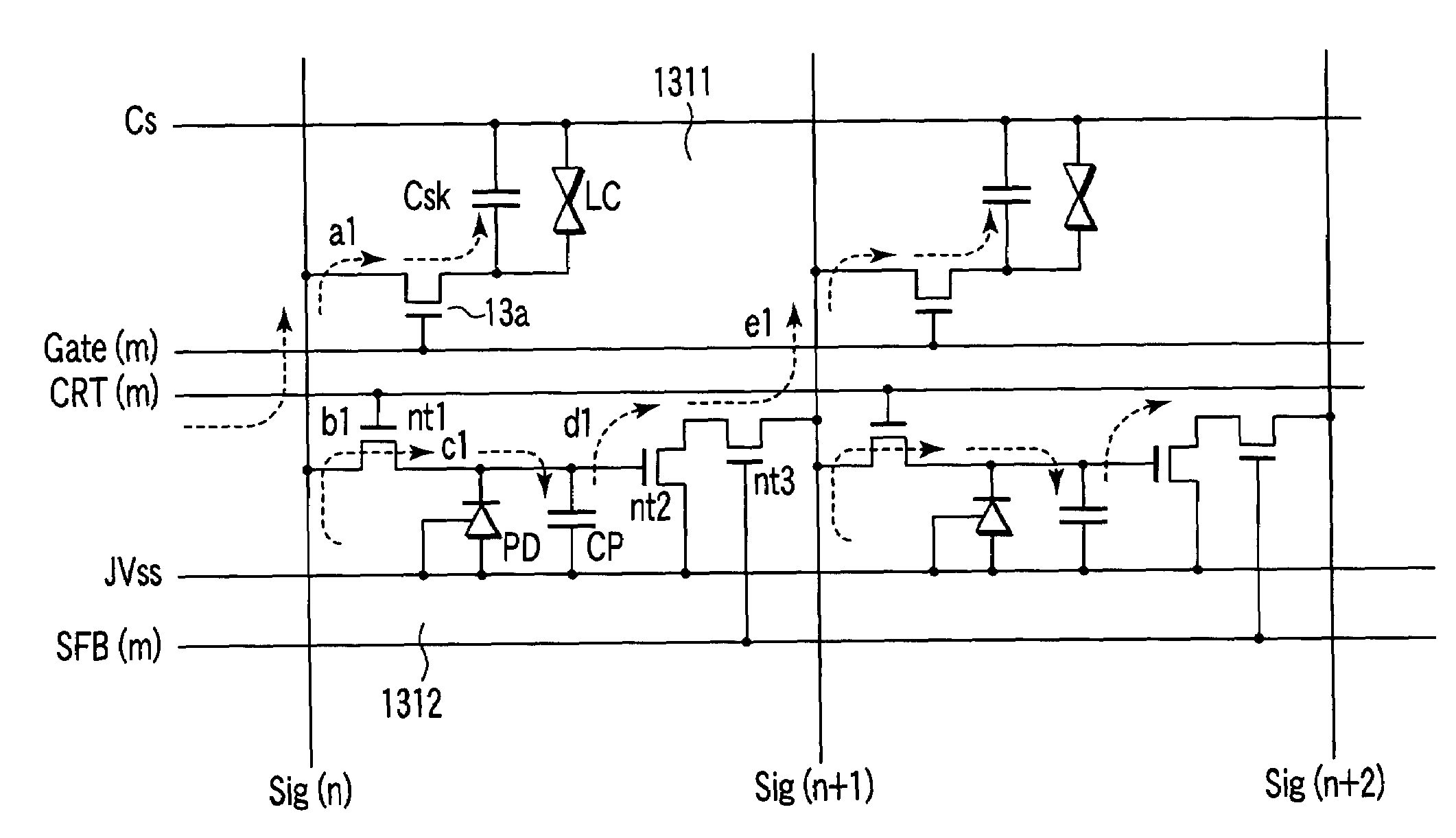
[0107]A second embodiment is characterized in that the precharge voltage of the sensor capacitor CP is varied with the sensors on the basis of the results of calibration image pickup. In the calibration image pickup, light from the backlight is, for example, uniformly applied. In this case, even within the same chip, there may be noticeable differences among the optical sensors (photodiodes) PD or transistors nt2 formed on the glass substrate. Thus, disadvantageously, some parts of the image may appropriately show reflected light from an indicating member such as a finger in white while showing the absence of reflected light in black, but other parts may undergo underexposure or overexposure to prevent the indicating section from being properly detected. This is due to differences among the currents through the optical sensors or differences among the thresholds of the transistors nt2. In this case, the underexposure or overexposure is avoided by incr...
PUM
| Property | Measurement | Unit |
|---|---|---|
| precharge voltages | aaaaa | aaaaa |
| voltage | aaaaa | aaaaa |
| voltage | aaaaa | aaaaa |
Abstract
Description
Claims
Application Information
 Login to View More