

Titanium complexes, their production methods, titanium-containing thin films, and their formation methods
a technology of titanium complexes and thin films, which is applied in the field of titanium complexes, their production methods, and titanium-containing thin films, can solve the problems of clogging a pipe, affecting the stability of the surface, and not meeting the demand characteristics of the barrier layer, etc., and achieves excellent thermal stability and good volatility characteristics.
- Summary
- Abstract
- Description
- Claims
- Application Information
AI Technical Summary
Benefits of technology
Problems solved by technology
Method used
Image

Examples
example 1
Synthesis of Ti(tBuNC(H)C(H)NtBu)(NMe2)2
[0067]In an argon atmosphere, 212 mg (30.5 mmol) of lithium was added to a solution of 1.68 g (10.0 mmol) of N,N′-di(tert-butyl)-1,4-diaza-1,3-butadiene dissolved in 40 ml of tetrahydrofuran, followed by stirring at room temperature for 14 hours. The remaining lithium was filtered off, and a solvent was distilled away from a filtrate under reduced pressure. The remaining yellow solid was suspended in 10 ml of hexane, and a solution of 1.98 g (8.81 mmol) of titanium tetrakis(dimethylamide) dissolved in 20 ml of hexane was added thereto. After stirring at 50° C. for 4 hours, the resulting mixture was cooled to room temperature, and insoluble matters were filtered off. The solvent is distilled away under reduced pressure from the filtrate, and the residue obtained was distilled under reduced pressure to obtain 2.37 g of a deep red liquid (yield 88%).
[0068]1H NMR (500 MHz, C6D6, δ / ppm) 5.86 (s, 2H), 3.06 (s, 12H), 1.28 (s, 18H) 13C NMR (125 MHz, ...
experimental example 1
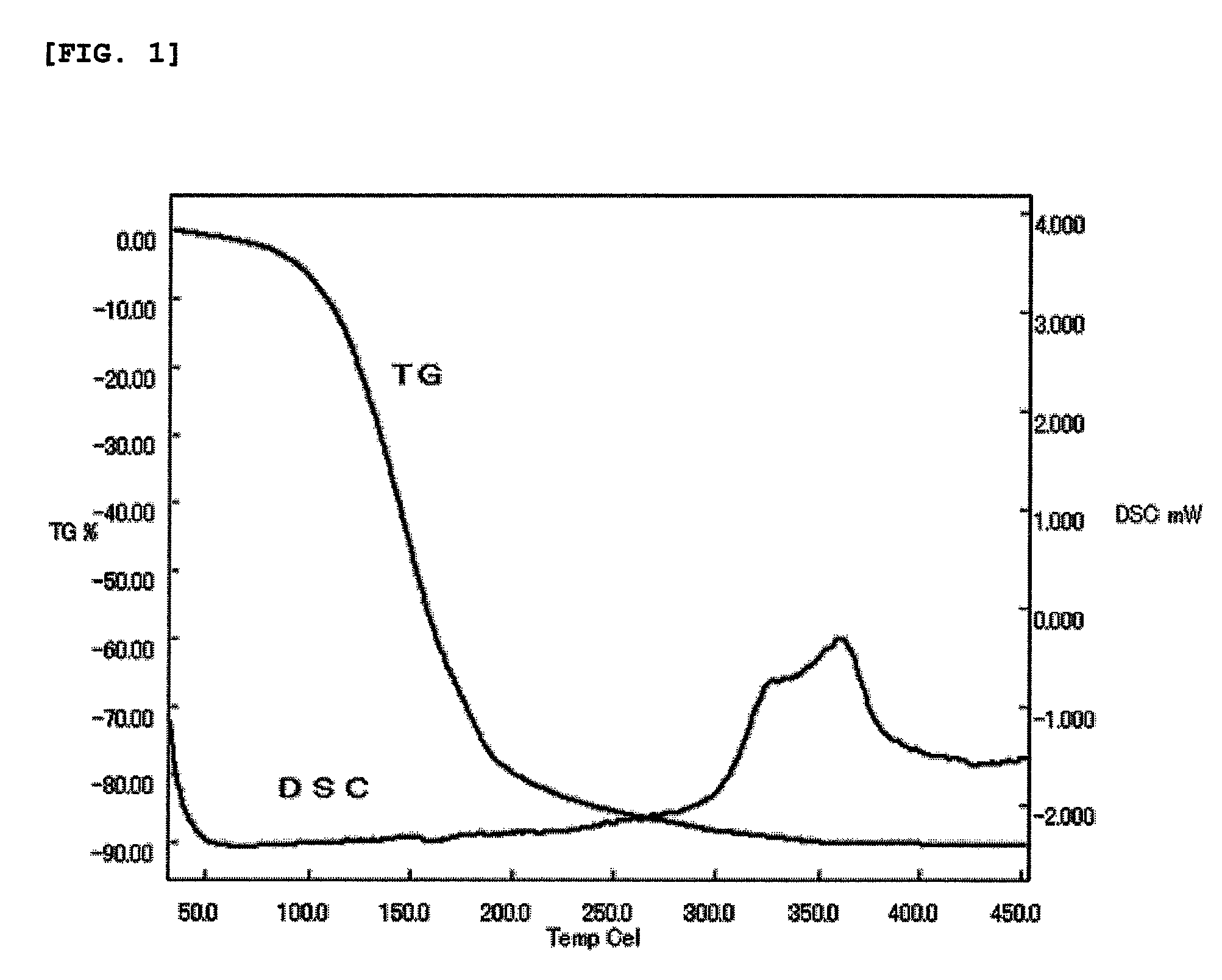
[0069]Regarding the deep red liquid, the result of TG (thermogravimetric determination) measured at a temperature rising rate of 10° C. / min in an atmosphere flowing argon at 400 ml / min and the result of DSC (differential scanning calorimetry) measured at a temperature rising rate of 10° C. / min in a closed vessel were shown in FIG. 1. It is seen from TG to have appropriate vaporization characteristics as a raw material of CVD method or ALD method, and it is apparent from DSC that thermal stability is good.
example 2
Synthesis of Ti(tBuNC(H)C(H)NtBu)(NMe2)2
[0070]In an argon atmosphere, 1.14 g (49.6 mmol) of sodium was added to a solution of 4.00 g (23.8 mmol) of N,N′-di(tert-butyl)-1,4-diaza-1,3-butadiene dissolved in 25 ml of tetrahydrofuran, followed by stirring at room temperature for 14 hours. The remaining sodium was filtered off, and a solvent was distilled away from a filtrate under reduced pressure. The remaining red solid was suspended in 10 ml of toluene, and a solution of 5.08 g (22.7 mmol) of titanium tetrakis(dimethylamide) dissolved in 20 ml of toluene was added thereto. After stirring at 80° C. for 6 hours, the resulting mixture was cooled to room temperature, and insoluble matters were filtered off. The solvent is distilled away under reduced pressure from the filtrate, and the residue obtained was distilled under reduced pressure to obtain 3.05 g of a deep red liquid (yield 42%). This liquid was dissolved in C6D6, and 1H NMR and 13C NMR spectra were measured. As a result, the s...
PUM
| Property | Measurement | Unit |
|---|---|---|
| reaction time | aaaaa | aaaaa |
| temperature | aaaaa | aaaaa |
| temperature | aaaaa | aaaaa |
Abstract
Description
Claims
Application Information
 Login to View More