Unlock instant, AI-driven research and patent intelligence for your innovation.

Method and apparatus for tracking cached addresses for maintaining cache coherency in a computer system having multiple caches

a computer system and cache technology, applied in the field of digital data processing hardware, can solve the problems of increasing complexity of architectural problems, system throughput, and multiple processors to a system, and achieve the effects of reducing the number of invalidation messages, and small caches

Inactive Publication Date: 2010-08-31
INT BUSINESS MASCH CORP
View PDF9 Cites 9 Cited by
  • Summary
  • Abstract
  • Description
  • Claims
  • Application Information

AI Technical Summary

Benefits of technology

The patent describes a computer system with a cache line state directory structure that helps determine whether to send an invalidation message to a cache. The directory structure includes a dedicated portion for a particular device cache and multiple portions for processor caches and I / O bridge device caches. By limiting the number of entries in the directory, the system reduces the number of unnecessary invalidation messages and improves performance. The computer system is constructed according to a NUMA architecture with multiple nodes and cache line state information for each node. The technical effect of the invention is to optimize cache performance and reduce unnecessary traffic on the cache bus.

Problems solved by technology

Early computer processors, which were constructed from many discrete components, were susceptible to significant clock speed improvements by shrinking and combining components, eventually packaging the entire processor as an integrated circuit on a single chip.
However, one does not simply double a system's throughput by going from one processor to two.
The introduction of multiple processors to a system creates numerous architectural problems.
As more processors are introduced, these architectural issues become increasingly complex, scalability becomes more difficult, and there is greater likelihood that processors will spend significant time waiting for some resource being used by another processor.
As the number of CPUs increases, there are greater bottlenecks in the buses and accessing mechanisms to such main memory.
Thus, while any CPU can still access any arbitrary memory location, a CPU can access addresses in its own node faster than it can access addresses outside its node (hence, the term “non-uniform memory access”).
The devices typically used for storing mass data (e.g., rotating magnetic hard disk drive storage units) require relatively long latency time to access data stored thereon.
If a processor were to access data directly from such a mass storage device every time it performed an operation, it would spend nearly all of its time waiting for the storage device to return the data, and its throughput would be very low indeed.
Where a computer system contains multiple processors, whether of a NUMA architecture or some other form of multi-processor design, an issue of cache coherency arises.
If multiple processors were to alter different copies of the same data stored in different caches, there would be a possibility of data corruption.
If data in a “shared” state is altered, then all other copies of the same data in other caches are changed to an “invalid” state, indicating that the copy is no longer reliable, and can not be saved to main memory or storage.
Broadcasting therefore causes a large number of unnecessary invalidation messages to be sent.
For many computer architectures, and particularly NUMA architectures, it is undesirable to clog the available hardware communications channels with a large number of invalidation messages.
For many system architectures, it is impractical to keep track of all cache activity in such a directory.
In particular, in a NUMA architecture, it is generally impractical for a given node to keep track of all the cache activity taking place in other nodes.
As a result, information in the remote cache directory of a NUMA node is overly inclusive.
The consequence of these extraneous entries is that unnecessary invalidation messages are often sent.
Unnecessary invalidation messages will not corrupt system data, but they will reduce performance.

Method used

the structure of the environmentally friendly knitted fabric provided by the present invention; figure 2 Flow chart of the yarn wrapping machine for environmentally friendly knitted fabrics and storage devices; image 3 Is the parameter map of the yarn covering machine
View more

Image

Smart Image Click on the blue labels to locate them in the text.
Viewing Examples
Smart Image
  • Method and apparatus for tracking cached addresses for maintaining cache coherency in a computer system having multiple caches
  • Method and apparatus for tracking cached addresses for maintaining cache coherency in a computer system having multiple caches
  • Method and apparatus for tracking cached addresses for maintaining cache coherency in a computer system having multiple caches

Examples

Experimental program
Comparison scheme
Effect test

Embodiment Construction

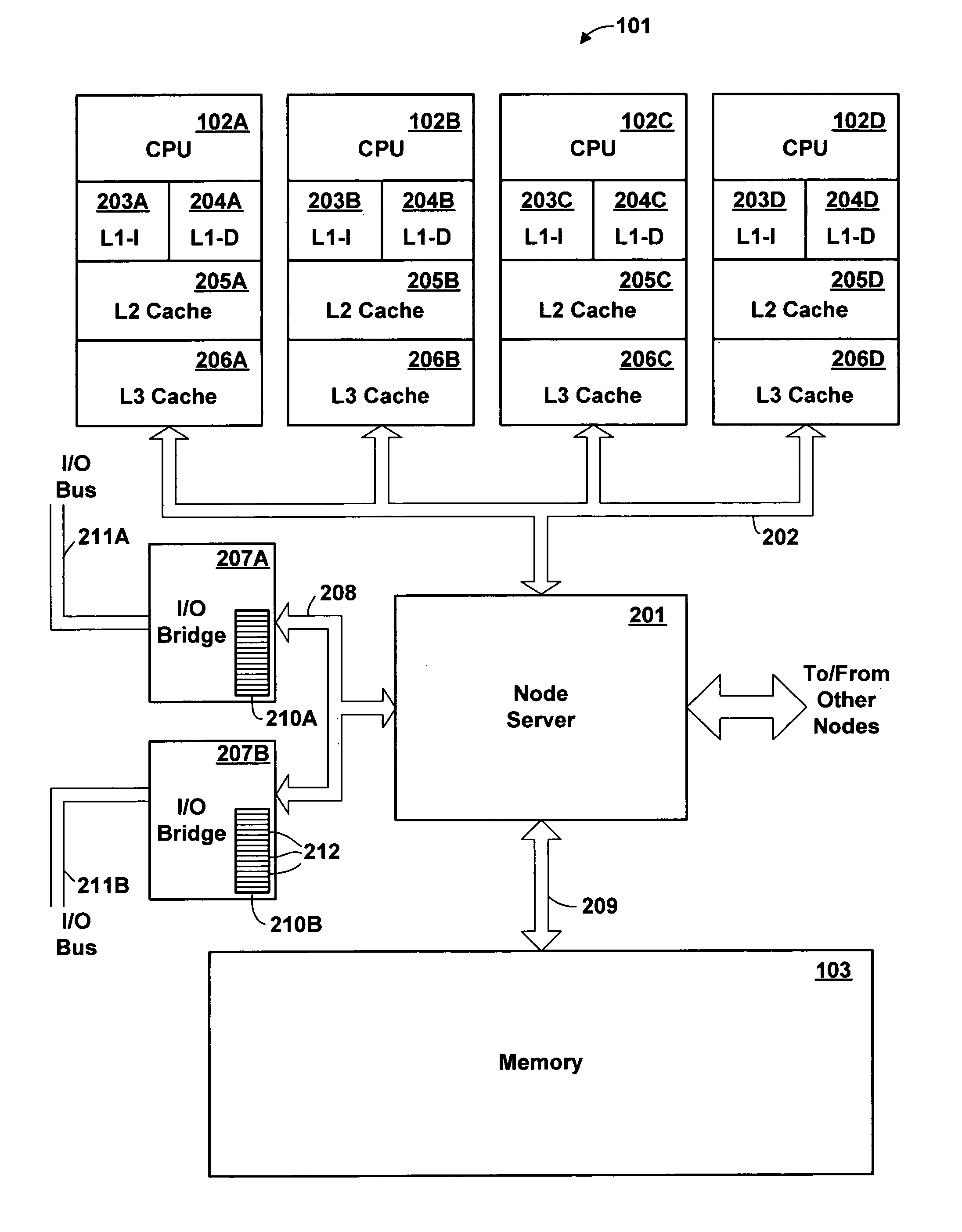
[0029]Referring to the Drawing, wherein like numbers denote like parts throughout the several views, FIG. 1 is a high-level block diagram of the major hardware components of a multi-node, multiprocessor computer system 100 in accordance with the preferred embodiment of the present invention. Computer system 100 is designed according to a NUMA architecture, it being understood that a computer system in accordance with the present invention need not necessarily be a NUMA system. Computer system 100 comprises multiple nodes 101A-101D (herein generically referred to as feature 101), of which four are shown in the exemplary system of FIG. 1, it being understood that the number of nodes may vary. Each node includes multiple general-purpose programmable central processing units (CPUs) 102A-102P (herein generically referred to as feature 102) and a respective local portion of main memory 103A-103D (herein generically referred to as feature 103).

[0030]Computer system 100 utilizes a distribut...

the structure of the environmentally friendly knitted fabric provided by the present invention; figure 2 Flow chart of the yarn wrapping machine for environmentally friendly knitted fabrics and storage devices; image 3 Is the parameter map of the yarn covering machine
Login to View More

PUM

No PUM Login to View More

Abstract

A computer system includes multiple caches and a cache line state directory structure, having at least a portion dedicated to a particular device cache within a particular device, and contains a fixed number of entries having a one-to-one correspondence to the cache lines of the cache to which it corresponds. The cache line state directory is used to determine whether it is necessary to send an invalidation message to the device cache. In the preferred embodiment, a dedicated portion of the cache line state directory structure corresponds to an I / O bridge device cache. Preferably, the cache line state directory also maintains state for one or more processor caches in a different format. The computer system preferably uses a NUMA architecture, the directories being maintained by node servers in each node.

Description

FIELD OF THE INVENTION[0001]The present invention relates to digital data processing hardware, and in particular to the design and operation of mechanisms for enforcing cache coherency in a digital data processing device having multiple caches.BACKGROUND OF THE INVENTION[0002]In the latter half of the twentieth century, there began a phenomenon known as the information revolution. While the information revolution is a historical development broader in scope than any one event or machine, no single device has come to represent the information revolution more than the digital electronic computer. The development of computer systems has surely been a revolution. Each year, computer systems grow faster, store more data, and provide more applications to their users.[0003]A modern computer system typically comprises one or more central processing units (CPUs) and supporting hardware necessary to store, retrieve and transfer information, such as communications buses and memory. It also inc...

Claims

the structure of the environmentally friendly knitted fabric provided by the present invention; figure 2 Flow chart of the yarn wrapping machine for environmentally friendly knitted fabrics and storage devices; image 3 Is the parameter map of the yarn covering machine
Login to View More

Application Information

Patent Timeline
no application Login to View More
Patent Type & Authority Patents(United States)
IPC IPC(8): G06F13/00G06F15/76G06F12/00G06F12/08
CPCG06F12/0817G06F12/0891G06F2212/2542
Inventor AVERILL, DUANE ARLYNHOOVER, RUSSELL DEANSHEDIVY, DAVID ALANVOYTOVICH, MARTHA ELLEN
Owner INT BUSINESS MASCH CORP