Frequency divider circuits
a frequency divider and circuit technology, applied in the field of frequency divider circuits, can solve problems such as unsuitable for many applications
- Summary
- Abstract
- Description
- Claims
- Application Information
AI Technical Summary
Benefits of technology
Problems solved by technology
Method used
Image



Examples
Embodiment Construction
[0025]FIG. 5 illustrates the state table for the divide-by-5 circuit of FIG. 2, but this time showing the states within each of the flip flops, i.e. the states for the individual D-type latches. The left hand column “N” shows the count, split into half clock pulses. In order to obtain an output with a 50% duty cycle, the output must be switched between counts (i.e. clock pulses) 4 and 0, and midway through count 2. We need to identify edges within the state table that can be used to generate appropriate switching signals. For the purpose of this example, we make use of the transition of the input to the first latch D0 from 0 to 1, and the transition of the input to the second latch D0i from 1 to 0.
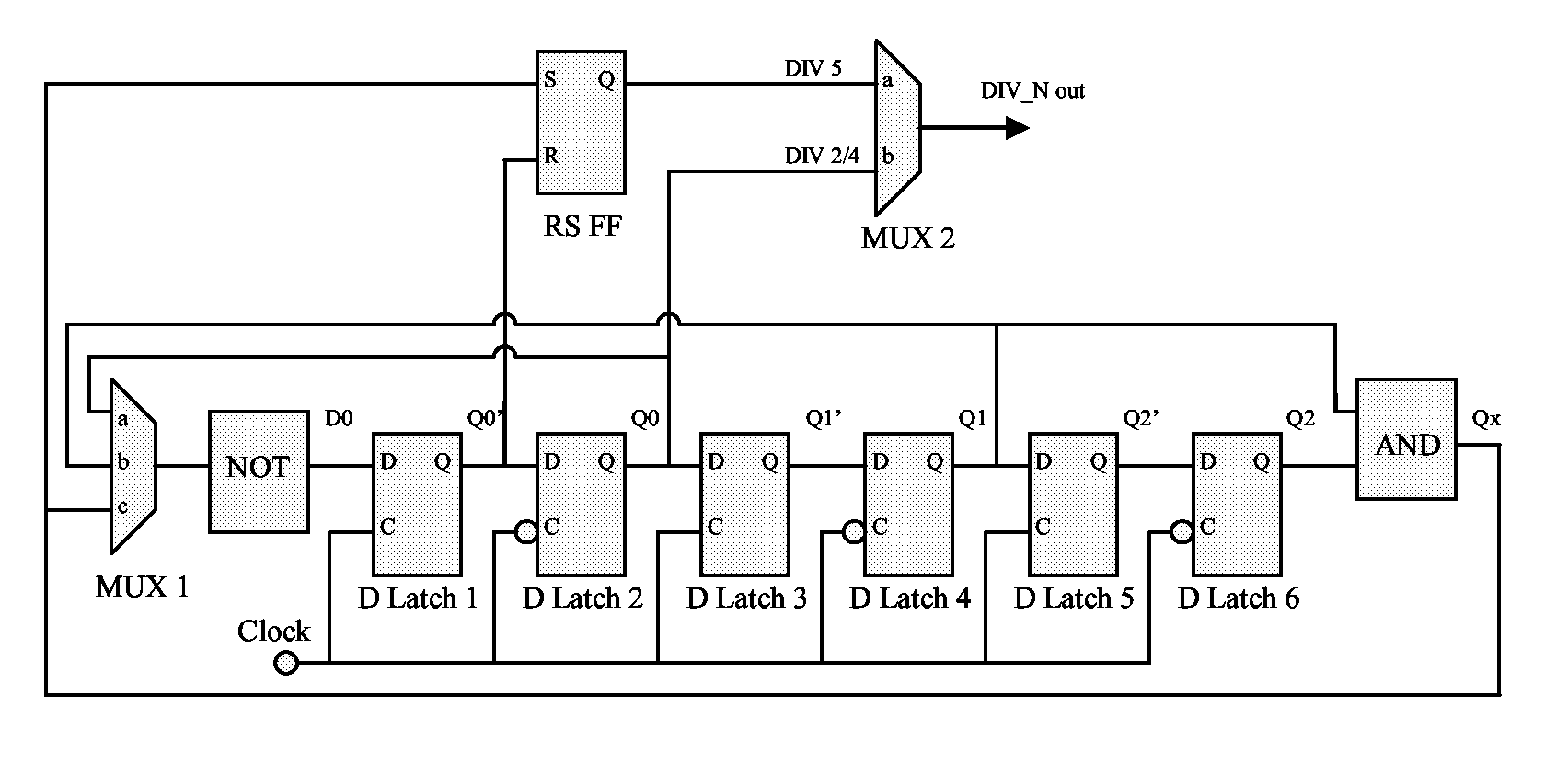
[0026]There is illustrated in FIG. 6 a divider circuit which is programmable to provide an output clock signal (DIV_N out) having a clock frequency which is 1 / Nth of the frequency of an input clock signal (Clock). According to this architecture, N may be 2, 4, or 5.
[0027]The circuit of FIG...
PUM
 Login to View More
 Abstract
Description
Claims
Application Information
 Login to View More