
Dye-sensitized solar cell and dye-sensitized solar cell module
a solar cell and dye sensitization technology, applied in the direction of electrolytic capacitors, pv power plants, electrochemical generators, etc., can solve the problems of high silicon substrate manufacturing cost, unresolved problems, and high manufacturing cost, so as to increase the photocurrent density, increase the efficiency, and manufacture more easily
- Summary
- Abstract
- Description
- Claims
- Application Information
AI Technical Summary
Benefits of technology
Problems solved by technology
Method used
Image

Examples
example 1
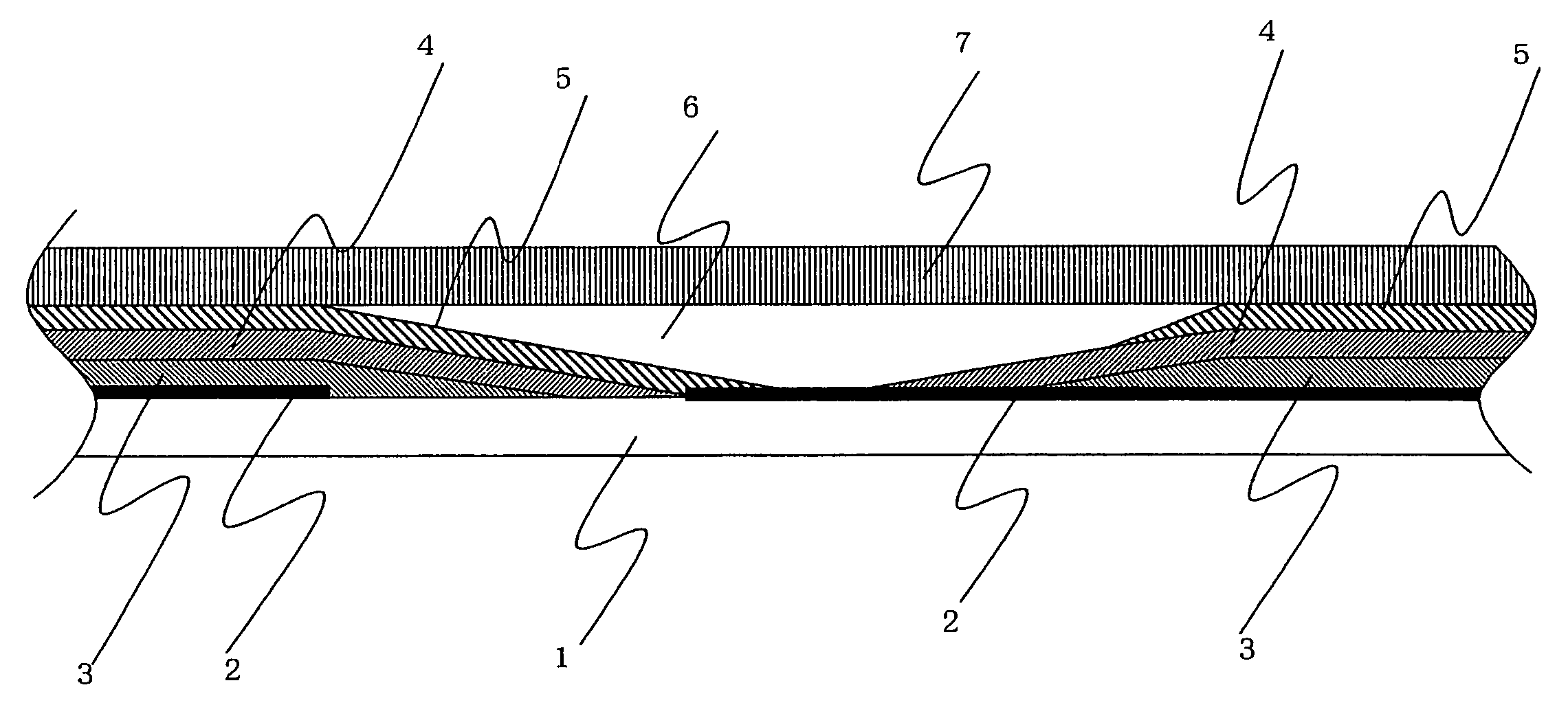
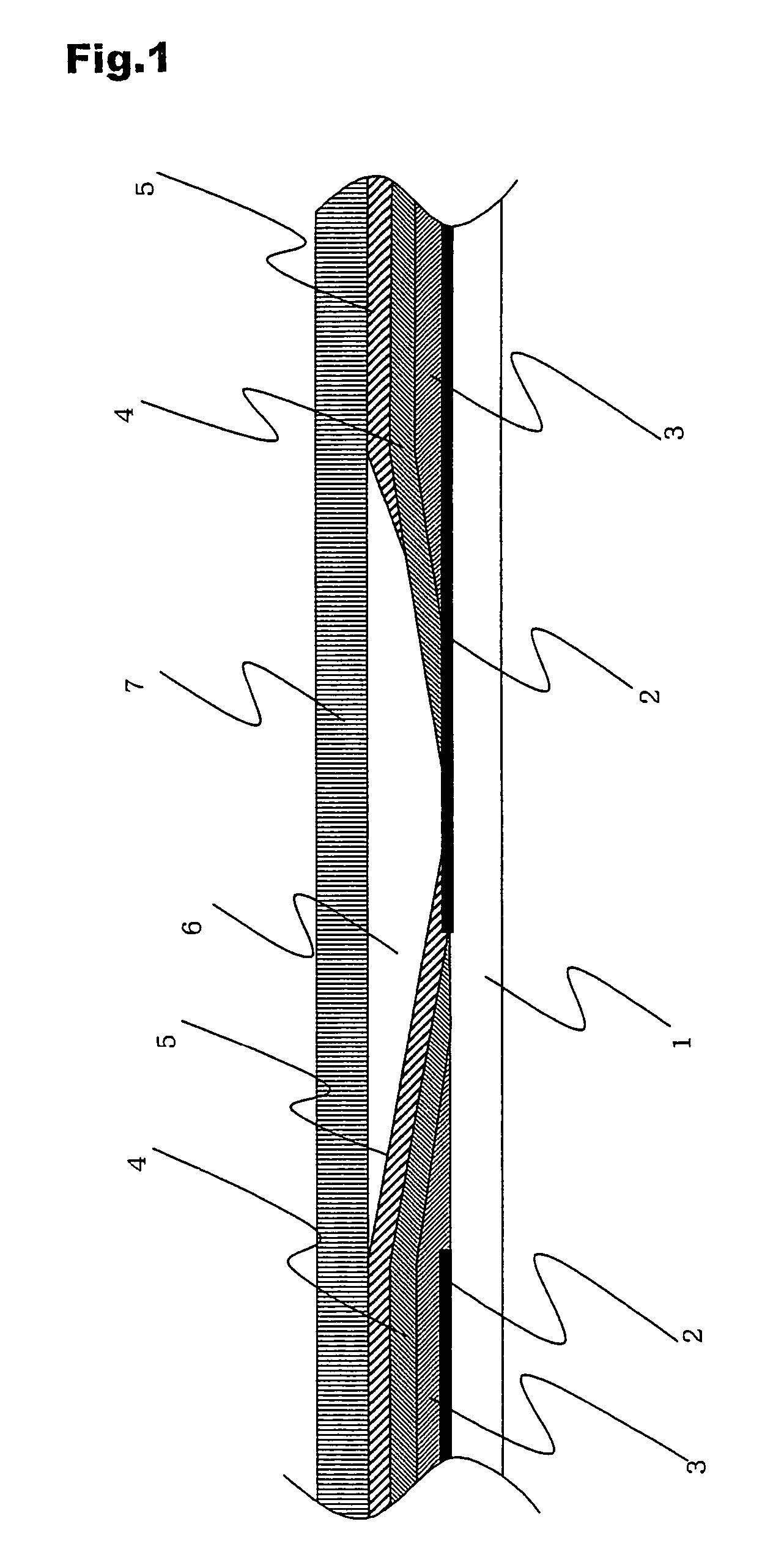
[0101]An integrated dye-sensitized solar cell module was manufactured, such that 10 unit cells are connected in series. Manufacturing processes thereof are described below. A series connection portion is a structure shown in FIG. 1.
[0102]As a substrate, used was a glass substrate (first support 1) of 10 mm×10 mm, manufactured by Nippon Sheet Glass Co., Ltd., with fluorine-doped SnO2 (first conductive layer 2). SnO2 was irradiated with laser light (YAG laser, fundamental wavelength: 1.06 μm) so as to be in the shape of a strip having a width of 1.035 cm and a gap between adjacent unit cells of 350 μm, and then patterning was performed by vaporizing SnO2.
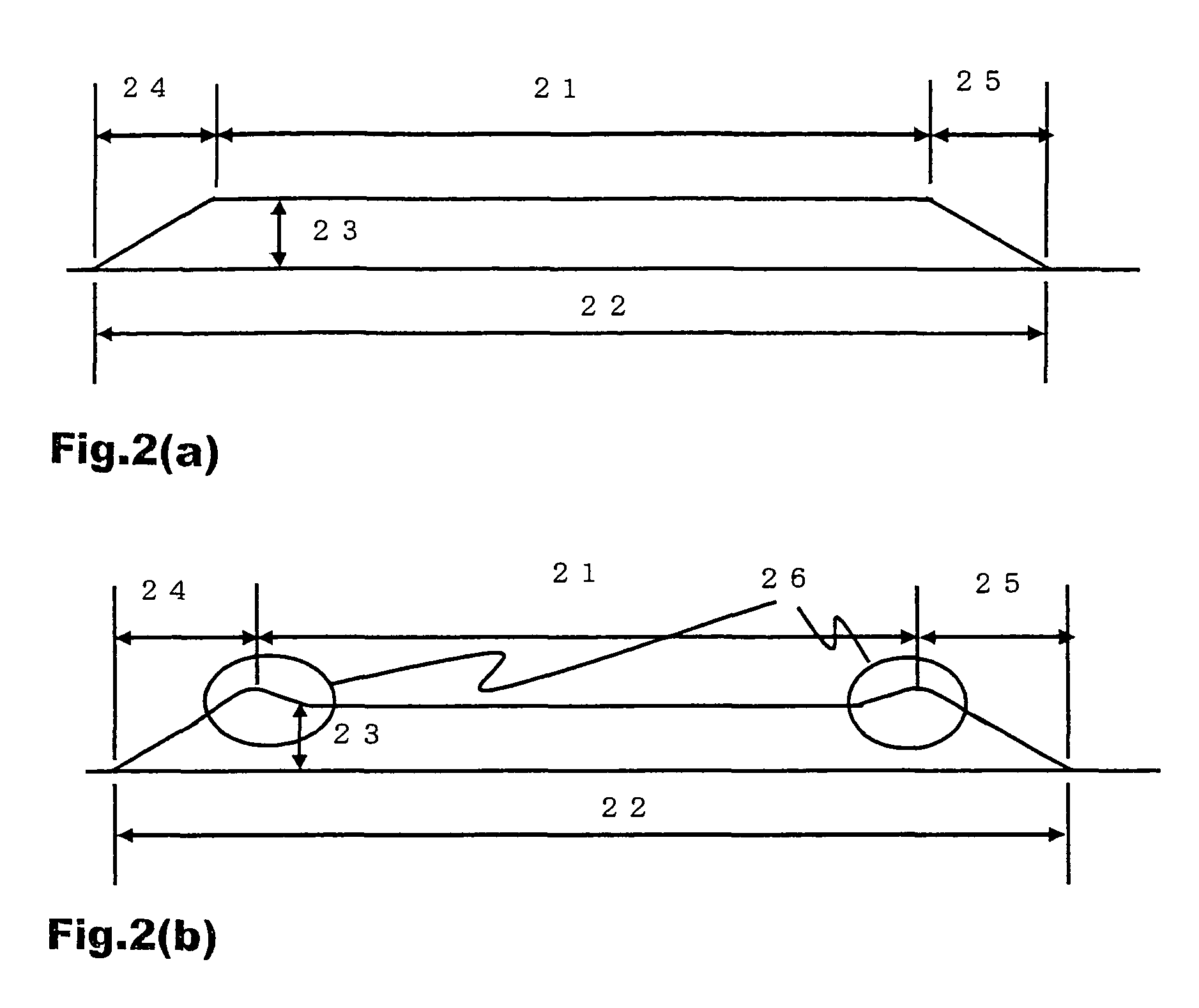
[0103]Next, a porous photovoltaic layer 3 after firing was manufactured by a screen printing machine so that a shape was 1 cm×9 cm, a film thickness was 15 μm, the shortest distance X between the intersection of the perpendicularly drawn from the surface edge of the confronted side of the porous photovoltaic layer to the contact side ...
example 2
[0109]A dye-sensitized solar cell module having the porous photovoltaic layer 3 in which the dimensionless number K was 0.15 and the shortest distance X between the intersection of the perpendicularly drawn from the surface edge of the confronted side of the porous photovoltaic layer to the contact side of the porous photovoltaic layer and the surface edge of the contact side was 100 μm was manufactured in conformance with Example 1. The obtained dye-sensitized solar cell module had the short-circuit current density of 11.08 mA / cm2, the open-circuit voltage value was 6.50 V, the FF of 0.53 and the module conversion efficiency of 3.82%.
example 3
[0110]A dye-sensitized solar cell module having the porous photovoltaic layer 3 in which the dimensionless number K was 0.03, the shortest distance X between the intersection of the perpendicularly drawn from the surface edge of the confronted side of the porous photovoltaic layer to the contact side of the porous photovoltaic layer and the surface edge of the contact side was 330 μm, and the film thickness was 10 μm was manufactured in conformance with Example 1. The performance of the obtained dye-sensitized solar cell module offered the results shown in Table 1.
PUM
| Property | Measurement | Unit |
|---|---|---|
| length | aaaaa | aaaaa |
| thickness | aaaaa | aaaaa |
| length | aaaaa | aaaaa |
Abstract
Description
Claims
Application Information
 Login to View More