Check patentability & draft patents in minutes with Patsnap Eureka AI!

Apparatus and method for optimizing the performance of x87 floating point addition instructions in a microprocessor

a microprocessor and floating point addition technology, applied in the field of mathematical operations on floating point numbers, can solve the problems of rounding determination taking longer in some conditions than in others, and affecting the accuracy of calculations performed on double extended-precision floating point numbers

Active Publication Date: 2011-10-25
VIA TECH INC
View PDF8 Cites 1 Cited by
  • Summary
  • Abstract
  • Description
  • Claims
  • Application Information

AI Technical Summary

Benefits of technology

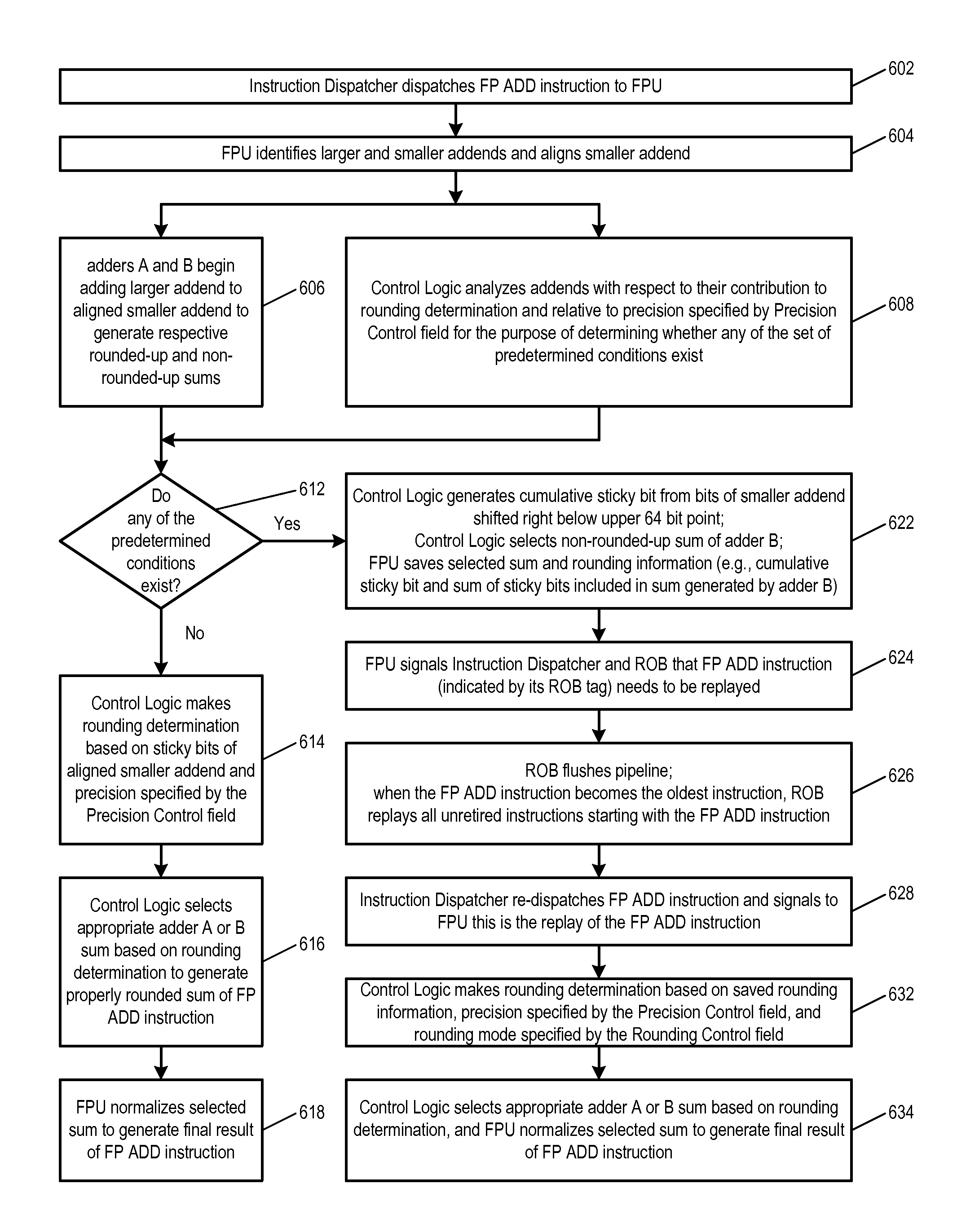
The present invention is a system and method for improving the performance of a microprocessor by analyzing and optimizing the execution of x87 floating point addition instructions. The system includes an x87 Floating Point Control Word (FPCW) with a Precision Control (PC) field, an instruction dispatcher, and a Floating Point Unit (FPU). The FPU is responsible for executing the addition instruction and making the rounding determination based on the PC field. The system distinguishes between long and short cases of the addition instruction, with the long cases requiring an additional clock cycle. The short cases are executed in two steps, with the first step being an initial dispatch and the second step being a re-dispatch. The system takes advantage of the fact that the FPU can execute the instruction faster in the short cases, improving performance in popular commercial software applications.

Problems solved by technology

However, the precision of calculations performed on double extended-precision format floating point numbers may be limited to less than 64 bits, and the precision limit is determined by the programmer.
More specifically, the fact that the programmer could specify a precision via the PC field that is different than the precision of one or both of the addends could cause the rounding determination to take longer under some conditions than in others.
However, if the precision of the larger addend is greater than the precision specified by the PC field, then the larger addend may also contribute sticky bits to the rounding determination.
However, this paper fails to take into account the requirements imposed upon a commercially-viable x87 FPU with respect to the ability of the programmer to specify the precision of floating point number calculations via the PC field.
However, this solution is undesirable with respect to instruction scheduling, particularly within a superscalar, out-of-order execution microprocessor.
However, this solution is obviously not a high performance solution.

Method used

the structure of the environmentally friendly knitted fabric provided by the present invention; figure 2 Flow chart of the yarn wrapping machine for environmentally friendly knitted fabrics and storage devices; image 3 Is the parameter map of the yarn covering machine
View more

Image

Smart Image Click on the blue labels to locate them in the text.
Viewing Examples
Smart Image
  • Apparatus and method for optimizing the performance of x87 floating point addition instructions in a microprocessor
  • Apparatus and method for optimizing the performance of x87 floating point addition instructions in a microprocessor
  • Apparatus and method for optimizing the performance of x87 floating point addition instructions in a microprocessor

Examples

Experimental program
Comparison scheme
Effect test

Embodiment Construction

[0023]The term “sticky bits” refers to the bits of an addend after alignment, if necessary (such as the aligned smaller addend), of a floating point addition instruction that have less arithmetic significance than the precision specified by the PC field 308 of FIG. 3. Stated alternatively, the sticky bits are the bits of an addend that have less arithmetic significance than the least representable bit of the result as specified by the PC field 308.

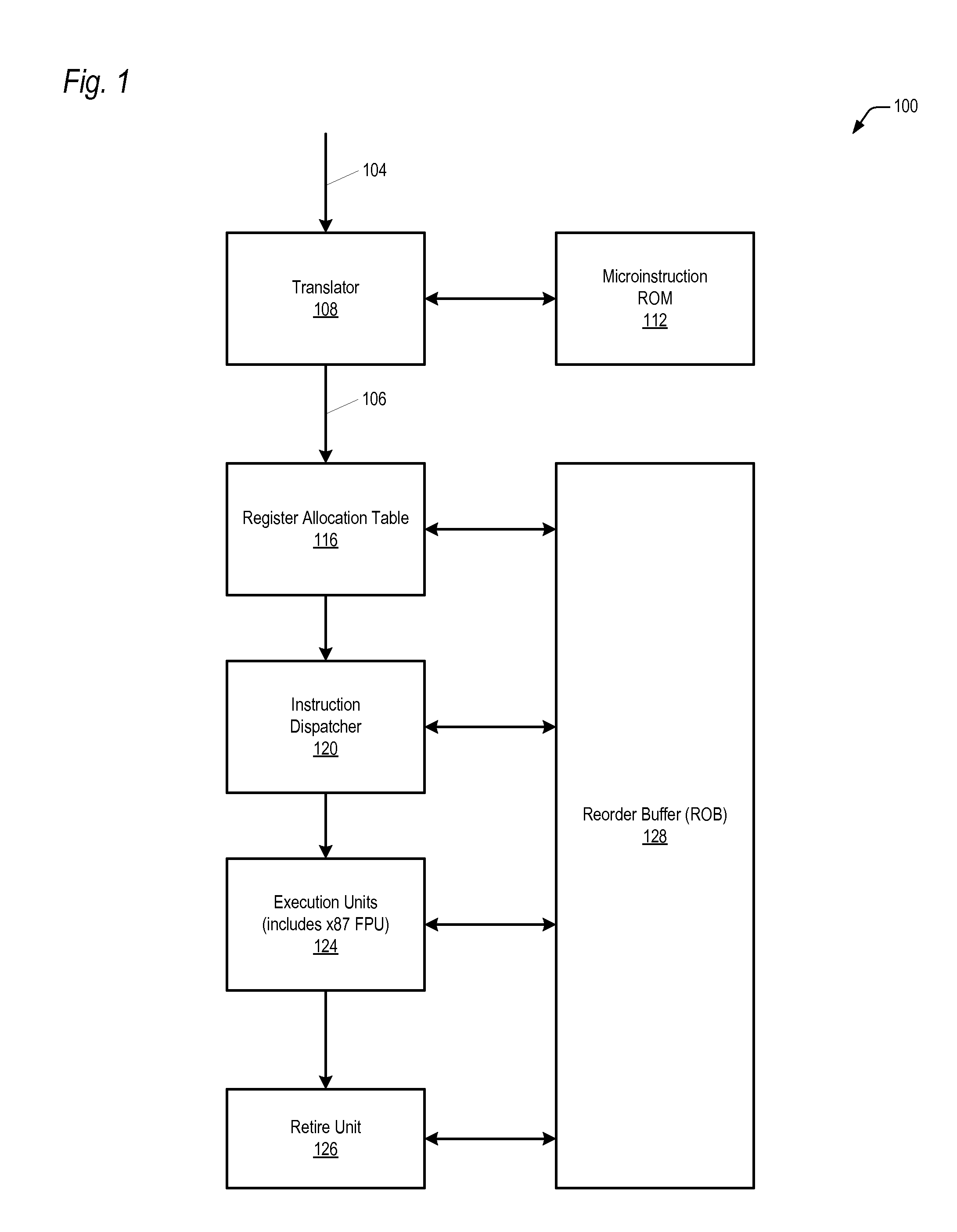
[0024]Referring to FIG. 1, a block diagram illustrating a microprocessor 100 according to the present invention is shown. The microprocessor 100 includes a Translator 108 coupled to a Microinstruction ROM 112. The Translator 108 receives x86 macroinstructions 104 and translates them into one or more microinstructions 106. In one embodiment, the x86 macroinstructions 104 comprise instructions of the well-known IA-32 architecture, such as those specified in the Intel manual incorporated by reference above. In particular, the macroinstruction...

the structure of the environmentally friendly knitted fabric provided by the present invention; figure 2 Flow chart of the yarn wrapping machine for environmentally friendly knitted fabrics and storage devices; image 3 Is the parameter map of the yarn covering machine
Login to View More

PUM

No PUM Login to View More

Abstract

A microprocessor having a Precision Control (PC) field, an instruction dispatcher, and a Floating Point unit (FPU). The FPU receives an FP Add instruction from the instruction dispatcher, and generates a sum from its addends. The FPU determines whether any conditions exist in the addends with respect to their contribution to a rounding determination and relative to the PC field. If none of the conditions exists, the FPU makes the rounding determination based on the smaller addend and the PC field, and selectively rounds the sum based on the rounding determination. If any conditions exist, the FPU saves the sum and rounding information derived from the addends, and signals the instruction dispatcher to re-dispatch the instruction. On re-dispatch, the FPU makes the rounding determination based on the saved rounding information and the PC field, and selectively rounds the sum based on the rounding determination.

Description

FIELD OF THE INVENTION[0001]The present invention relates to mathematical operations on floating point numbers, and more particularly to a method and system for performing a high speed x87 floating point addition operation.BACKGROUND OF THE INVENTION[0002]Floating point numbers are typically represented by a sign bit, an exponent, and a mantissa (also referred to as the significand) that contains the significant digits of the floating point number. For example, when representing a normalized floating point number in the IEEE Standard 754 for binary floating point arithmetic, the mantissa comprises an integer “1” and a fraction following a binary point.[0003]The x87 architecture is a popular architecture for performing floating point arithmetic. The x87 architecture is described in the IA-32 Intel Architecture Software Developer's Manual, Volume 1: Basic Architecture, June 2006, which is hereby incorporated by reference in its entirety for all purposes (referred to herein as the “Int...

Claims

the structure of the environmentally friendly knitted fabric provided by the present invention; figure 2 Flow chart of the yarn wrapping machine for environmentally friendly knitted fabrics and storage devices; image 3 Is the parameter map of the yarn covering machine
Login to View More

Application Information

Patent Timeline
no application Login to View More
Patent Type & Authority Patents(United States)
IPC IPC(8): G06F7/485
CPCG06F7/49942G06F9/32G06F9/3836G06F9/30014G06F9/30065G06F9/3867
Inventor ELMER, TOMPARKS, TERRY
Owner VIA TECH INC
Features
  • R&D
  • Intellectual Property
  • Life Sciences
  • Materials
  • Tech Scout
Why Patsnap Eureka
  • Unparalleled Data Quality
  • Higher Quality Content
  • 60% Fewer Hallucinations
Social media
Patsnap Eureka Blog
Learn More