
Morpholine derivatives as ashless TBN sources and lubricating oil compositions containing same
a technology of morpholine derivatives and tbn, which is applied in the field of compounds, can solve the problems of oxidation catalyst poisoning, less effective, and claim that such lubricants will provide sufficient tbn, and achieve the effect of reducing the number of oxidation catalysts
Patent Information
- Authority / Receiving Office
- US · United States
- Patent Type
- Patents(United States)
- Current Assignee / Owner
- Publication Date
- 2012-03-27
Smart Images
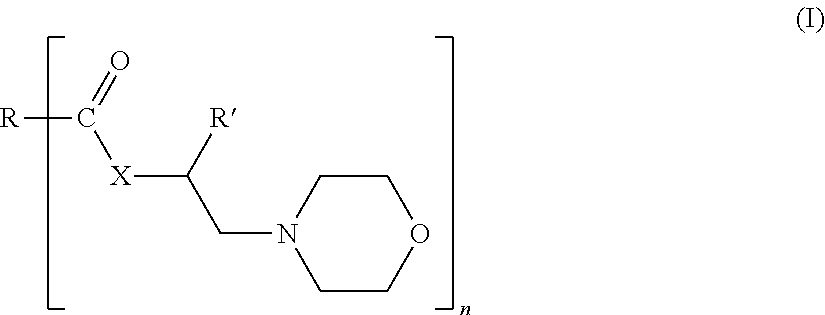
Figure 1 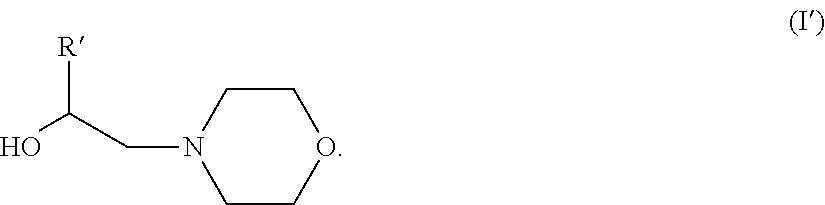
Figure 2 
Figure 3
Abstract
Description
FIELD OF THE INVENTION
[0001] This invention relates to a novel class of compounds derived from morpholine, which compounds are useful as ashless TBN (Total Base Number) boosters for lubricating oil compositions, and lubricating oil compositions, particularly crankcase lubricating oil compositions having reduced levels of sulfated ash (SASH), containing same.BACKGROUND OF THE INVENTION
[0002] Environmental concerns have led to continued efforts to reduce the CO, hydrocarbon and nitrogen oxide (NOx) emissions of compression ignited (diesel-fueled) and spark ignited (gasoline-fueled) light duty internal combustion engines. Further, there have been continued efforts to reduce the particulate emissions of compression ignited internal combustion engines. To meet the upcoming emission standards for heavy duty diesel vehicles, original equipment manufacturers (OEMs) will rely on the use of additional exhaust gas after-treatment devices. Such exhaust gas after-treatment devices may include cata...
Examples
synthesis example 1.1
[0080]44.2 moles of iso-stearic acid and 1.25 eq. of 4-(2-hydroxyethyl)morpholine or HEM were charged into a 4-neck 30 L glass reactor equipped with a mechanical stirrer, condenser / Dean-Stark trap, and inlets for nitrogen. The reaction mixture was heated to 190° C.), and maintained at that temperature for 10 to 15 hours. After completion of the reaction, excess 4-(2-hydroxyethyl)morpholine was distilled off using a rotary evaporator, with full vacuum, at 160° C. The final product was characterized by NMR, total acid number titration (ASTM D-664), total base number titration (ASTM D-4739 and D-2896) and GC analysis.
synthesis example 1.2
[0081]0.58 moles of Floradyme™ 1500 (organic dimer acid available from Florachem Corp.) and 2.5 eq. of 4-(2-hydroxyethyl)morpholine or HEM were charged into a 4-neck 30 L glass reactor equipped with a mechanical stirrer, condenser / Dean -Stark trap, and inlets for nitrogen. The reaction mixture was heated to 190° C.), and maintained at that temperature for 10 to 15 hours. After completion of the reaction, excess 4-(2-hydroxyethyl)morpholine was distilled off using a rotary evaporator, with full vacuum, at 160° C. The final product was characterized by NMR, total acid number titration (ASTM D-664), total base number titration (ASTM D-4739 and D-2896) and GC analysis.
synthesis example 1.3
[0082]44.2 moles of Floradyme™ 6500 (organic trimer acid available from Florachem Corp.) and 4 eq. of 4-(2-hydroxyethyl)morpholine or HEM were charged into a 4-neck 30 L glass reactor equipped with a mechanical stirrer, condenser / Dean-Stark trap, and inlets for nitrogen. The reaction mixture was heated to 190° C.), and maintained at that temperature for 10 to 15 hours. After completion of the reaction, excess 4-(2-hydroxyethyl)morpholine was distilled off using a rotary evaporator, with full vacuum, at 160° C. The final product was characterized by NMR, total acid number titration (ASTM D-664), total base number titration (ASTM D-4739 and D-2896) and GC analysis.
[0083]The general reaction scheme for the above-synthesis is shown below:
[0084]
TBN Performance
[0085]The basicity of a lubricating oil composition can be determined by acid titration. The resulting neutralization number is expressed as total base number, or TBN, and can be measured using various methods. Two methods conventio...