

Driving method of a semiconductor device with an inverted period having a negative potential applied to a gate of an oxide semiconductor transistor
a technology of semiconductor devices and negative potentials, applied in the direction of static storage, digital storage, instruments, etc., can solve the problems of data stored in semiconductor devices that may change with time, and achieve the effect of suppressing the temporal change of data stored in the semiconductor device, suppressing the decrease of positive electric charge, and shortening the tim
- Summary
- Abstract
- Description
- Claims
- Application Information
AI Technical Summary
Benefits of technology
Problems solved by technology
Method used
Image

Examples
embodiment 1
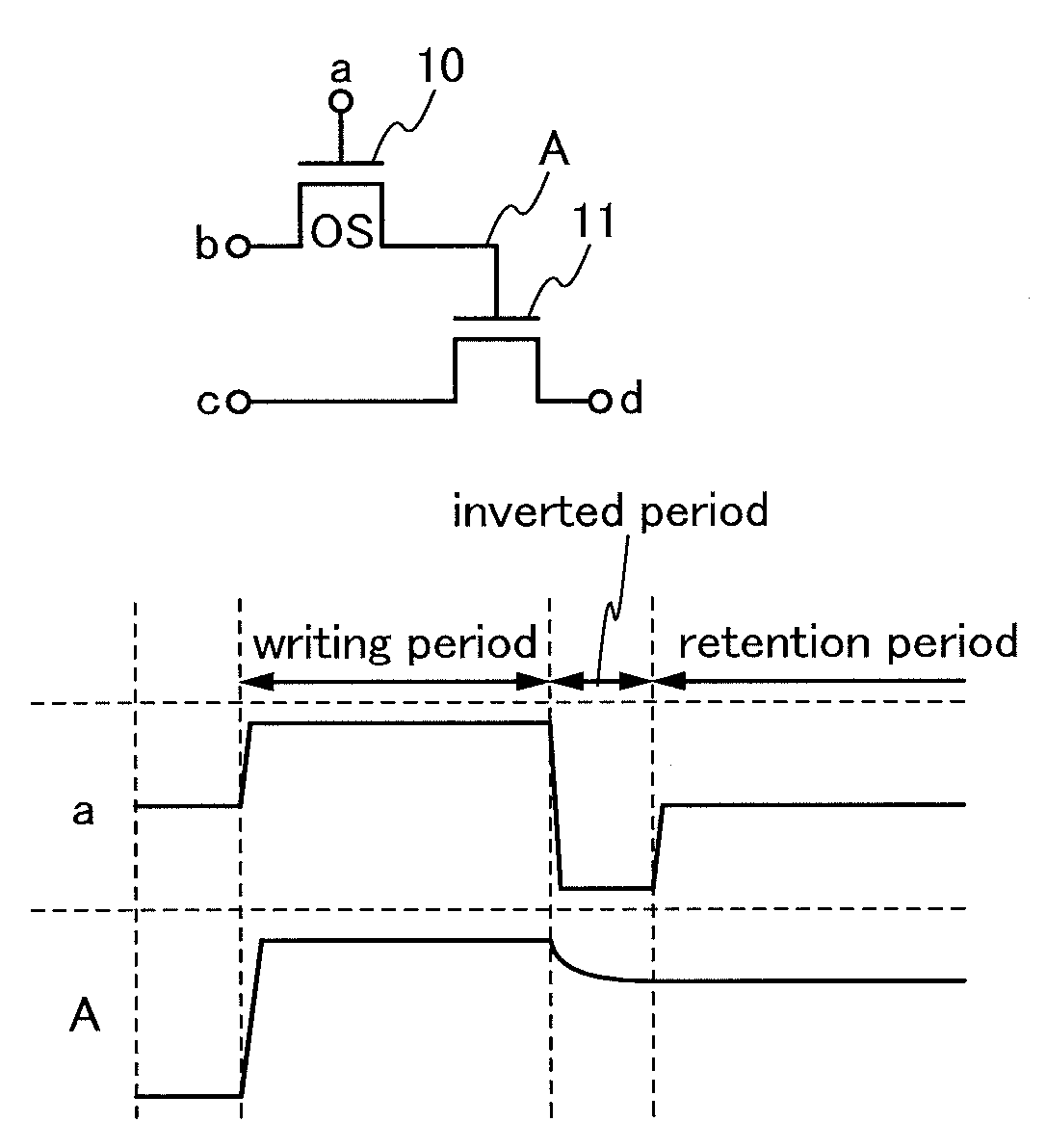
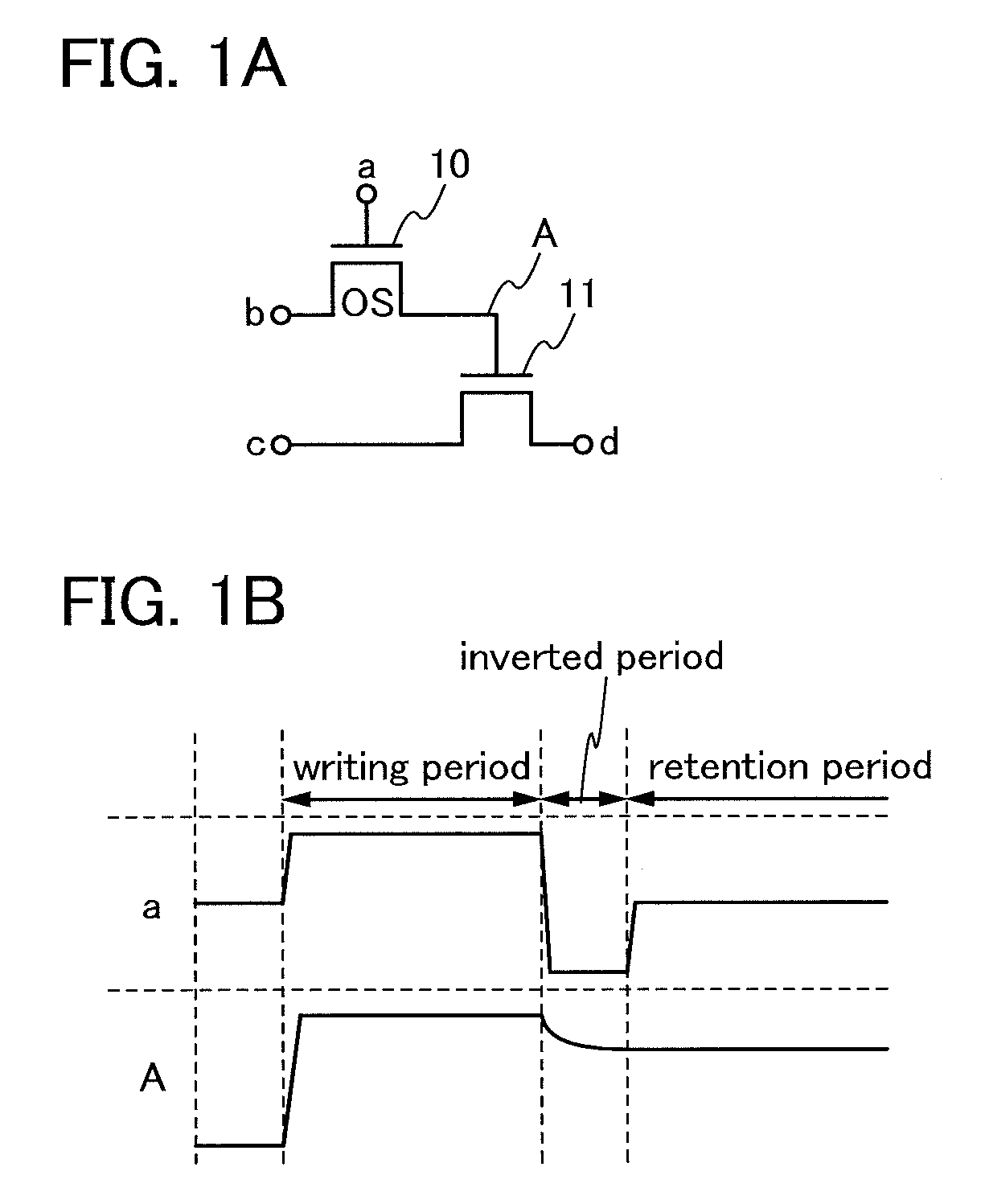
[0034]In this embodiment, an example of a semiconductor device which stores data by retaining electric charge in a node electrically connected to one of a source and a drain of a transistor whose channel region is included in an oxide semiconductor layer, and an example of a driving method of the semiconductor device will be described with reference to FIGS. 1A and 1B.
Example of Configuration
[0035]FIG. 1A is a circuit diagram of an example of a configuration of the semiconductor device according to this embodiment. The semiconductor device illustrated in FIG. 1A includes a transistor 10 and a transistor 11. A gate of the transistor 10 is electrically connected to a terminal a, and one of a source and a drain of the transistor 10 is electrically connected to a terminal b. A gate of the transistor 11 is electrically connected to the other of the source and the drain of the transistor 10, one of a source and a drain of the transistor 11 is electrically connected to a terminal c, and th...
embodiment 2
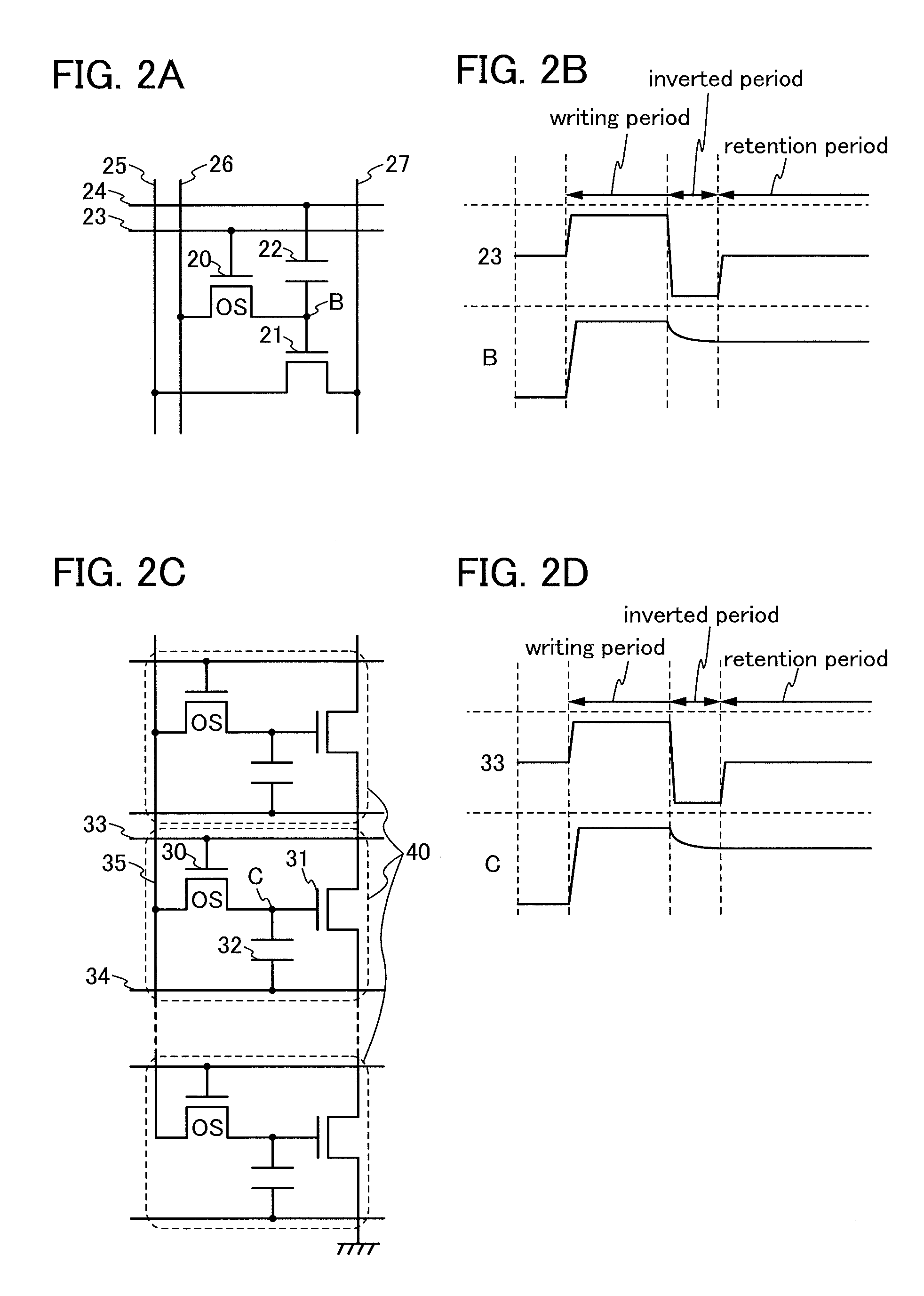
[0041]In this embodiment, specific examples of the semiconductor devices described in Embodiment 1 will be described with reference to FIGS. 2A to 2D.
specific example 1
[0042]FIG. 2A is a circuit diagram of a specific example of the semiconductor device described in Embodiment 1. The semiconductor device illustrated in FIG. 2A includes a transistor 20, a transistor 21, and a capacitor 22. A gate of the transistor 20 is electrically connected to a writing word line 23, and one of a source and a drain of the transistor 20 is electrically connected to a writing bit line 26. A gate of the transistor 21 is electrically connected to the other of the source and the drain of the transistor 20, one of a source and a drain of the transistor 21 is electrically connected to a reading bit line 25, and the other of the source and the drain of the transistor 21 is electrically connected to a fixed potential line 27. One electrode of the capacitor 22 is electrically connected to the other of the source and the drain of the transistor 20 and the gate of the transistor 21, and the other electrode of the capacitor 22 is electrically connected to a reading word line 2...
PUM
 Login to View More
 Abstract
Description
Claims
Application Information
 Login to View More