

Image processing apparatus and image processing method
a technology of image processing apparatus and image processing method, which is applied in the direction of visual presentation, instruments, digital computers, etc., to achieve the effect of reducing notches in edge portions
- Summary
- Abstract
- Description
- Claims
- Application Information
AI Technical Summary
Benefits of technology
Problems solved by technology
Method used
Image



Examples
example configuration
and Image Processing According to Embodiment of Present Invention
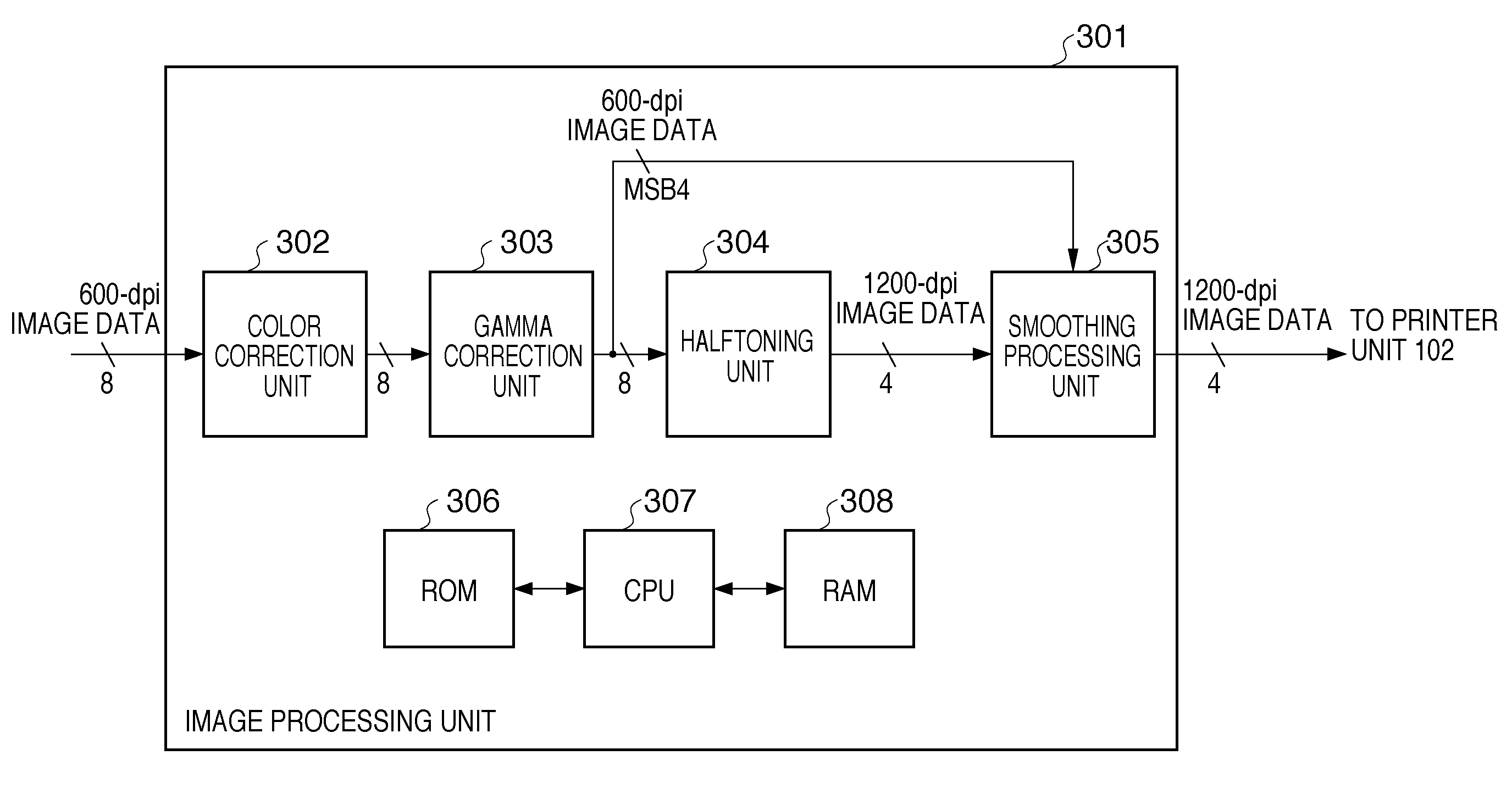
[0051]Next, the abovementioned image processing for printing will be described in detail with reference to FIG. 3A.
[0052]In FIG. 3A, the reference numeral 301 denotes an image processing unit that performs image processing for printing in the controller 102. Referring to the image data and the attribute data that have been input from the memory 105, the image data is subjected to color correction processing by a color correction unit 302 and then converted by a color conversion LUT or matrix computation into a CMYK color space having a density constituted by four image signals. The converted image data hold an 8-bit pixel value for each image signal. Then, through gamma correction processing by a gamma correction unit 303 and digital halftoning through dithering or an error diffusion process by a halftoning unit 304, the image data is converted from an 8-bit pixel value to a 4-bit pixel value that is printable by the p...
specific example 1
[0080]In the case where a reference area 601 illustrated in FIG. 7A is input into the smoothing determination unit 402, the pixel value “15” of pixels 602 is obtained as a maximum value in step S501 and the pixel value “0” of pixels 603 is obtained as a minimum value in step S502. Then, in step S503, the density difference therebetween, “15”, is compared with the threshold value Zsub. In the present embodiment, the threshold value Zsub is assumed to be “4”, so that the density difference in the reference area 601 is higher than the threshold value Zsub, and accordingly, the value of “1” is output into the edge correction unit 406 as the determination signal OutDataZ for the reference area 601.
[0081]The reference area 601 is also input into the edge correction data generation unit 403, so that an average value AVE of “7” is obtained in step S901 and a binarized reference area 1201 illustrated in FIG. 7B is obtained in step S902. Here, in the present embodiment, the threshold value th...
specific example 2
[0083]Similarly, in the case where a reference area 701 illustrated in FIG. 8A is input into the smoothing determination unit 402, a maximum value is the pixel value “7” of pixels 702 and a minimum value is the pixel value “0” of pixels 703. Thus, the density difference “7” therebetween and the threshold value Zsub are compared, so that the determination signal OutDataZ is set to “1”. Meanwhile, the edge correction data generation unit 403 obtains an average value AVE of “4”, and since all of the pixels in the reference area 701 are lower than the threshold value threSST, they are binarized into “0” so that a reference area 1301 illustrated in FIG. 8B is obtained. Then, since the binarized reference area 1301 illustrated in FIG. 8B does not match any of the edge patterns in FIGS. 5A and 5B, the value of “4” is output as the edge correction data in step S908.
[0084]The edge correction unit 406 inputs, in addition to the above-described determination signal and the above-described edge...
PUM
 Login to View More
 Abstract
Description
Claims
Application Information
 Login to View More