
Curable composition comprising dual reactive silane functionality
a technology of reactive silane and functional composition, which is applied in the direction of organic chemistry, coatings, group 5/15 element organic compounds, etc., can solve the problems of slow or incomplete cure, difficult to obtain good balance between these properties, and difficult to process materials without risking premature gelation, etc., to achieve fast cure upon drying, stable solution, and efficient processing
- Summary
- Abstract
- Description
- Claims
- Application Information
AI Technical Summary
Benefits of technology
Problems solved by technology
Method used
Image

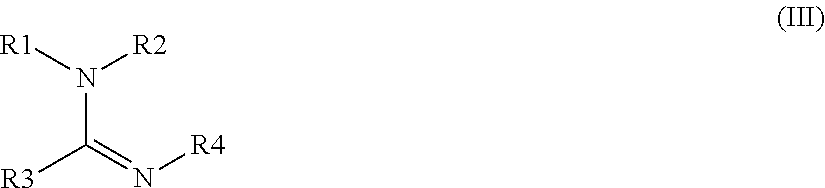
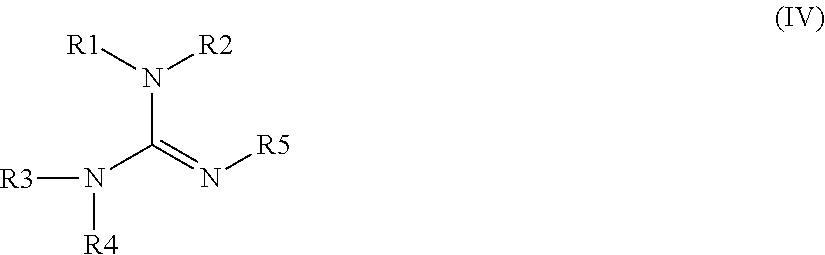
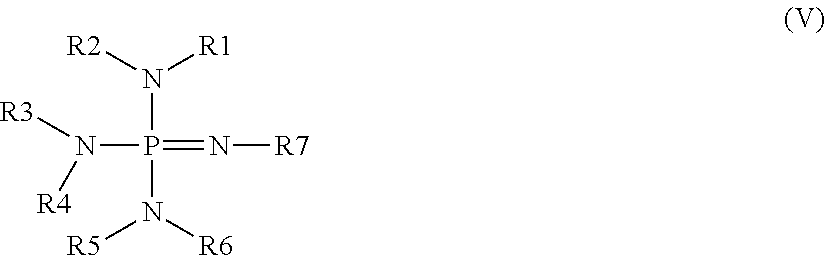
Examples
examples
[0110]Objects and advantages of this invention are further illustrated by the following examples, but the particular materials and amounts thereof recited in these examples, as well as other conditions and details, should not be construed to unduly limit this invention. These examples are merely for illustrative purposes only and are not meant to be limiting on the scope of the appended claims.
Materials
[0111]Unless otherwise noted, all parts, percentages, ratios, etc., in the examples and in the remainder of the specification are by weight. Unless otherwise noted, all chemicals were obtained from, or are available from, chemical suppliers such as Aldrich Chemical Company, Milwaukee, Wis.
Preparation of 2,3,6,7-Tetrahydro-5H-thiazolo[3,2-a]pyrimidine
[0112]2,3,6,7-Tetrahydro-5H-thiazolo[3,2-a]pyrimidine was prepared by cycloalkylation of a cyclic thiourea essentially according to the reaction scheme described in Org. Lett., Vol. 9, No. 1, 2007, and shown below (wherein n=2 and m=1):
[01...
example 11
[0119]9 g of Syl-Off™ 292 release coating composition, 0.1 g 1,8-diazabicyclo[5.4.0]-7-undecene (DBU, obtained from Aldrich Chemical Company, Milwaukee, Wis.), 16.7 g heptane, and 4.2 g methyl ethyl ketone (MEK) were weighed into a 120 mL glass jar. The glass jar was shaken until the contents were homogeneous. The homogeneous mixture was coated on the primed side of a 50 micrometers thick 3SAB PET film.
[0120]The coated film was taped to a cardboard and then left under ambient conditions (about 23° C.) for at least 3 minutes. After 2 minutes, the coating was not greasy but could be scuffed with a light finger rub. After 2 minutes and 40 seconds, the coating was firm and could not be scuffed with a finger rub. The coated film was then placed in a Despatch oven (Model RFD2-19-2E, commercially available from Despatch Industries, Minneapolis, Minn.) with the heat turned off and the fans turned on for 3 minutes in order to remove the solvents.
example 12
[0121]29.4 g of Syl-Off™ 292 release coating composition, 0.1 g DBU, 56.4 g heptane, and 14.1 g MEK were weighed into a 120 mL glass jar. The glass jar was shaken until the contents were homogeneous. The homogeneous mixture was coated on the primed side of a 50 micrometers thick 3SAB PET film.
[0122]The coated film was taped to a cardboard and then left under ambient conditions (about 23° C.) for at least 3 minutes. After 1 minute and 30 seconds, the coating was dry and felt cured to the touch. The coated film was then placed in a Despatch oven with the heat turned off and the fans turned on for 3 minutes in order to remove the solvents.
PUM
| Property | Measurement | Unit |
|---|---|---|
| temperatures | aaaaa | aaaaa |
| surface energy | aaaaa | aaaaa |
| temperature | aaaaa | aaaaa |
Abstract
Description
Claims
Application Information
 Login to View More