Mass production of secondary metabolite in plant cell culture by treatment of saccharide mixture in medium
a technology of saccharide mixture and plant cell culture, which is applied in the field of mass production of secondary metabolites using plant cell culture, can solve the problems of limited supply of secondary metabolites produced by plant extraction, inability to generalize to most plant cell cultures, and inability to mass produce secondary metabolites. to achieve the effect of increasing the productivity of secondary metabolites
- Summary
- Abstract
- Description
- Claims
- Application Information
AI Technical Summary
Benefits of technology
Problems solved by technology
Method used
Image

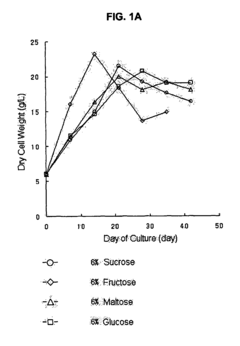
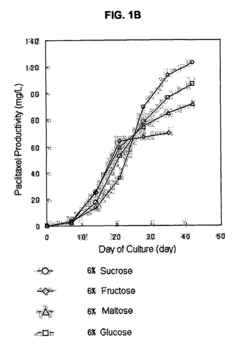
Examples
example 1
Effect of Single Carbon Source on the Productivity of a Secondary Metabolite
[0056]In this example, Taxus chinensis SYG-1 cell line (KCTC-0232BP), which produces paclitaxel and taxane compounds, was used for production of secondary metabolites in a plant cell culture.
[0057]For proliferation of the cells, a modified Gamborg B5 medium containing 3% sucrose was put into a 250 Ml Erlenmeyer flask. Then, the SYG-1 cells were inoculated into the medium so that the concentration of the cell reached 3 g / L, and cultured under dark conditions at 24° C. and 150 rpm for 14 days.
[0058]For production of paclitaxel, a modified Gamborg B5 medium containing 6% sucrose was put into a 250 Ml Erlenmeyer flask, and 50 Ml of the obtained SYG-1 cell culture media was added thereto. The cell culture solution was cultured under dark condition at 24° C. and 150 rpm for 14 days, and further cultured at an elevated temperature of 29° C. for 28 days. In order to increase the productivity of paclitaxel, not only ...
example 2
Productivity of Paclitaxel by Treating with a Mixture of Glucose and Fructose as a Carbon Source
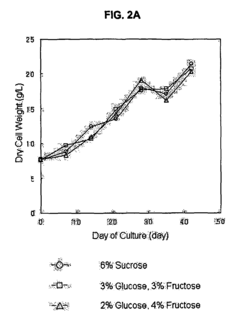
[0063]SYG-1 cells were cultured by the same method as in Example 1, except that the medium used contained a mixture of glucose and fructose as a carbon source in the mixture ratio as shown in the following Table 3. On days 14, 21, 28, 35, and 42 of the culture, the cultured cells were sampled, and the cell growth and the paclitaxel productivity of each of the samples were determined according to the method in Example 1.
[0064]The obtained results are shown in FIGS. 2A and 2B and Table 3. FIG. 2A shows the changes of dry cell weight depending on the mixture ratio of glucose and fructose. As shown in FIG. 2A, the groups treated with the saccharide mixtures of 2% glucose and 4% fructose, and 3% glucose and 3% fructose, as a carbon source, exhibit an accelerated cell growth equal to that of the group treated with 6% sucrose only, as a carbon source, and at days 35 of the culture, also exhibit ...
example 3
Productivity of Paclitaxel by Treating with a Mixture of Fructose and Sucrose as a Carbon Source
[0067]SYG-1 cells were cultured by the same method as in Example 1, except that the medium used contained the mixture of glucose and fructose, or sucrose and fructose, in the mixture ratio shown in Table 4, as a carbon source, and sucrose was further added at days 28 and 49 of the culture when the content of sugar in the media was 2% or less, to continue the culture for the extended period of 56 days. On days 14, 21, 28, 35, 49, and 56 after initiation of culture, the cultured cells were randomly sampled, and the cell growth and the paclitaxel productivity of each of the samples were determined according to the method in Example 1.
[0068]From the result for the dry cell weight, which is an indicator of the cell growth, it is found that the cells cultured by using the saccharide mixture of glucose and fructose, or sucrose and fructose, as a carbon source, exhibit the cell growth equal to th...
PUM
| Property | Measurement | Unit |
|---|---|---|
| temperature | aaaaa | aaaaa |
| temperature | aaaaa | aaaaa |
| concentration | aaaaa | aaaaa |
Abstract
Description
Claims
Application Information
 Login to View More