Transcutaneous electrical stimulation for treating neurological disorders

a neurological disorder and transcutaneous electrical stimulation technology, applied in the field of systems and methods for treating neurological disorders, can solve the problems of pain to patients, tissue heating, and limited stimulation techniques near the skin surfa

a neurological disorder and transcutaneous electrical stimulation technology, applied in the field of systems and methods for treating neurological disorders, can solve the problems of pain to patients, tissue heating, and limited stimulation techniques near the skin surfa

US9242085B2Active Publication Date: 2016-01-26BOSTON SCI NEUROMODULATION CORP

Image

Smart Image Click on the blue labels to locate them in the text.
Viewing Examples
Smart Image
  • Transcutaneous electrical stimulation for treating neurological disorders
  • Transcutaneous electrical stimulation for treating neurological disorders
  • Transcutaneous electrical stimulation for treating neurological disorders

Examples

Experimental program
Comparison scheme
Effect test

Embodiment Construction

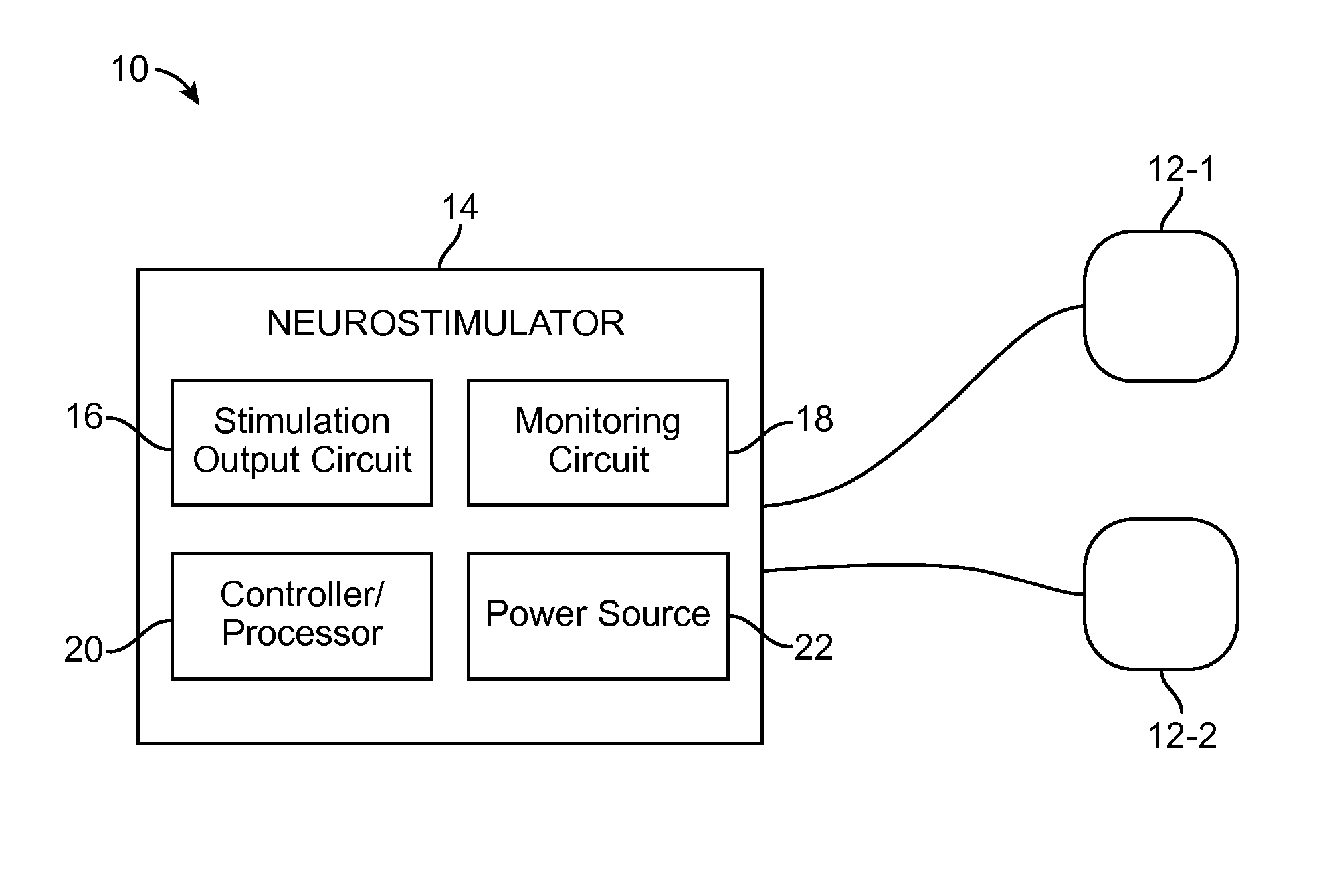
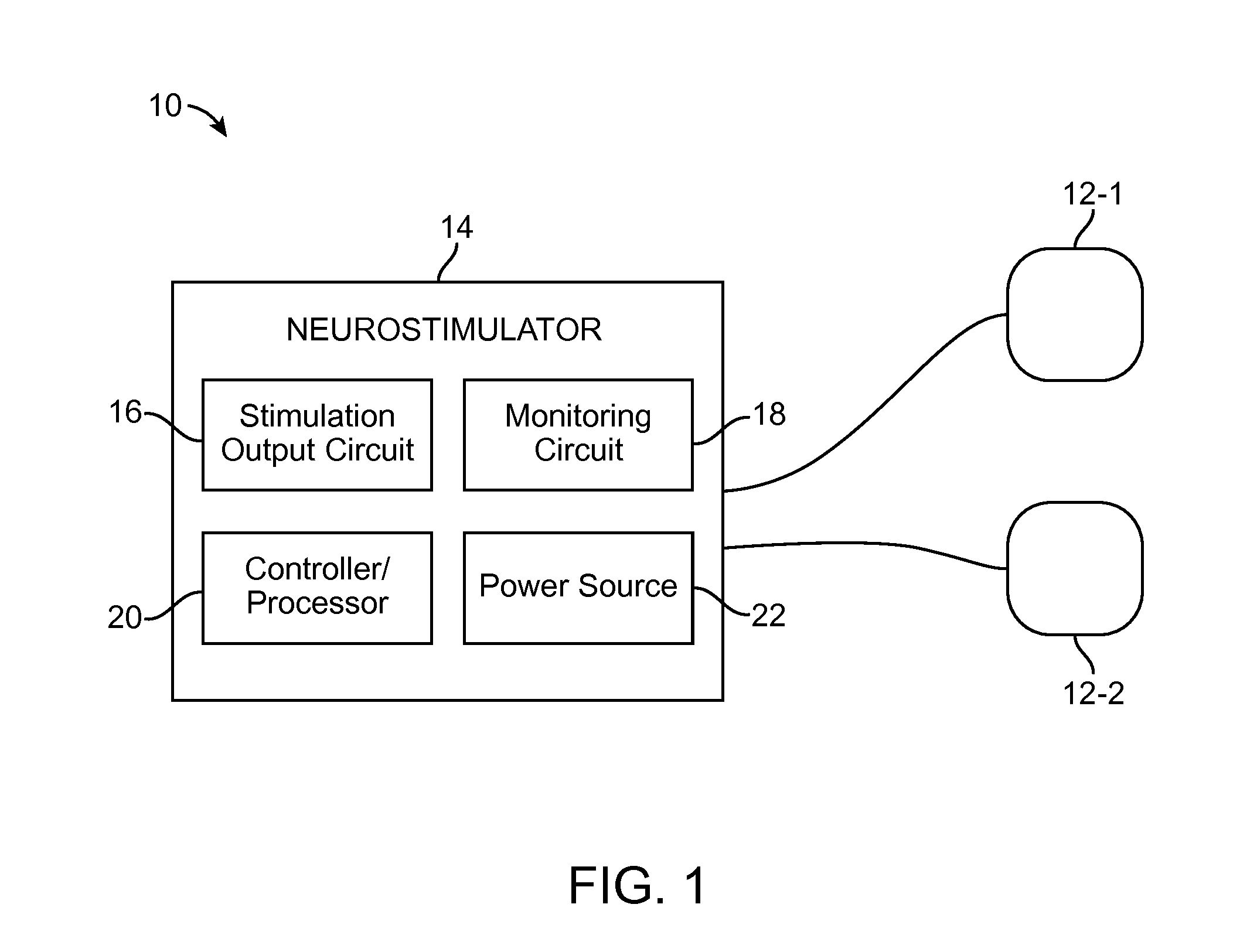
[0013]Turning first to FIG. 1, an exemplary transcutaneous neurostimulation system 10 will be described. The system 10 includes patch electrodes 12-1 and 12-2 (collectively, electrodes 12) and a neurostimulator 14. The patch electrodes 12 may store an electrically conducting medium, such as various known, related art and / or later developed hydrophilic materials and hydrogels, and configured to release the medium from a side that is to be placed in communication with a patient's skin. Alternatively, this electrically conductive medium may be applied separately between the electrodes 12 and the skin.

[0014]The neurostimulator 14 generally includes a stimulation output circuit 16, a monitoring circuit 18, a controller / processor 20, and a power source 22. The stimulation output circuit 16 is configured to generate electrical stimulation energy in accordance with a relatively high rate electrical pulse train to treat a disorder. Alternatively, a relatively high frequency continuous stimul...

the structure of the environmentally friendly knitted fabric provided by the present invention; figure 2 Flow chart of the yarn wrapping machine for environmentally friendly knitted fabrics and storage devices; image 3 Is the parameter map of the yarn covering machine
Login to View More

PUM

No PUM Login to View More

Abstract

A method for treating a disorder of a patient. The method comprises transcutaneously delivering electrical energy to a targeted tissue site at a frequency of at least 50 KHz, thereby treating the disorder.

Description

RELATED APPLICATION DATA[0001]The present application claims the benefit under 35 U.S.C. §119 to U.S. Provisional Patent Application No. 61 / 841,199, filed Jun. 28, 2013. The foregoing application is hereby incorporated by reference into the present application in its entirety.TECHNICAL FIELD[0002]The present disclosure relates to systems and methods for transcutaneously treating neurological disorders in patients.BACKGROUND OF THE INVENTION[0003]Transcutaneous electrical nerve stimulation (TENS) is a known non-invasive technique extensively used by numerous health-care providers worldwide. TENS uses an electrical current to stimulate nerves and acupuncture points across the surface of the skin. Due to its simplicity, TENS can be administered either in clinics by health-care professionals or at home by patients through various TENS devices available in the market. Its ease of use, general safety and portability make it a preferred treatment over a long term use of medications and ner...

Claims

the structure of the environmentally friendly knitted fabric provided by the present invention; figure 2 Flow chart of the yarn wrapping machine for environmentally friendly knitted fabrics and storage devices; image 3 Is the parameter map of the yarn covering machine
Login to View More

Application Information

Patent Timeline
26 Jan 2016
Publication
US9242085B2
IPC
A61N1/00; A61N1/04; A61N1/36
CPC
A61N1/0456; A61N1/36014; A61N1/36021; A61N1/36031; A61N1/36034
Inventors
HERSHEY, BRADLEY L.; BAYNHAM, TAMARA C.