[0009]In view of the above-mentioned and other drawbacks of the prior art, it is an object of the present invention to aid the user's placement of the finger on the fingerprint sensor by providing proper guidance for the purpose of ensuring optimal performance, typically without having to resort to including mechanical guiding means.
[0011]The present invention is based upon the realization that it is desirable to automatically adapt the guidance provided to a user when using a fingerprint sensor comprised with an electronic device. That is, the guidance to be shown, e.g. within the GUI provided at the display unit should target a specific behavior of the user, to adaptively guide the user to use the fingerprint sensor in the most optimal way for achieving a good finger enrollment as well as for using the fingerprint sensor in the best possible way during general use of the electronic device. That is, the acquisition of a high quality partial fingerprint image will allow for successful feature extraction, in turn typically an essential part in achieving a successful enrollment as well as verification / authentication of the users fingerprint, e.g. for use in unlocking the electronic device, for verifying a purchase, etc. Accordingly, the invention allows for an improved enrollment process as well as an improved general use of the fingerprint sensor. Within the context of the invention, it should be understood that user guidance may be provided to the user in other ways, such as for example by means of an audio instruction or using haptic feedback.
[0014]However, the request for rearrangement of the finger may also be made for instructing the user to move his finger such that a “better” partial fingerprint image may be acquired, i.e. for improving the quality of the partial fingerprint image. The first guidance may also be provided for requesting the user to “press harder” towards the surface of the fingerprint sensor, or for press less hard towards the surface of the fingerprint sensor.
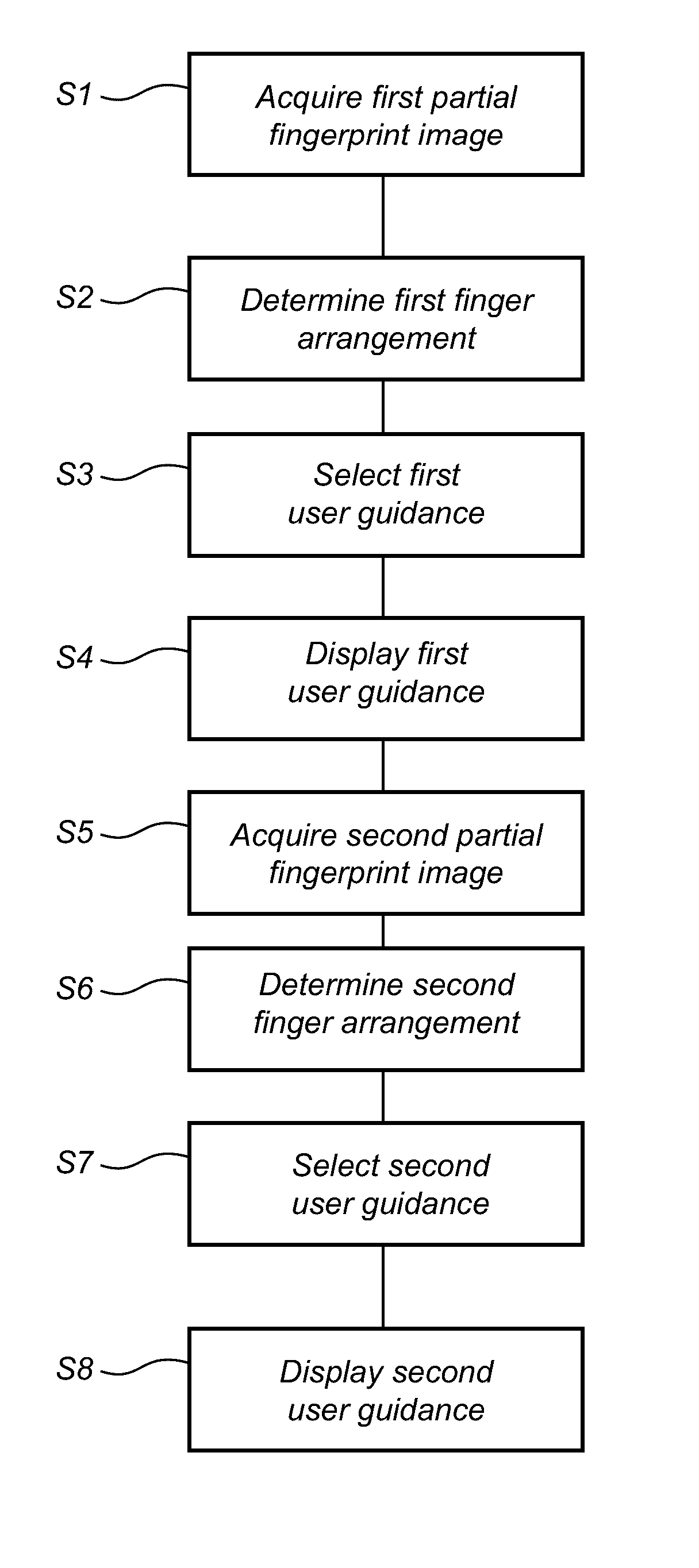
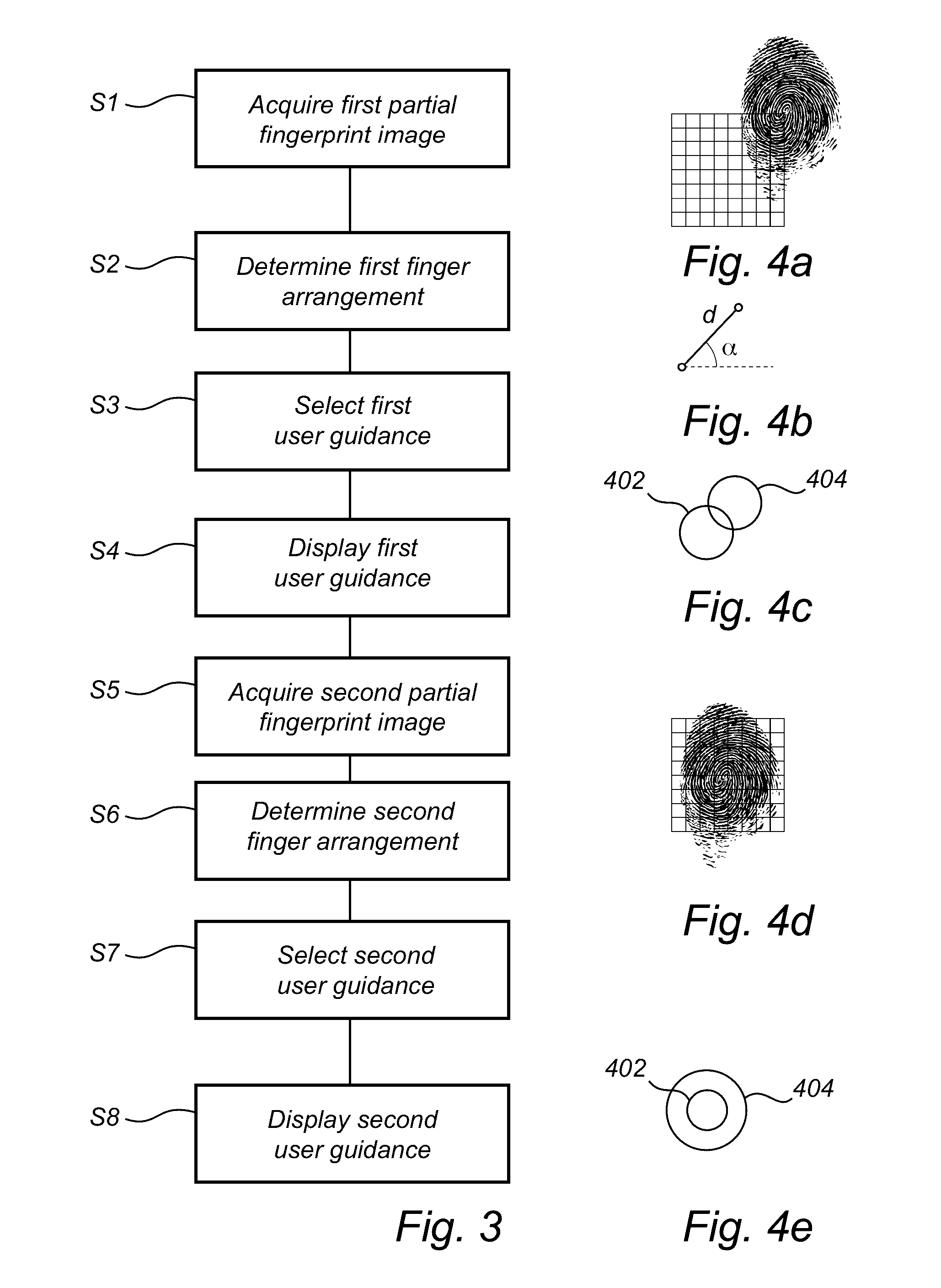
[0025]According to another aspect of the present invention, there is provided a portable electronic device, comprising a display unit configured to display a graphical user interface (GUI), a fingerprint sensor having an array of pixels and configured for capturing a fingerprint representation of a fingerprint pattern of a finger, and a control unit electrically connected to the fingerprint sensor and the display unit, wherein the control unit is configured to acquire, at a first instance in time, a first partial fingerprint image of a corresponding first portion of a fingerprint pattern using the fingerprint sensor, determine, based on the first partial fingerprint image, a first arrangement of the finger in relation to the fingerprint sensor, select a first user guidance based on the first finger arrangement, provide the first user guidance to the user for rearranging the finger in relation to the fingerprint sensor, acquire, at a second instance in time, a second partial fingerprint image of a corresponding second portion of the fingerprint pattern using the fingerprint sensor, determine, based on the second partial fingerprint image, a second arrangement of the finger in relation to the fingerprint sensor, select a second user guidance taking into account both the first and the second finger arrangement, and provide the second user guidance to the user for arranging the finger in relation to the fingerprint sensor. This aspect of the invention provides similar advantages as discussed above in relation to the previous aspect of the invention.
[0028]In summary, the present invention relates to a method of guiding a user of a portable electronic device when operating a fingerprint sensor comprised with the portable electronic device. The invention allows for an improved enrollment process as well as for general improvements when using the fingerprint sensor.

 Login to View More
  Login to View More