
Method and components for detecting nucleic acid chains
a nucleic acid chain and component technology, applied in the field of nucleic acid chain components and compositions, can solve the problems of reducing the quality of the assay, poor signal-to-noise ratio, and falsifying the result of the entire analysis, so as to prevent potential non-specific interactions of nucleotides, and improve the specificity of the analysis
- Summary
- Abstract
- Description
- Claims
- Application Information
AI Technical Summary
Benefits of technology
Problems solved by technology
Method used
Image

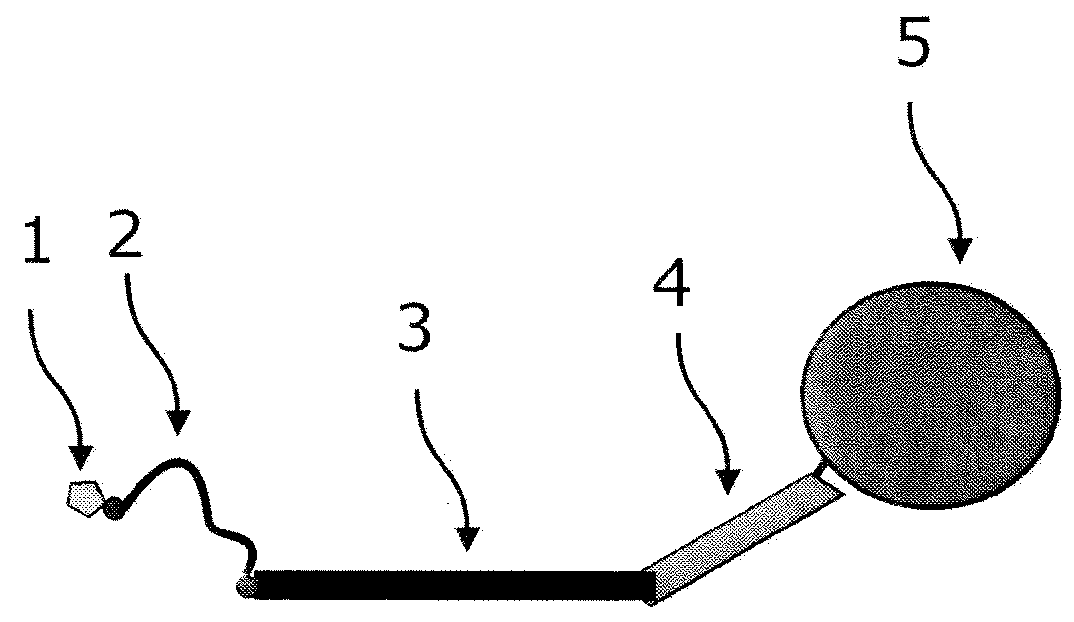
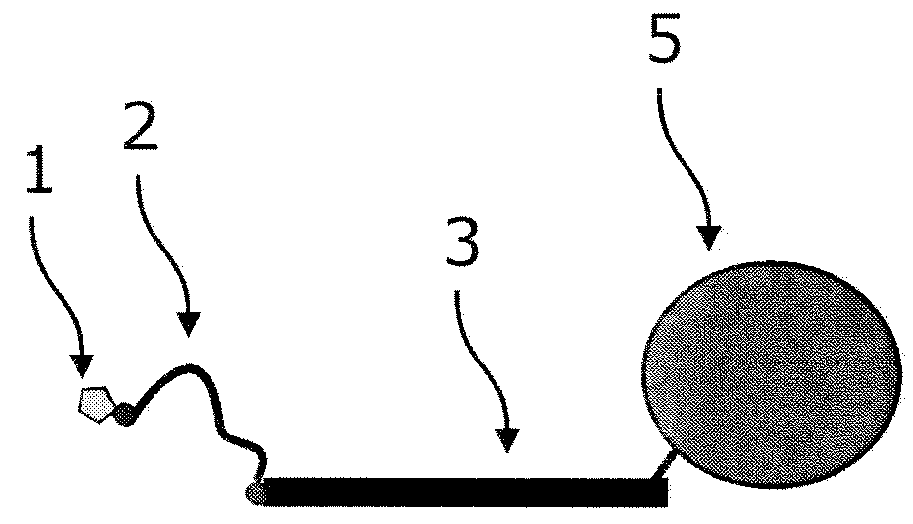
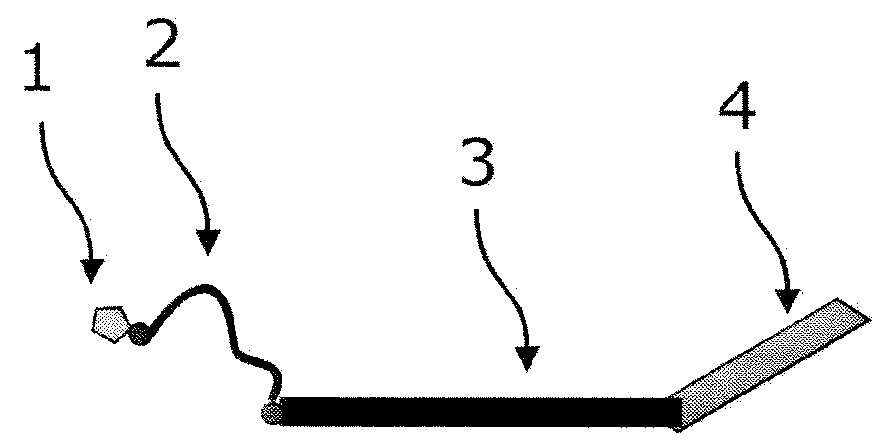
Examples
examples
1.5.1 General Procedure of the Incorporation Reaction
[0723]As an example for an incorporation reaction, the labeling of a single stranded DNA with nuc-macromolecules can be considered. For a labeling reaction, nucleic acid chains are provided and contacted with a primer, and a polymerase, and at least one kind of nuc-macromolecules and incubated under conditions which allow the primer to be extended by the polymerase. Through the incorporation of nuc-macromolecules into the growing strand, domains of nuc-macromolecules are coupled to those growing strands of nucleic acid chains.
[0724]In an advantageous embodiment of the application, the nucleic acid chains are labeled with nuc-macromolecules, which comprise at least one target domain specific for the target sequence. This domain binds to the target nucleic acid chain to be labeled at the 3′-side of the primer allowing the nuc-macromolecules to bind in a sequence-specific way to the nucleic acid chain to be labeled.
[0725]The nuc-comp...
PUM
| Property | Measurement | Unit |
|---|---|---|
| molecular weight | aaaaa | aaaaa |
| molecular weight | aaaaa | aaaaa |
| molecular weight | aaaaa | aaaaa |
Abstract
Description
Claims
Application Information
 Login to View More