

Positive/passive exercise training device for simulating weightless tail suspended rats
A passive movement and training device technology, applied in the field of aerospace biomedical engineering research, can solve the problems of quantitative monitoring of active and passive training of rats, and the inability to maintain the angle of tail suspension of rats, etc., and achieve the effect of consistent trajectories
- Summary
- Abstract
- Description
- Claims
- Application Information
AI Technical Summary
Problems solved by technology
Method used
Image

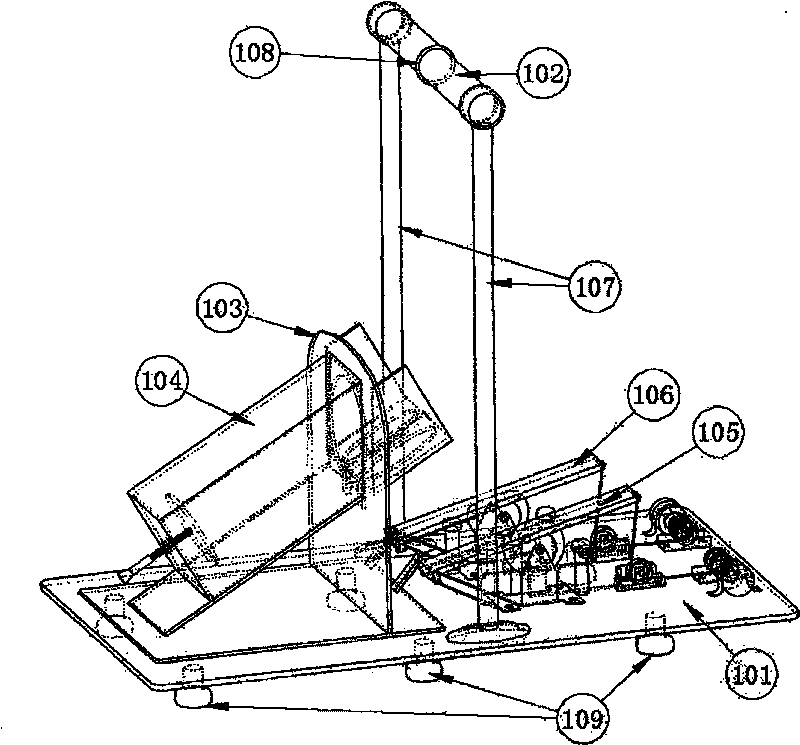
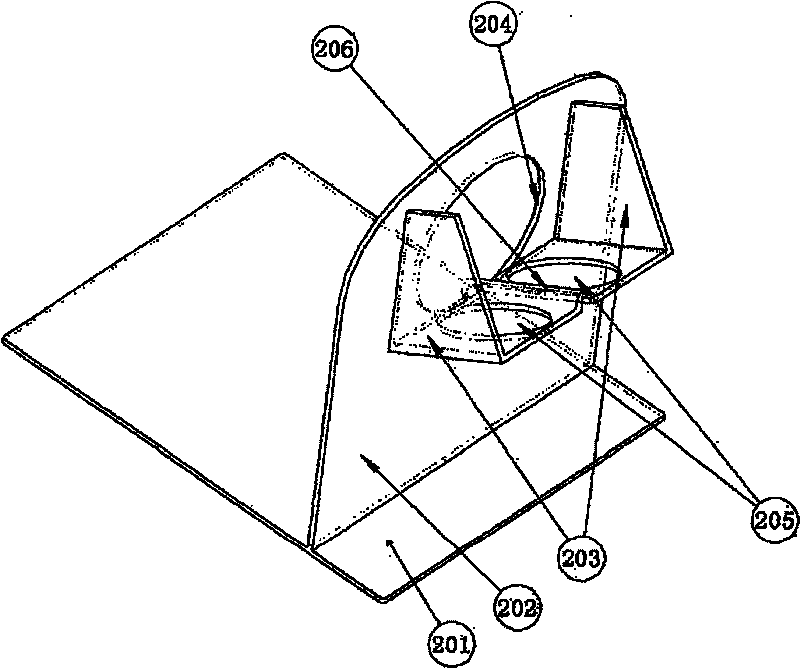
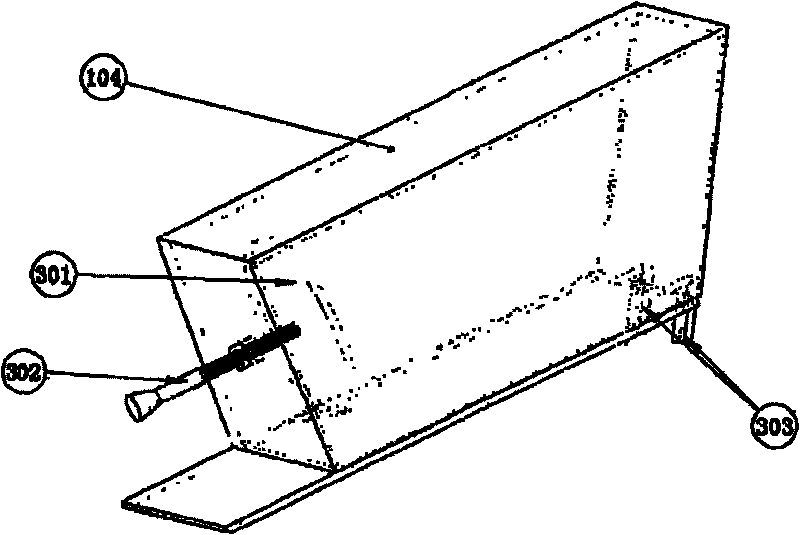
Examples
Embodiment 1
[0045] Keep the same training angle under the condition of weightlessness in embodiment 1
[0046]During use, earlier the rat fixed box 104 is taken off, the tail of the rat is mentioned, the opening of the rat fixed box 104 is approached to the rat head, and the habit of drilling holes of the rat is utilized to allow the rat to drill into the rat fixed box 104, Afterwards, the rat fixing box 104 is connected with the fixing base 103 using the hook 303 . Adjust the length of the rat position adjustment bolt 302 in the rat fixing box 104 , and adjust the position of the fixing seat 103 on the base 101 , so that the rat's hind limbs can pass through the rat's hind limbs through the hole 205 . Then the tail of the rat is suspended on the tail ring 108, and the rat foot is fixed on the left / right hindlimb resistance exercise device 105 / 106 of the rat with medical adhesive tape (the two are symmetrical structures, and one side can be selected as required) Or both sides carry out t...
Embodiment 2
[0047] Embodiment 2 only trains the hind limbs
[0048] No matter it is the control group or the active / passive training group, the whole limbs of the rats are fixed in the rat fixing box 104 except the hind limbs, and its movement is restricted, and the active / passive exercise training is only carried out for the hind limbs, effectively excluding The interference of other limb movements of rats to the experiment.
Embodiment 3
[0049] Embodiment 3 Angle adjustable active training
[0050] If the backguy 409 is not connected to the joint 410, and the rat fixing box adopts an integrated design, the device such as Figure 5 shown. Active locomotor training can be performed only on the hindlimb of the rat, and the angle of the rat tail suspension can be adjusted. When the sole of the rat's foot is stimulated by the high-voltage and low-current arc pulse released by the electrode connected to the foot pedal 401, the rat will actively contract the hind limbs to avoid the pain caused by the click, thereby lifting one end of the movement trajectory limiting plate 407 In this process, it is necessary to overcome the resistance of the loaded rubber band 403, and the lifting height is determined by the rat movement restriction rod 408, so as to complete the training of the rat actively contracting the hind limbs against a certain resistance (or no resistance) for active resistance exercise. The movement load ...
PUM
 Login to View More
 Abstract
Description
Claims
Application Information
 Login to View More