

Transmission of multiplex protocol data units in physical layer packets
A protocol data unit, multiplexing technology, applied in the field of communication, can solve the problem of multiplexing protocol data unit loss and other problems
- Summary
- Abstract
- Description
- Claims
- Application Information
AI Technical Summary
Problems solved by technology
Method used
Image

Examples
Embodiment Construction
[0018] The term "exemplary" is used herein to mean "serving as an example, instance, or illustration." Any embodiment or design described herein as "exemplary" is not necessarily to be construed as preferred or advantageous over other embodiments or designs.
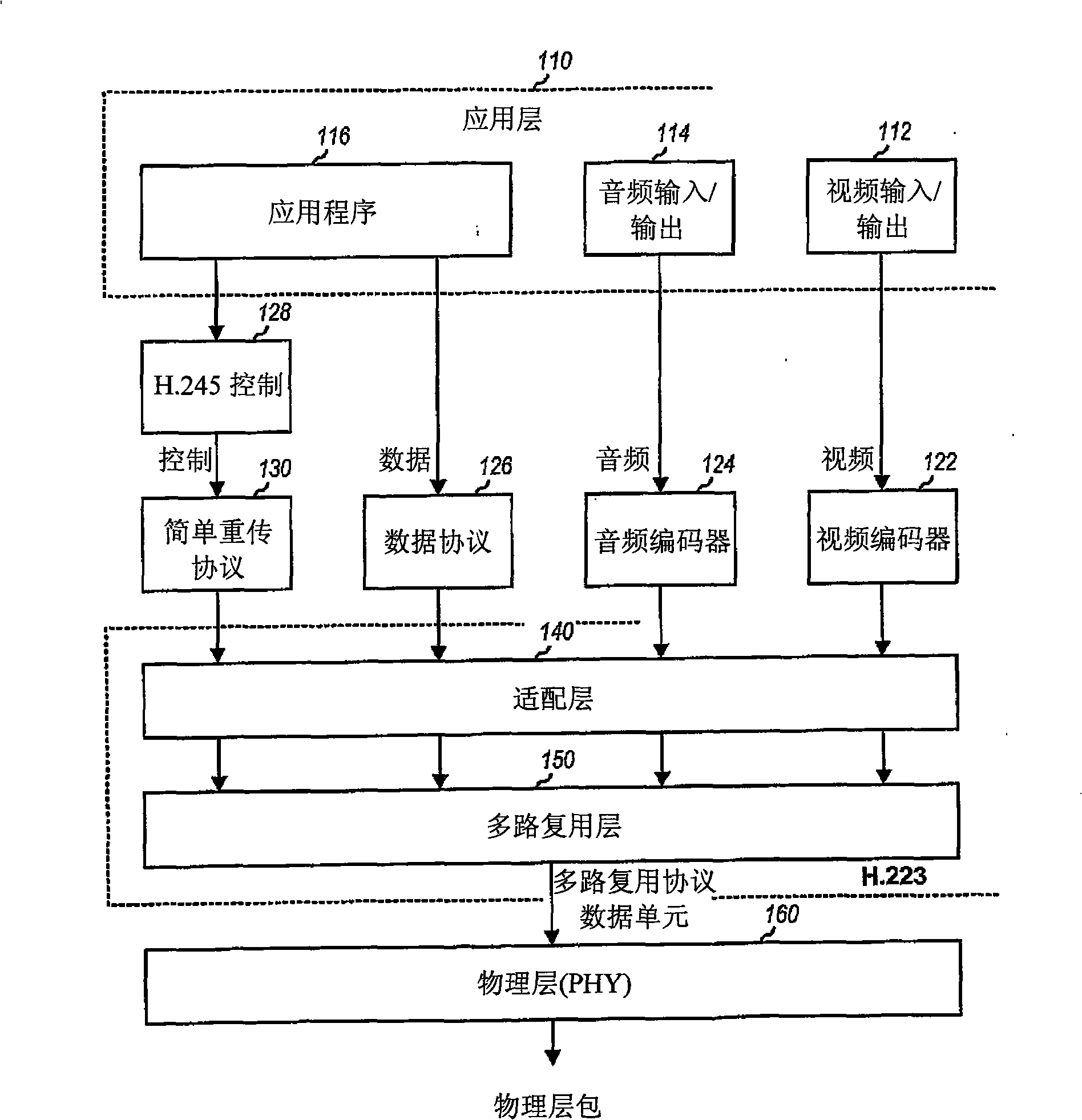
[0019] figure 1 A block diagram showing the processing and multiplexing at the transmitter for a video telephony call using ITU-T Recommendation H.324M (or simply "H.324M"). H.324M is a modified version of H.324 recommended by ITU-T, and its name is "Terminal for Low Bit Rate Multimedia Communication (Terminal for Low Bit Rate Multimedia Communication)". H.324 is an international standard for multimedia communication over low bit rate circuit conversion systems, and uses H.223 as a data transfer / multiplexing protocol.
[0020] At the application layer 110, the video telephony call is processed as separate video, audio, data and control signals sent on different logical channels. The data can be used for text or some o...
PUM
 Login to View More
 Abstract
Description
Claims
Application Information
 Login to View More