
Phosphorylated polymer composite film for full vanadium flow battery and preparation method thereof
An all-vanadium redox flow battery and polymer technology, which is applied in the direction of fuel cells, electrochemical generators, battery components, etc., can solve the problems of high vanadium ion permeability, short service life, and high price, and achieve high Effect of voltage efficiency and energy conversion efficiency, cost reduction, and promotion of commercialization process
- Summary
- Abstract
- Description
- Claims
- Application Information
AI Technical Summary
Problems solved by technology
Method used
Image

Examples
Embodiment 1
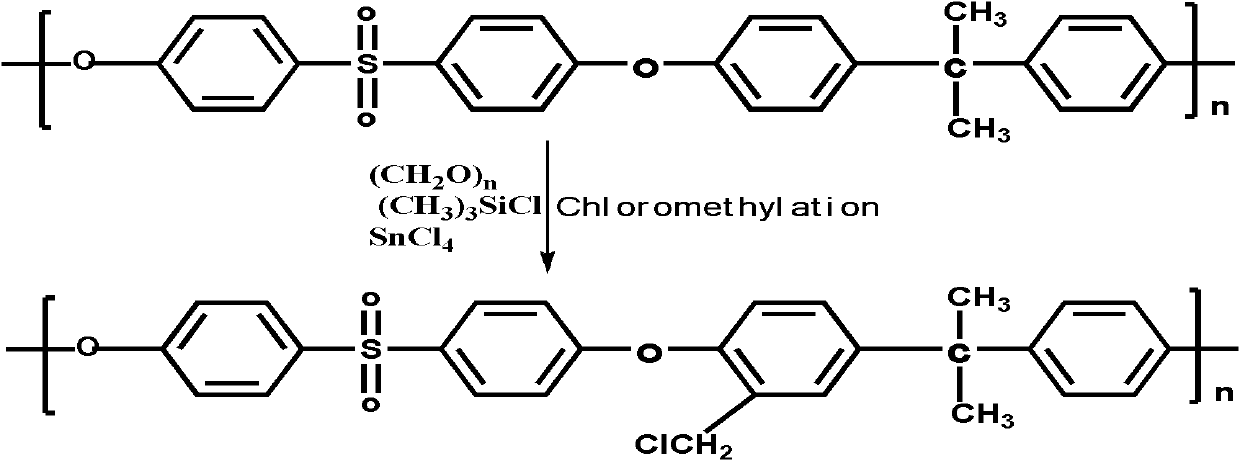
[0036] (1) Add 14.88g polysulfone and 750ml chloroform to a 1000ml round bottom flask, stir at room temperature to dissolve the polysulfone, then add 10g paraformaldehyde, 0.8ml tin tetrachloride and 42.5ml trimethylchlorosilane, and the system heats up React at 52°C for 20h. After the reaction is terminated, the product is precipitated in methanol, filtered, the filter cake is washed with methanol, and vacuum-dried at 40°C to obtain the chloromethylated polysulfone product (the production process diagram is shown in figure 1 Shown), its degree of substitution as determined by NMR is 0.55, that is, there are 0.55 chloromethyl groups on each polysulfone repeating unit;
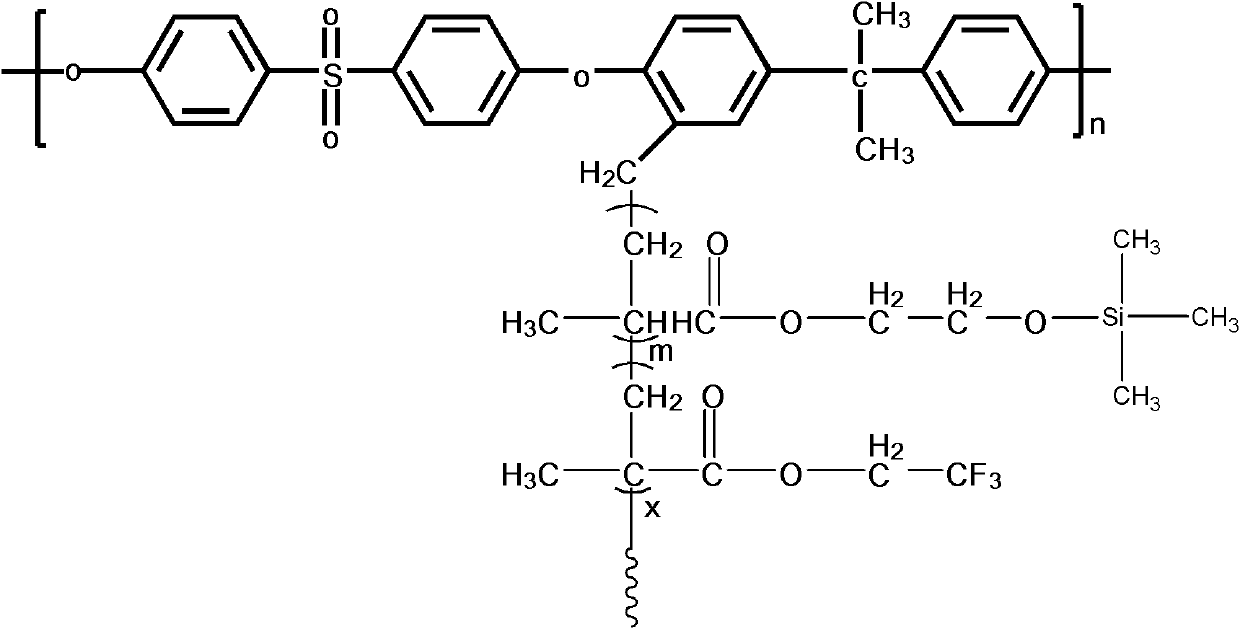
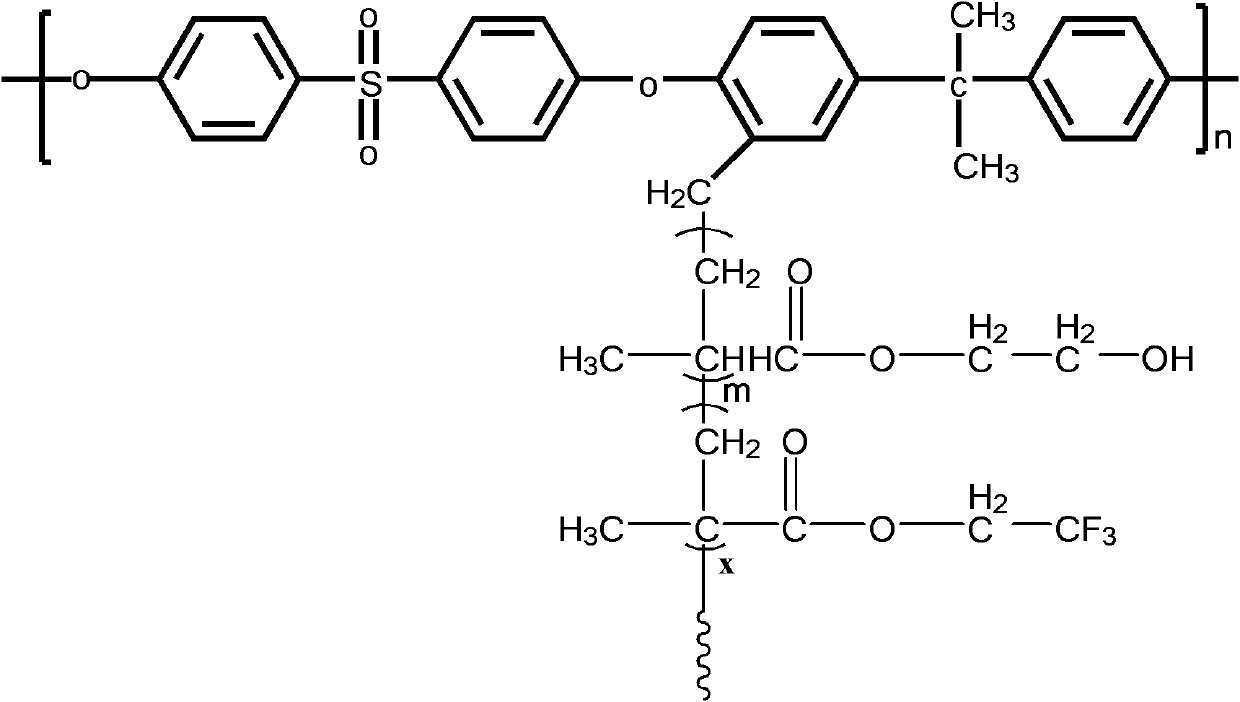
[0037] (2) In a 100ml round bottom flask, add 10g trifluoroethyl methacrylate, 10g trimethylchlorosilane-terminated hydroxyethyl methacrylate, 10g chloromethylated polysulfone obtained in step (1), 10g polysulfone Dipyridine and 50ml N,N-dimethylformamide were mixed, the mixed system was dissolved and argon was...
Embodiment 2
[0045] Same as Example 1, except that 35 g of trifluoroethyl methacrylate and 30 g of trimethylchlorosilane-terminated hydroxyethyl methacrylate were added in the reaction. The phosphorylated polymer composite membrane obtained in this embodiment has a structure as shown in formula (I), wherein m is 19, x is 21, and n is 65.
Embodiment 3
[0047] Same as Example 1, except that 30 g of trifluoroethyl methacrylate and 20 g of trimethylchlorosilane-terminated hydroxyethyl methacrylate were added in the reaction. The phosphorylated polymer composite membrane obtained in this embodiment has a structure as shown in formula (I), wherein m is 13, x is 18, and n is 65.
PUM
| Property | Measurement | Unit |
|---|---|---|
| thickness | aaaaa | aaaaa |
| degree of polymerization | aaaaa | aaaaa |
| degree of polymerization | aaaaa | aaaaa |
Abstract
Description
Claims
Application Information
 Login to View More