Real-time fluorescent PCR (polymerase chain reaction) method and application
What is AI technical title?
AI technical title is built by Patsnap AI team. It summarizes the technical point description of the patent document.
A real-time fluorescent, useful technology, applied in the field of PCR
Active Publication Date: 2012-01-18
爱基因鑫享(厦门)医学检验实验室有限公司
View PDF4 Cites 6 Cited by
Summary
Abstract
Description
Claims
Application Information
AI Technical Summary
This helps you quickly interpret patents by identifying the three key elements:
Problems solved by technology
Method used
Benefits of technology
Problems solved by technology
This method has fast reaction speed and high signal-to-noise ratio, but the design and synthesis of Scorpion probes are complicated and costly
[0005] CN101033486B discloses a fluorescent PCR detection method, using upstream and downstream primers and a probe for detection, the probe is designed to be complementary to the upstream primer, and no amplification product appears When the fluorescent group on the upstream primer and the quenching group on the probe are close to the fluorescence and is quenched, when the amplification product appears, the fluorescent group on the upstream primer and the quenching group on the probe release the fluorescent signal separately , so as to realize real-time fluorescent PCR. The specificity of this method is poor, and the fluorescent signal can still be detected when non-specific amplification occurs.
Method used
the structure of the environmentally friendly knitted fabric provided by the present invention; figure 2 Flow chart of the yarn wrapping machine for environmentally friendly knitted fabrics and storage devices; image 3 Is the parameter map of the yarn covering machine
View more
Image
Smart Image Click on the blue labels to locate them in the text.
Viewing Examples
Smart Image
Click on the blue label to locate the original text in one second.
Reading with bidirectional positioning of images and text.
Smart Image
Examples
Experimental program
Comparison scheme
Effect test
Embodiment 1
[0043] Example 1: Select the human SOD1 gene (Gene ID: 6647), and design the corresponding primers and probes according to the principles described in the instructions. The sequence is as follows:
[0044] Upstream primer: TMR- TTTGCTGCTGTGCCTGAAGACAGCCGTGTTATGAA (SEQ ID NO:1)
[0045] Downstream primer: TCTATCTGTGCCCTTTACTTGGT (SEQ ID NO: 2)
[0046] Detection probe: CATTCCAACTGTATCCTGTGTAGAAG (SEQ ID NO: 3)-FAM
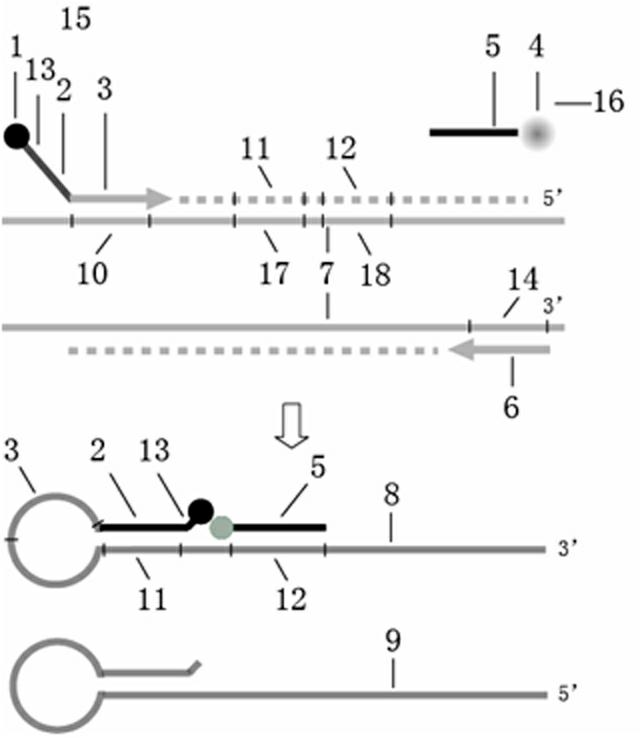
[0047] Among the upstream primers: the double underline is the additional sequence 13, the single underline is the specific detection sequence 2, and the single underline is the specific primer sequence 3.
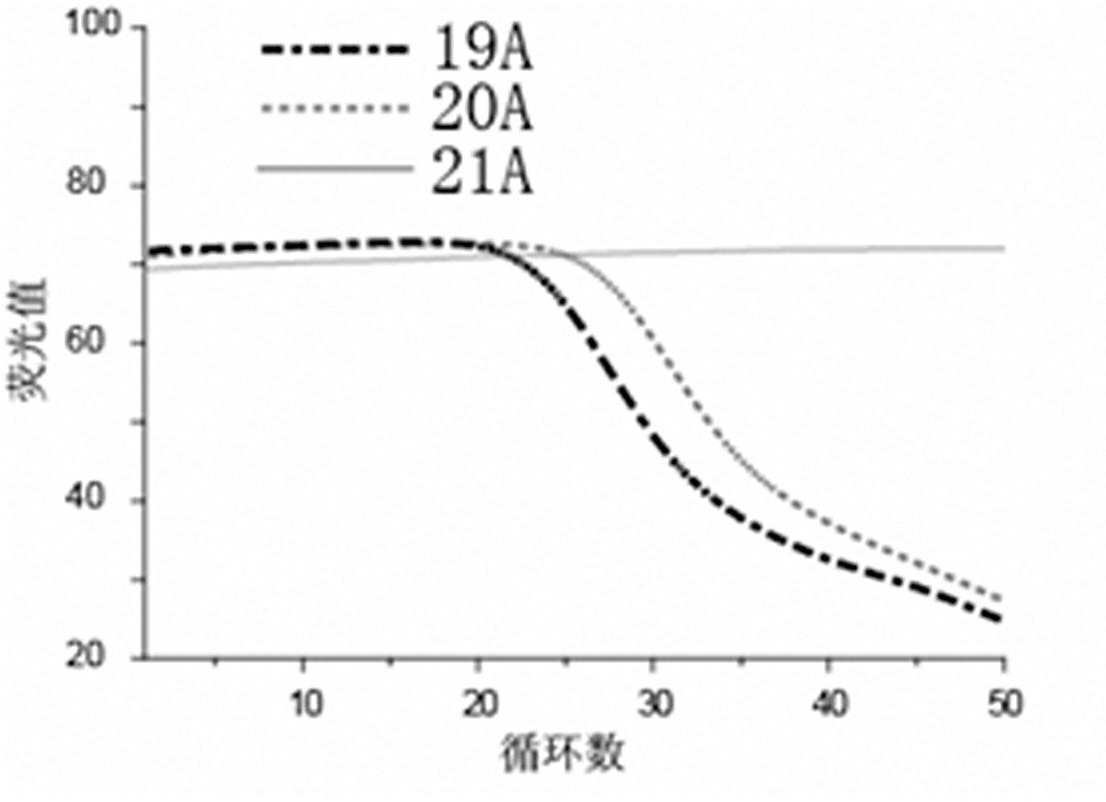
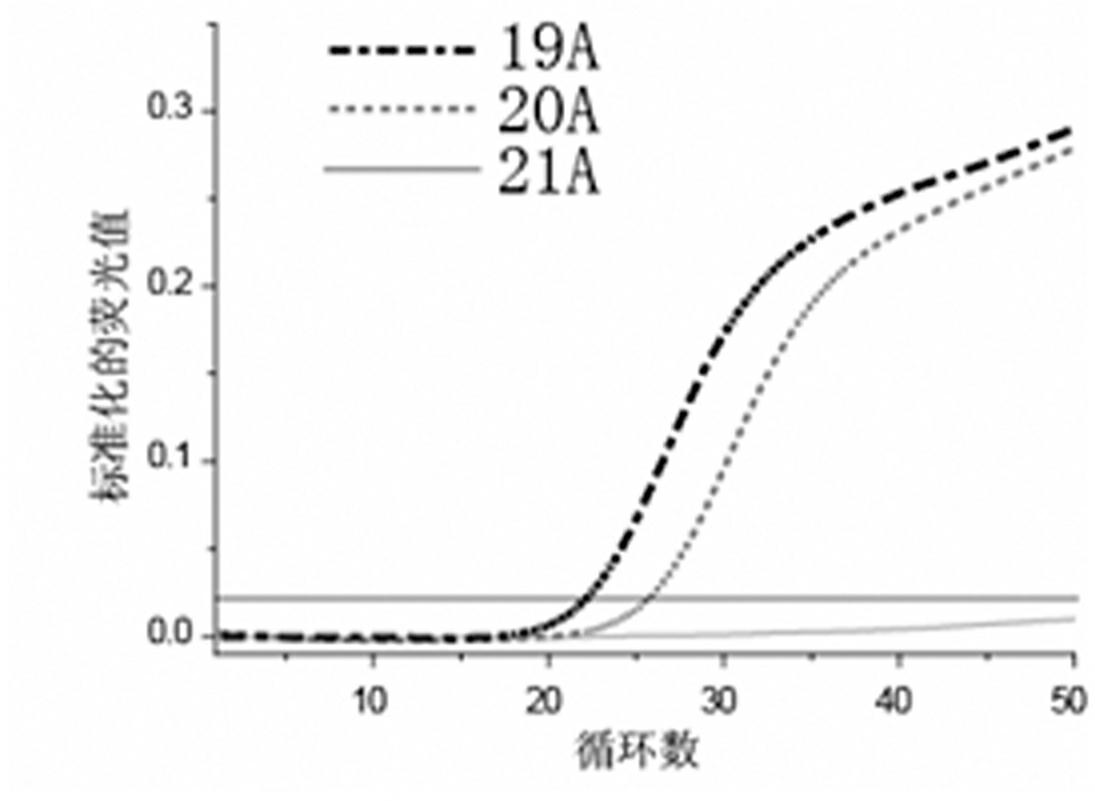
[0048] In the system, the 5-terminal of the upstream primer is labeled with the quenching group TMR, and the 3-terminal of the detection probe is labeled with the FAM group. During the annealing stage, the extension product of the labeled TMR primer and the detection probe form a hybrid complex, and contact occurs after the complex is formed. Quenching (belo...
Embodiment 2
[0051] Example 2: Select a SNP site (rs13182883) in the human genome, and design typing primers and probes according to the principles described in the instructions. The sequence is as follows:
[0052] Upstream primer: TMR- GGATGCTCACTGCCTAGTAGAGGGCCTGGCCT( SEQ ID NO:4)
[0053] Downstream primer: CAGGCTCTCCGTTACTTTCTTC (SEQ ID NO:5)
[0054] Detection probe: ACCCTGTTCCTCGAGGATTTGA (SEQ ID NO:6)-FAM
[0055] Among the upstream primers: the double underline is the additional sequence 13, the single underline is the specific detection sequence 2, and the single underline is the specific primer sequence 3.
[0056] In the system, the 5-terminal of the upstream primer is labeled with the quenching group TMR, and the 3-terminal of the detection probe is labeled with the fluorescent group FAM. The designed detection probe "covers" the SNP site to be detected, and the amplified labeled product chain forms an internal The Tm value of the secondary structure (theoretical value is ...
Embodiment 3
[0059] Embodiment 3: Select the human SOD1 gene, and design the corresponding primers and probes according to the principles described in the specification, the sequence is as follows:
[0060] Upstream primer: FAM- TTCCTCGACAGCACTGAAGACAGCCGTGTTATGAA( SEQ ID NO:7)
[0061] Downstream primer: TCTATCTGTGCCCTTTACTTGGT ( SEQ ID NO:2)
[0062] Detection probe: ACCAGGGGATGACATTCACAGA (SEQ ID NO: 8)-ROX Among them, upstream: the double underline is the additional sequence 13, the single underline is the specific detection sequence 2, and the single underline is the specific primer sequence 3.
[0063]The 5-end of the upstream primer in the system is labeled with the FAM (donor) fluorophore, and the 3-end of the detection probe is labeled with the ROX (acceptor) fluorophore. They hybridize with the amplification product to form a complex, and fluorescence energy resonance occurs after the complex is formed. Transfer to achieve the purpose of real-time monitoring of product forma...
the structure of the environmentally friendly knitted fabric provided by the present invention; figure 2 Flow chart of the yarn wrapping machine for environmentally friendly knitted fabrics and storage devices; image 3 Is the parameter map of the yarn covering machine
Login to View More
PUM
Login to View More
Abstract
The invention relates to a real-time fluorescent PCR (polymerasechain reaction) method and application. The method only requires one pair of upstream primer and downstream primer and one detection probe, wherein the upstream primer and the detection probe are respectively subjected to single marking; the upstream primer comprises three regions, namely a specific primer sequence 3, a specific detection sequence 2 and an additional sequence 13; the downstream primer is designed according to general primer design; and the detection probe comprises a specific detection sequence 5. The specific detection sequence 2 and an extension sequence of the upstream primer form an unique neck ring structure, the structure is formed by guiding of the specific detection sequence 2, and the detection probe is hybridized at adjacent position. The method provided by the invention has good specificity and strong selectivity, probe and primer design are simple and flexible, purification is easy, yield is high, the method can be used for monitoring amplification product quantity in real time to realize qualitative and quantitative analysis on a target sequence, also can be applicable to melting curve analysis, is especially applicable to detection of SNP (Single Nucleotide Polymorphism) or mutational site and has strong single base difference distinguishing capability.
Description
technical field [0001] The invention relates to a PCR method, in particular to a real-time fluorescent PCR method. Background technique [0002] Since the polymerasechain reaction (PCR) was proposed in 1985, it has developed at an astonishing speed. At present, PCR technology has been widely used in both basic life science research and clinical diagnosis. Detection techniques that rely on PCR are mainly divided into two categories, one is heterogeneous detection technology, and the other is homogeneous detection technology. Heterogeneous detection techniques include agarosegel electrophoresis, capillary electrophoresis, chip hybridization and other detection methods, while homogeneous detection techniques mainly refer to real-time fluorescence detection techniques. Real-time fluorescent PCR detection technology is to monitor the formation of products in real time during the PCR amplification process. It is fast and convenient without opening the tube, and can obtain the i...
Claims
the structure of the environmentally friendly knitted fabric provided by the present invention; figure 2 Flow chart of the yarn wrapping machine for environmentally friendly knitted fabrics and storage devices; image 3 Is the parameter map of the yarn covering machine
Login to View More
Application Information
Patent Timeline
Application Date:The date an application was filed.
Publication Date:The date a patent or application was officially published.
First Publication Date:The earliest publication date of a patent with the same application number.
Issue Date:Publication date of the patent grant document.
PCT Entry Date:The Entry date of PCT National Phase.
Estimated Expiry Date:The statutory expiry date of a patent right according to the Patent Law, and it is the longest term of protection that the patent right can achieve without the termination of the patent right due to other reasons(Term extension factor has been taken into account ).
Invalid Date:Actual expiry date is based on effective date or publication date of legal transaction data of invalid patent.


 Login to View More
  Login to View More