Peer-to-peer (P2P) system resource scheduling method and device and system thereof
A scheduling method and system resource technology, applied in the P2P system resource scheduling method and its device and system field, can solve the problems of high playback interruption, insufficient access resource scheduling mechanism, poor scalability, etc., meet the bandwidth requirements and reduce playback The probability of interruption, the effect of meeting bandwidth requirements
- Summary
- Abstract
- Description
- Claims
- Application Information
AI Technical Summary
Problems solved by technology
Method used
Image

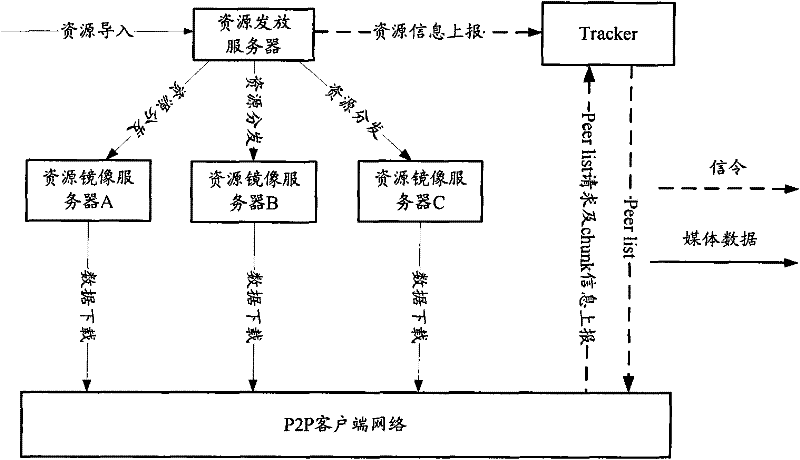


Examples
Embodiment 1
[0081] This embodiment describes the implementation process of the adaptive prefetch mechanism. The adaptive prefetching mechanism obtains the access probability of each chunk of the resource accessed by the user by counting the user's past viewing behavior, and then obtains the shortage degree of each chunk based on the probability distribution and the number of resource chunks requested by the client in the network. , and finally, on the premise of ensuring smooth playback on the client side, chunk prefetch is triggered according to the shortage of chunks, and finally balance the supply and demand relationship of chunks in each location of the resource.
[0082] image 3 A VoD system architecture using an adaptive prefetch mechanism is shown. like image 3 As shown, the main nodes involved in the system architecture and their functions may include:
[0083] The user log server is a newly added node device in the existing VoD system according to the embodiment of the prese...
Embodiment 2
[0131] This embodiment describes the implementation process of the adaptive load balancing mechanism. The adaptive load balancing mechanism estimates the future viewing and sharing conditions of each resource (such as a movie) based on the user's viewing behavior and sharing behavior, and dynamically balances the resources on the mirror server of each resource. Resource distribution to improve the utilization of storage resources and upload bandwidth resources of each resource mirror server.
[0132] Image 6 A VoD system architecture using an adaptive load balancing mechanism is shown. like Image 6 As shown, the main nodes involved in the system architecture and their functions may include:
[0133] The user log server is a newly added node device in the existing VoD system according to the embodiment of the present invention. The user log server can collect user viewing behavior information and sharing behavior information from Tracker, and perform statistical processin...
Embodiment 3
[0196] This embodiment can be obtained by combining Embodiment 1 and Embodiment 2, that is, adopting the adaptive prefetching mechanism of Embodiment 1 on the client side and adopting the adaptive load balancing mechanism of Embodiment 2 on the server side respectively.
[0197] The P2P system architecture involved in this embodiment can be as follows Figure 9 shown, where:
[0198] A user log server can have two functions:
[0199] (1) Count the number of viewers and sharers at each time for each resource, estimate the viewing and sharing status of users of each resource for a period of time in the future (such as the next day), and feed back to the resource distribution server;
[0200] (2) Periodically (for example, every 5 minutes) receive the viewing behavior logs of each movie user from the Tracker, count the user’s viewing behavior in each resource, generate a user viewing behavior statistics log for each movie, and periodically feed back to the Tracker.
[0201] The...
PUM
 Login to View More
 Abstract
Description
Claims
Application Information
 Login to View More