Unlock instant, AI-driven research and patent intelligence for your innovation.
Method of processing and mass-producing green whole grains
What is Al technical title?
Al technical title is built by PatSnap Al team. It summarizes the technical point description of the patent document.
A mass production and processing method technology, applied in the field of ), can solve the problems of high whole grain glutinous barley, lack of nutrition, poor taste in food, etc., and achieve the effect of overcoming seasonal restrictions, preventing adult diseases, and improving international competitiveness.
Inactive Publication Date: 2012-09-26
THE IND & ACADEMIC COOP IN CHUNGNAM NAT UNIV (IAC)
View PDF9 Cites 13 Cited by
Summary
Abstract
Description
Claims
Application Information
AI Technical Summary
This helps you quickly interpret patents by identifying the three key elements:
Problems solved by technology
Method used
Benefits of technology
Problems solved by technology
However, due to the characteristics of barley, the taste is not soft and has a slightly bitter taste, so the taste of food is also poor, so although it is used as a health food, the actual consumption has not increased
As a result, if you want to use it as a health food, there is a limit to the use as a food in the state where the important nutritional components of whole grain barley (whole grain barley) have disappeared, such as bran and grain germ.
[0004] In addition, for food use, although the breeding and development of sticky glutinous naked barley (Chalssalbori) with a slightly reduced rough texture is eaten, but it is also impossible to eat whole grain glutinous barley with high nutrition without pounding and polishing the rice.
Folk breeders have developed a purple barley, which has attracted attention as a colored functional grain. However, this pigment is mainly contained in the bran of the whole grain, so most of the pigment layer disappears after the rice is pounded and polished. Difficult to ingest
[0005] Although this kind of whole grain is rich in nutrition, it is cumbersome to cook as a meal, and it is rough to eat and the taste is not soft. Therefore, due to indigestion, the intake is limited, so in order to be delicious and soft, the shaved (polished rice) contains It is used in the state of the bran of a lot of nutritious grains
Method used
the structure of the environmentally friendly knitted fabric provided by the present invention; figure 2 Flow chart of the yarn wrapping machine for environmentally friendly knitted fabrics and storage devices; image 3 Is the parameter map of the yarn covering machine
View more
Image
Smart Image Click on the blue labels to locate them in the text.
Viewing Examples
Smart Image
Click on the blue label to locate the original text in one second.
Reading with bidirectional positioning of images and text.
Smart Image
Examples
Experimental program
Comparison scheme
Effect test
Embodiment 1
[0048] On October 30 of the previous year (suitable sowing date), the new glutinous naked barley (Saechalssalbori) variety was sown on 1,200 pyeong in the plains of Gunsan District, Jeollabuk-do. May 20th (wax ripening period) confirmed the mature state of the caryopsis, judged that May 22nd (20th day after earing) was the most appropriate harvesting day, and harvested about Completed in 1 hour and a half. The weight of the green barley harvested at this time is 3,100 kg, which is relatively heavier than the average weight of 2,400 kg of barley harvested in the same area in the yellow ripening period, because the barley in the green state has more water content.
[0049] And, usually on the above-mentioned same area, it takes about 50 minutes to cut the barley in the yellow ripening period by the harvester, but it is not easy to cut the barley leaves, trunks, etc. of the barley in the green ripening state, so the cutting rotation speed ratio of the harvester is adjusted The r...
Embodiment 2
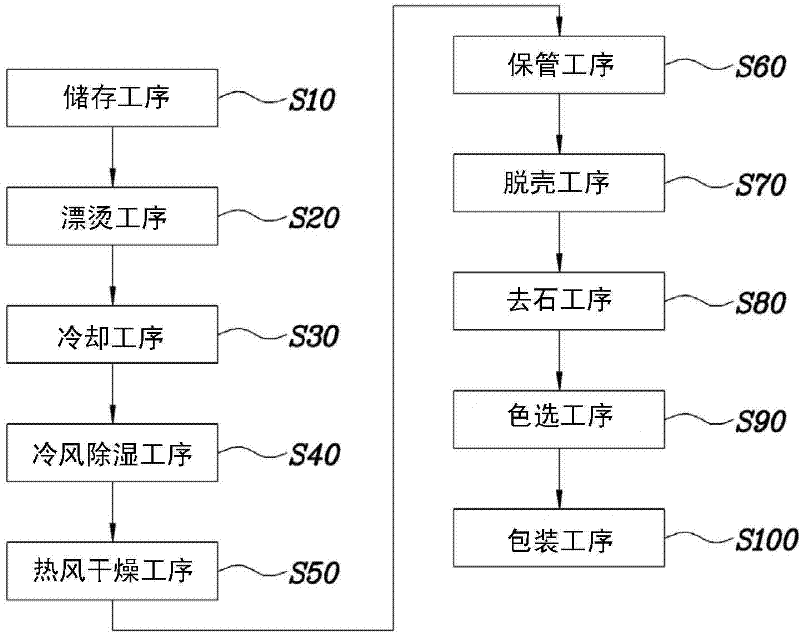
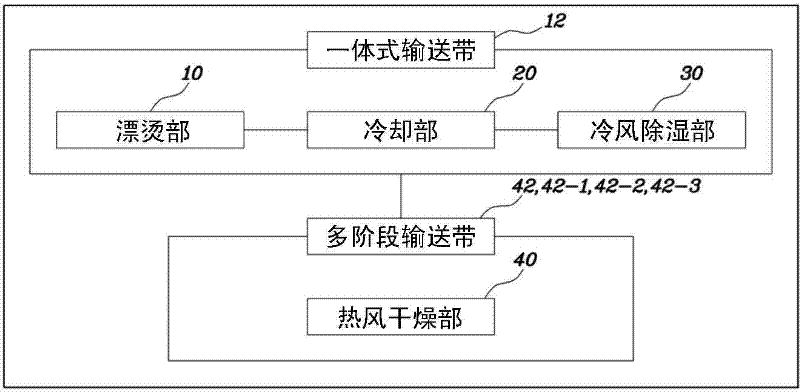
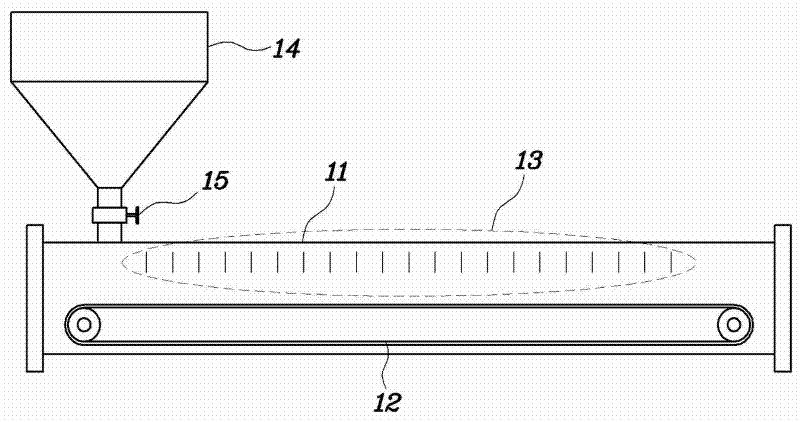
[0091] In Example 2, the blanching step S20, the cooling step S30, and the cold air dehumidification step S40 were implemented under the following conditions. For reference, in the blanching process S20, the cooling process S30, and the cold wind dehumidification process S40, the steel mesh conveyor belt used as a device for transferring green whole grains is composed of an integrated conveyor belt 12 that is continuously connected to each other, so that the above-mentioned processes are continuous. conduct.
[0092] 1. Processing objects (species): Hwanggeum-noeul, Hopum, Samgwang, Dongjin-chal, Boseok-chal, The green whole grain of Baekok-chal rice was used as the processing object.
[0093] 2. Blanching process: a steel mesh conveyor belt is used as the transfer device for the green whole grains, and the green whole grains are laminated on the conveyor belt with a thickness of 2.5 cm and passed through the steam channel 11 of 3.5 m. Also, steam at 100±1.5° C. was used t...
the structure of the environmentally friendly knitted fabric provided by the present invention; figure 2 Flow chart of the yarn wrapping machine for environmentally friendly knitted fabrics and storage devices; image 3 Is the parameter map of the yarn covering machine
Login to View More
PUM
Login to View More
Abstract
The invention relates to a method of processing and mass-producing green whole grains. According to the method of processing and mass-producing green whole grains of the present invention, the green whole grains is so smooth and chewy that they can be convenient to eat. Further, since the green whole grains are tinged with clear green, they can provide freshness visually. Furthermore, their nutrients are very so abundant that green whole grains good for health and prevention of adult diseases can be processed and mass-produced. The method of processing and mass-producing green whole greens, is characterized by comprising: a blanching step of discharging the green whole grains stored in the storage tank and steaming the discharged green whole grains for 30 to 120 seconds with water or steam at a temperature ranging from 88 to 102 DEG C.; a cooling step of rapidly cooling the green whole grains which have undergone the blanching step at a temperature ranging from 1 to 7 DEG C.; a cold air dehumidifying step of blowing air to the green whole grains cooled to a low temperature through the cooling step to remove excessive moisture permeated into surfaces of the green whole grains; and a hot air drying step of applying hot air of a low temperature ranging from 35 to 50 DEG C. to the green whole grains from which the excessive moisture has been removed through the cold air dehumidifying step to dry the green whole grains.
Description
technical field [0001] The present invention relates to a method for processing green whole grains so that they can be eaten, and more particularly to a green whole grains (during the yellow ripening stage) that cannot be eaten without rice milling (polished rice or pounded rice) before being used as edible or food materials. The green state whole grain harvested in the previous green ripening period), and the processing and mass production method of the green whole grain that can be mass-produced further. Background technique [0002] Green whole grains (Green Whole Grain) means green grains including green naked barley, green wheat, green rice, and green oats that have not been milled. They are usually used as staple food and are harvested in the yellow ripening period when the rice is fully mature. And after the process of threshing, drying, rice milling or pounding, it is provided as food. On the contrary, the green whole grains are before the grains of barley, wheat, ri...
Claims
the structure of the environmentally friendly knitted fabric provided by the present invention; figure 2 Flow chart of the yarn wrapping machine for environmentally friendly knitted fabrics and storage devices; image 3 Is the parameter map of the yarn covering machine
Login to View More
Application Information
Patent Timeline
Application Date:The date an application was filed.
Publication Date:The date a patent or application was officially published.
First Publication Date:The earliest publication date of a patent with the same application number.
Issue Date:Publication date of the patent grant document.
PCT Entry Date:The Entry date of PCT National Phase.
Estimated Expiry Date:The statutory expiry date of a patent right according to the Patent Law, and it is the longest term of protection that the patent right can achieve without the termination of the patent right due to other reasons(Term extension factor has been taken into account ).
Invalid Date:Actual expiry date is based on effective date or publication date of legal transaction data of invalid patent.



 Login to View More
  Login to View More