Molecule labeling method for maker-assisted selection of pig backfat thickness
What is AI technical title?
AI technical title is built by PatSnap AI team. It summarizes the technical point description of the patent document.
A marker-assisted selection and molecular marker technology, applied in biochemical equipment and methods, microbial determination/inspection, etc.
Inactive Publication Date: 2012-10-10
SUN YAT SEN UNIV
View PDF2 Cites 17 Cited by
Summary
Abstract
Description
Claims
Application Information
AI Technical Summary
This helps you quickly interpret patents by identifying the three key elements:
Problems solved by technology
Method used
Benefits of technology
Problems solved by technology
Fu Mao et al. (2002) also found that the deletion of base A at position 1457 of the CARTgene was not significantly associated with the occurrence of obesity in Chinese people by PCR-SSCP method
Method used
the structure of the environmentally friendly knitted fabric provided by the present invention; figure 2 Flow chart of the yarn wrapping machine for environmentally friendly knitted fabrics and storage devices; image 3 Is the parameter map of the yarn covering machine
View more
Image
Smart Image Click on the blue labels to locate them in the text.
Viewing Examples
Smart Image
Click on the blue label to locate the original text in one second.
Reading with bidirectional positioning of images and text.
Smart Image
Examples
Experimental program
Comparison scheme
Effect test
Embodiment 1
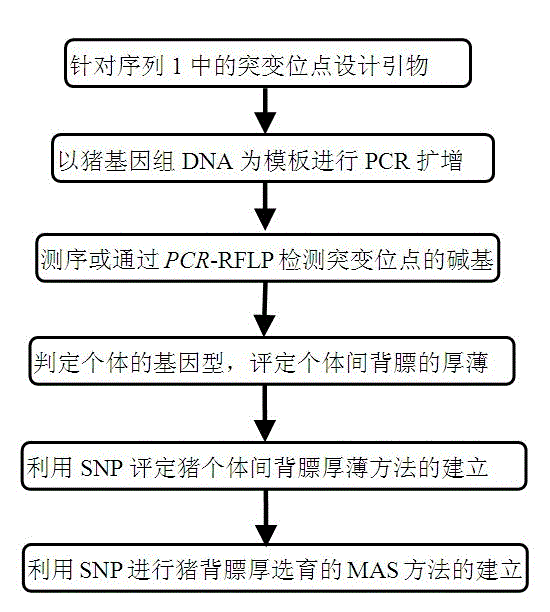
[0032] Example 1 Acquisition and polymorphism analysis of the DNA sequence where the SNP is used to assess the thickness of pig backfat
[0033] The DNA sample used for the SNP detection comes from the genome of the pig, which can be collected by collecting the saliva or hair follicles of the pig and then referring to the conventional method to extract the genomic DNA and then store it at -20°C for future use.
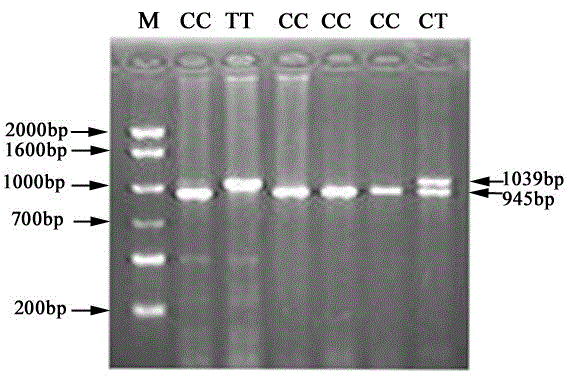
[0034] Primers PCAL / PCAR were designed according to the sequence 1 in the sequence listing, they are respectively located in the second display (Exon 2) and the third exon (Exon 3) regions of the gene, and the primer sequences are as follows:
[0035] SEQ ID NO: 3:
[0036] PCAL: 5'-GATTGAAGCGCTGCAGGAAGTC-3'
[0037] SEQ ID NO: 4:
[0038] PCAR: 5'-CAGGAGGAAGGAATTGCAGGAG-3'
[0039] The length of the primer amplified fragment is 1039bp, which is located on the second intron of the pig CARTgene, that is, the nucleotide fragment at the 5' end of the sequence in SEQ I...
Embodiment 2
[0052] Example 2 Landrace × Blue Tang F 2 Association analysis of marker genotypes and traits in resource populations
[0053] The DNA sample used for the detection of this single nucleotide polymorphism came from Changbai×Lantang F 2 Resource population, a total of 230 DNA samples. Genomic DNA was extracted by conventional methods and stored at -20°C for future use.
[0054] First, establish the following analysis model to eliminate the influence of gender, weight and batch on phenotype values:
[0055] the y ijkl =μ+s i +b j +g k + r i Cov W +e ijkl
[0056] Among them, y ijkl is the observed value of the trait, μ is the least square mean, s i is the sex effect (i=1 is boar, i=2 is sow), b j is the batch effect (j=1~4), g k Genotype effect (k = CC, CT and TT), r i is the regression coefficient of the covariate, Cov w is the covariate of live body weight before slaughter, e ijkl for the error. Assumed to obey the N (0, σ2) distribution.
[0057] Applying th...
the structure of the environmentally friendly knitted fabric provided by the present invention; figure 2 Flow chart of the yarn wrapping machine for environmentally friendly knitted fabrics and storage devices; image 3 Is the parameter map of the yarn covering machine
Login to View More
PUM
Login to View More
Abstract
The invention discloses a molecule labeling method for maker-assisted selection of pig backfat thickness. Through determination of a nucleotide at the 650th locus of a 5' end of a sequence of SEQ ID NO: 1 and a nucleotide at the 95th locus of a 5' end of a sequence of SEQ ID NO: 2, genotypes of the 650th and the 95th loci of a pig are determined so that the backfat thickness of the same type or variety of pigs can be determined. The molecule labeling method for maker-assisted selection of pig backfat thickness can be used for detecting thickness of backfat between the 6th and the 7th ribs of a living pig, thickness of backfat located at the last rib of a living pig, average thickness of backfat of a living pig, and average thickness of backfat of a pig carcass thereby showing the shape and the thickness of pig backfat and thus through maker-assisted selection, pig backfat thickness is reduced; a pig lean meat ratio is improved; and novel important molecular markers are provided. The molecule labeling method for maker-assisted selection of pig backfat thickness plays an important role in pig breeding.
Description
technical field [0001] The invention belongs to the field of biotechnology, and relates to a molecular marker method for assessing pig backfat thickness by using single nucleotide polymorphisms of genes and used for marker-assisted selection of pig backfat thickness. Background technique [0002] The principles and methods of modern quantitative genetics have achieved great success in the application of pig breeding practice, and today it is still an essential selection method for some quantitative traits with high heritability and continuous normal distribution. But for low heritability traits, such as sow litter size, the selection response is not ideal. In addition, most economically important traits cannot be identified until adulthood, which undoubtedly increases the generation interval and reduces the amount of annual genetic improvement. Therefore, animal genetic breeders find genetic differences of traits or genetic markers linked to quantitative traits at the molec...
Claims
the structure of the environmentally friendly knitted fabric provided by the present invention; figure 2 Flow chart of the yarn wrapping machine for environmentally friendly knitted fabrics and storage devices; image 3 Is the parameter map of the yarn covering machine
Login to View More
Application Information
Patent Timeline
Application Date:The date an application was filed.
Publication Date:The date a patent or application was officially published.
First Publication Date:The earliest publication date of a patent with the same application number.
Issue Date:Publication date of the patent grant document.
PCT Entry Date:The Entry date of PCT National Phase.
Estimated Expiry Date:The statutory expiry date of a patent right according to the Patent Law, and it is the longest term of protection that the patent right can achieve without the termination of the patent right due to other reasons(Term extension factor has been taken into account ).
Invalid Date:Actual expiry date is based on effective date or publication date of legal transaction data of invalid patent.



 Login to View More
  Login to View More