
Digital modulation signal identifying method under non-gaussian noise in cognitive radio
A digital modulated signal, cognitive radio technology, applied in the field of communication, can solve the problems of high computational complexity, unsuitable for cognitive radio systems, poor recognition performance, etc., to achieve low computational complexity, reduced computational complexity, and high recognition. rate effect
- Summary
- Abstract
- Description
- Claims
- Application Information
AI Technical Summary
Problems solved by technology
Method used
Image

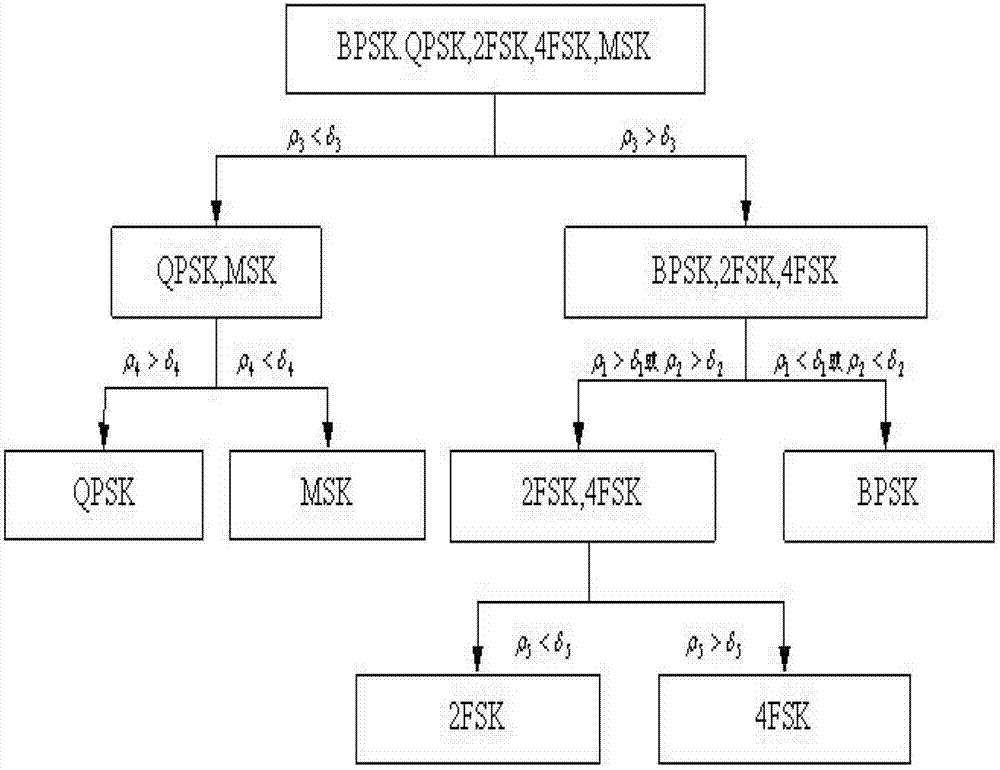
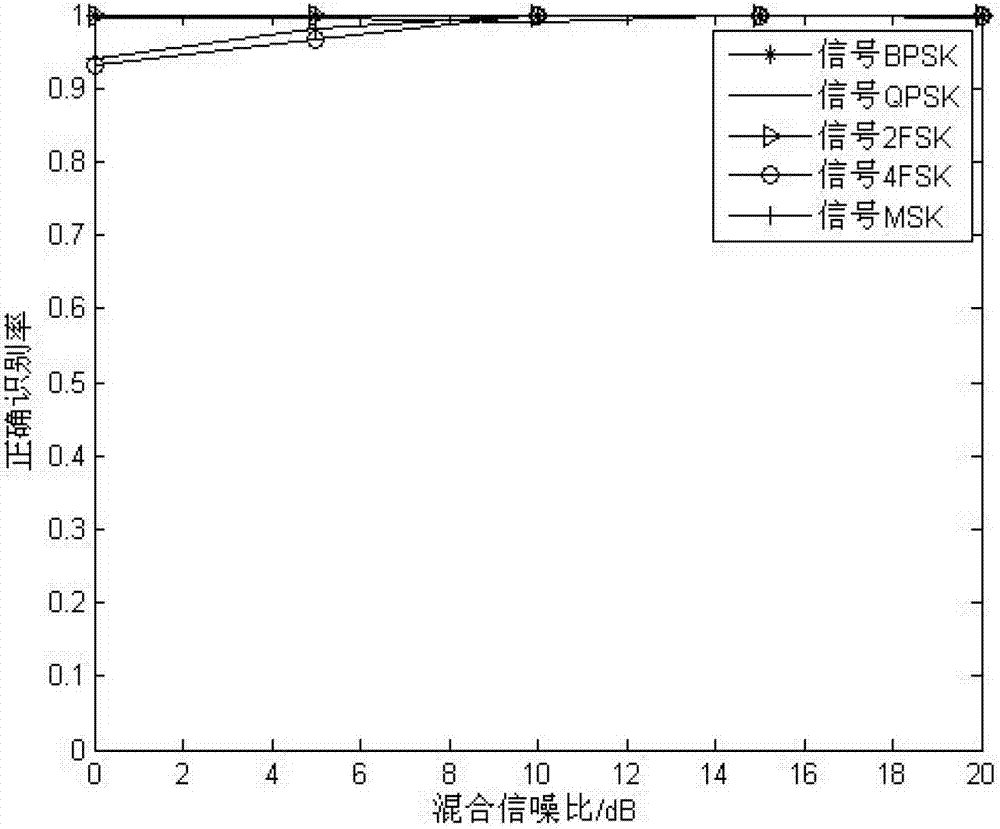
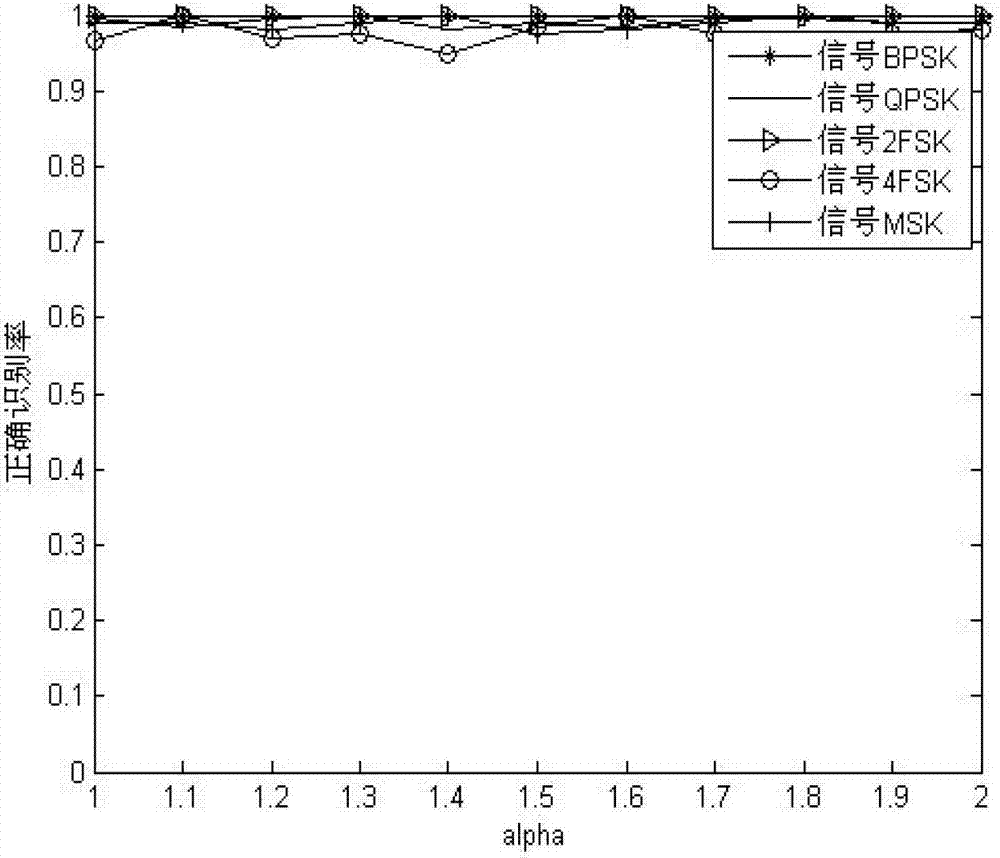
Examples
Embodiment Construction
[0024] The specific implementation steps of the present invention are as follows:
[0025] Step 1. Sampling the received signal y(t) to obtain y[n];
[0026] Step 2. Calculate the fractional low-order cyclic spectrum of y[n]
[0027] For T 0 Is a periodic cyclostationary random signal x(t), and its fractional low-order cyclic autocorrelation function is expressed as:
[0028] R x ϵ ( τ ) = 1 T 0 ∫ - T 0 / 2 T 0 / 2 [ x ( t + τ / 2 ) ] ( b ) [ x * ( t - τ / 2 ) ] ( b ) · e - j 2 πϵt dt
[0029] Where x (b) =|x| b-1 ·X * , * Means conjugate operation, this operation only changes the amplitude of the signal without changing the period information, so the cyclic frequency defined under the second-order cyclic correlation is also suitable for the fractional low-order cyclic correlation; 0 Fourier transform It is called the fractional low-or...
PUM
 Login to View More
 Abstract
Description
Claims
Application Information
 Login to View More