Tail-biting convolution code decoding method
A tail-biting convolutional code and decoding technology, which is applied in the direction of using convolutional code error correction/error detection, data representation error detection/correction, etc., can solve high complexity, low storage space utilization, a large number of stacking, Stack operation and other issues to achieve the effect of reducing complexity and solving algorithm non-convergence
- Summary
- Abstract
- Description
- Claims
- Application Information
AI Technical Summary
Problems solved by technology
Method used
Image



Examples
Embodiment 1
[0019] For tail-biting convolutional codes, the initial state of the encoder is initialized with the last few bits of information bits, so that when the encoding ends, the end state of the encoder is consistent with the initial state, which is "tail-biting". ".
[0020] This embodiment provides a decoding method for a tail-biting convolutional code, which finds an optimal tail-biting path by executing a cyclic Viterbi algorithm. In the process of looping, there may be a situation where all surviving paths obtained by two loops are exactly the same, which is called a loop trap. The tail-biting convolutional code decoding method detects loop traps, and speeds up the convergence speed of the algorithm by effectively processing the loop traps.
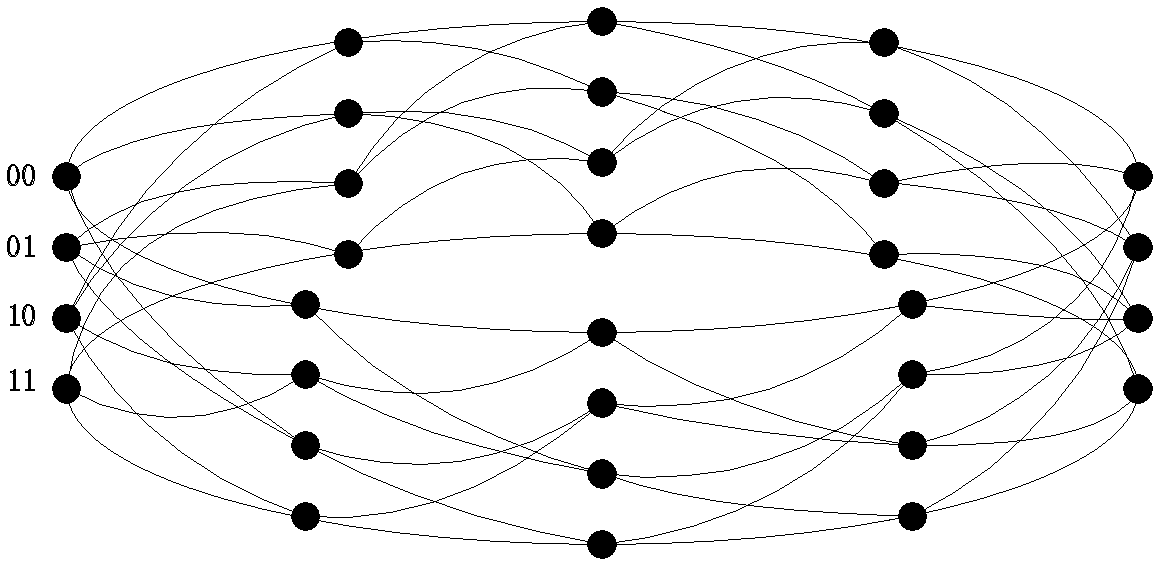
[0021] Such as figure 1 The trellis diagram shown is obtained by a convolutional encoder whose generator polynomial is {7, 5} (octal). There are 4 states at each position k, and the total length of the trellis diagram is L=8, that is, 0...
Embodiment 2
[0042] In this embodiment, the tail-biting convolution decoding method described in the present invention is recorded as a low-complexity maximum likelihood decoding algorithm (reduced-complexity maximum likelihood decoder, RC-MLD), and it is compared with the WAVA algorithm, The WAVA algorithm uses a simple termination condition. This embodiment compares the block error rate performance (BLER) and required average number of iterations (ITER) of RC-MLD and WAVA.
[0043] The simulation condition is: an AWGN channel, and the coded bits are modulated by quadriphase shift keying (quadri phase shift keying, QPSK). For the WAVA algorithm, the maximum allowable number of iterations set in the simulation is N=20, for the RC-MLD method, since the theoretically possible maximum number of iterations is 2 v , so the following settings are made according to different application scenarios.
[0044] The first set of simulation experiments: compare the decoding performance of different de...
PUM
 Login to View More
 Abstract
Description
Claims
Application Information
 Login to View More
PatSnap Eureka turns technology decisions into work you can execute. Powered by our Innovation Knowledge Graph, it runs expert workflows across engineering, life sciences, materials and intellectual property. Get your review-ready output in minutes.


