
Image segmentation method based on organizational evolutionary cluster algorithm
An image segmentation and clustering algorithm technology, applied in the fields of image processing, pattern recognition and computer vision, which can solve the problems of unfavorable image analysis and understanding, slow convergence speed, sensitive to noise data, etc.
- Summary
- Abstract
- Description
- Claims
- Application Information
AI Technical Summary
Problems solved by technology
Method used
Image

Examples
Embodiment Construction
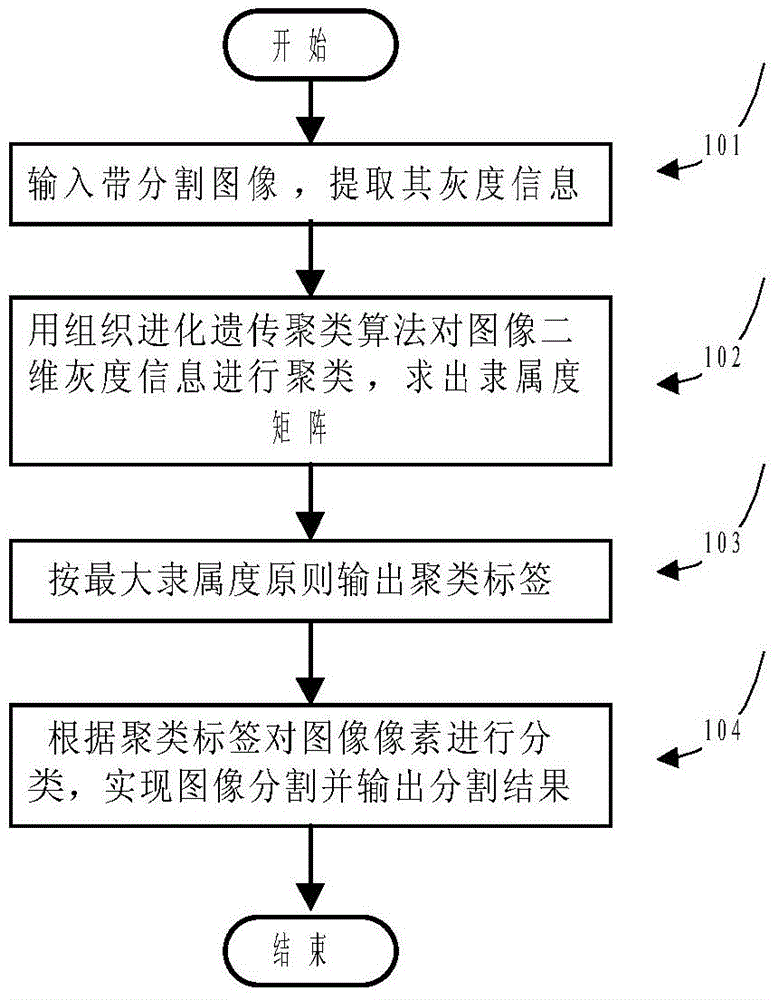
[0074] Such as figure 1 shown.
[0075] The main flowchart step features are:
[0076] Step 101: input the image to be segmented, and extract the grayscale information of the image to be segmented;
[0077] Step 102: applying the tissue evolution clustering algorithm to cluster the two-dimensional grayscale information of the image;
[0078] Step 103: According to the membership degree matrix output in step 102, output cluster labels according to the principle of maximum membership degree;
[0079] Step 104: According to the clustering labels output in step 103, classify the image pixels, implement image segmentation, and output the segmented image.
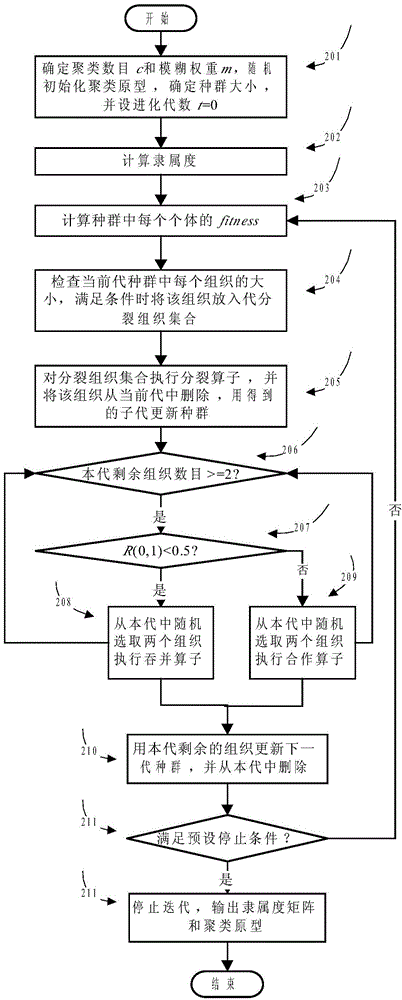
[0080] Such as figure 2 as shown,
[0081] Described step 102 includes the following steps:
[0082] Step 201: Determine the number of clusters c and the fuzzy weight m, and randomly initialize the cluster prototype, that is, randomly select the gray information of c pixels from the image to be segmented as the cluster cen...
PUM
 Login to View More
 Abstract
Description
Claims
Application Information
 Login to View More