AI technical title is built by Patsnap AI team. It summarizes the technical point description of the patent document.
A technology for elemental chlorine and wheat straw pulp, which is applied in pulp bleaching and other directions to achieve the effects of reducing pollution load, saving clean water and reducing waste water production.
Inactive Publication Date: 2014-12-03
CHINA NAT PULP & PAPER RES INST CO LTD
View PDF5 Cites 1 Cited by
Summary
Abstract
Description
Claims
Application Information
AI Technical Summary
This helps you quickly interpret patents by identifying the three key elements:
Problems solved by technology
Method used
Benefits of technology
Problems solved by technology
At present, there is no relevant process or technology that directly reuses the wastewater from the elemental chlorine-free bleaching of wheat straw pulp to the washing process water in the previous bleaching section without treatment.
Method used
the structure of the environmentally friendly knitted fabric provided by the present invention; figure 2 Flow chart of the yarn wrapping machine for environmentally friendly knitted fabrics and storage devices; image 3 Is the parameter map of the yarn covering machine
View more
Image
Smart Image Click on the blue labels to locate them in the text.
Viewing Examples
Smart Image
Click on the blue label to locate the original text in one second.
Reading with bidirectional positioning of images and text.
Smart Image
Examples
Experimental program
Comparison scheme
Effect test
Embodiment 1
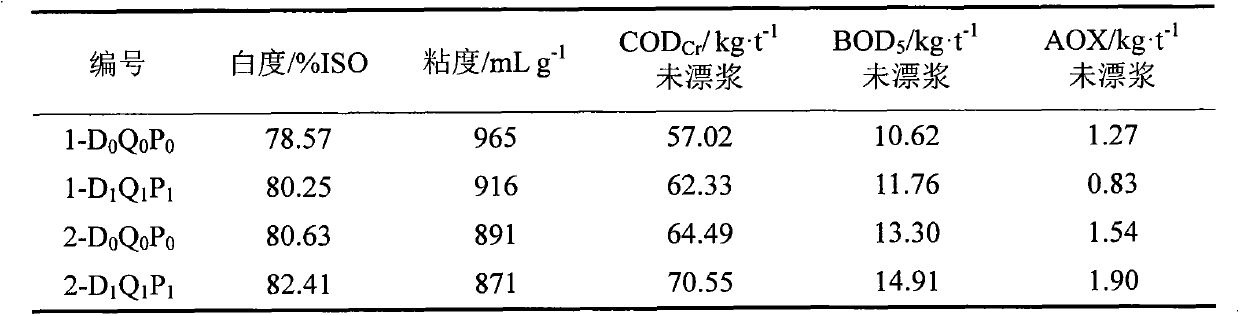
[0015] The process wastewater reuse test was conducted using the following bleaching conditions:
[0016] Section D: pulp concentration 10%, Kappa factor 0.15, H 2 SO 4 2%, time 60min, temperature 60℃;
[0017] Q segment: pulp concentration 10%, EDTA 0.2%, H 2 SO 4 0.5%, time 60min, temperature 70℃;
[0018] P segment: pulp concentration 10%, H 2 o 2 2.0%, NaOH 1.0%, time 180min, temperature 90°C.
[0020] D. 0 , Q 0 ,P 0 After each stage of bleaching, take the wastewater from the three stages of bleaching and mix them in proportion to detect the COD of the wastewater Cr 、BOD 5 , AOX, and detect P alone 0 Wastewater COD Cr 、BOD 5 , AOX; detection of pulp whiteness and viscosity after bleaching.
[0022] D. 1 After bleaching, reuse P 0 The washing wastewater of bleached pulp to D 1 After stage bleaching, the pulp is concentrated to 1% pulp concentration. After the pulp is fully mixed ...
Embodiment 2
[0025] The process wastewater reuse test was conducted using the following bleaching conditions:
[0026] Section D: pulp concentration 10%, Kappa factor 0.20, H 2 SO 4 2%, time 60min, temperature 60℃;
[0027] Section Q: pulp concentration 10%, EDTA 0.2%, H 2 SO 4 0.5%, time 60min, temperature 70℃;
[0028] P segment: pulp concentration 10%, H 2 o 2 2.0%, NaOH 1.0%, time 180min, temperature 90°C.
[0030] D. 0 , Q 0 ,P 0 After each stage of bleaching, take the wastewater from the three stages of bleaching and mix them in proportion to detect the COD of the wastewater Cr 、BOD 5 , AOX, and detect P alone 0 Wastewater COD Cr 、BOD 5 , AOX; detection of pulp whiteness and viscosity after bleaching.
[0031] 2) 2-D 1 Q 1 P 1 bleach
[0032] D. 1 After bleaching, reuse P 0 The washing wastewater of bleached pulp to D 1 After stage bleaching, the pulp is concentrated to 1.5% pulp concentration. After the pulp is fully mixe...
the structure of the environmentally friendly knitted fabric provided by the present invention; figure 2 Flow chart of the yarn wrapping machine for environmentally friendly knitted fabrics and storage devices; image 3 Is the parameter map of the yarn covering machine
Login to View More
PUM
Login to View More
Abstract
The invention discloses a wheat straw pulp elemental-chlorine-free bleaching wastewater recycling method which is characterized in that a paper pulp bleaching mode is DQP three-section bleaching, and the whole washing wastewater of pulp from hydrogenperoxide (P) section bleaching is reused, without being processed, in washing pulp from chlorine dioxide (D) section bleaching. The specific method is as follows: after the washing wastewater of pulp from the P section bleaching is reused in the D section bleaching, the pulp is diluted to the washing pulp concentration of 0.5-2%; the pulp is fully mixed and washed and then is concentrated to 15-18%; and the concentrated pulp is diluted with clear water and then is processed in a Q section. The amount of residual bleached chemicals in washing water from the P section is no less than 40%. By the method of directly recycling P-section bleaching wastewater in washing pulp from D-section bleaching without being processed, water consumption during the wheat strawpulp bleaching process and yield of bleaching wastewater can be reduced effectively. In addition, dosage of a bleaching agent can be decreased remarkably, pollution load can be reduced, and performance of the bleached pulp is basically not influenced. Heat energy of wastewater from the P section also can be utilized, and energy consumption of the bleaching section can be reduced effectively.
Description
technical field [0001] The invention relates to a method for recycling waste water from elemental chlorine-free bleaching of wheat straw pulp, in particular to a method in which the washing waste water of wheat straw pulp DQP bleached P-stage bleached pulp is fully reused for washing the D-stage bleached pulp without treatment. Background technique [0002] Wheat straw pulp has always been an important part of raw materials in my country's pulp and paper industry, but the scale of my country's wheat straw pulp production enterprises is generally small, the level of technical equipment and technology is generally low, the level of clean technology is relatively backward, and the pollution load per unit product is relatively high. At present, chlorine-containing bleaching agents are mostly used for bleaching wheat straw pulp, which not only produces high loads of COD Cr 、BOD 5 , and produce carcinogenic and mutagenic adsorbable organic chloride AOX; at the same time, the conc...
Claims
the structure of the environmentally friendly knitted fabric provided by the present invention; figure 2 Flow chart of the yarn wrapping machine for environmentally friendly knitted fabrics and storage devices; image 3 Is the parameter map of the yarn covering machine
Login to View More
Application Information
Patent Timeline
Application Date:The date an application was filed.
Publication Date:The date a patent or application was officially published.
First Publication Date:The earliest publication date of a patent with the same application number.
Issue Date:Publication date of the patent grant document.
PCT Entry Date:The Entry date of PCT National Phase.
Estimated Expiry Date:The statutory expiry date of a patent right according to the Patent Law, and it is the longest term of protection that the patent right can achieve without the termination of the patent right due to other reasons(Term extension factor has been taken into account ).
Invalid Date:Actual expiry date is based on effective date or publication date of legal transaction data of invalid patent.


 Login to View More
  Login to View More