
A bacterial cellulose membrane/porous carbon adsorbent and its preparation
A technology of bacterial cellulose membrane and adsorbent, which is applied in the field of bacterial cellulose membrane/porous carbon adsorbent and its preparation, can solve the problems of not being able to strictly control air PM2.5, and achieve the effect of cheap raw materials
- Summary
- Abstract
- Description
- Claims
- Application Information
AI Technical Summary
Problems solved by technology
Method used
Image

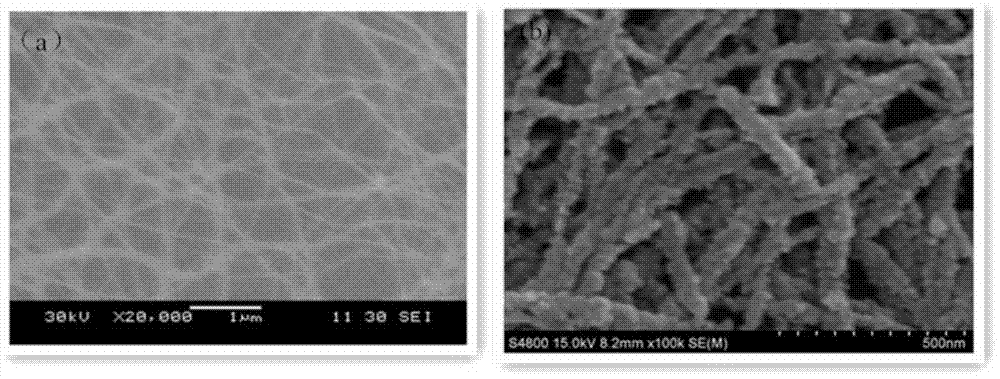
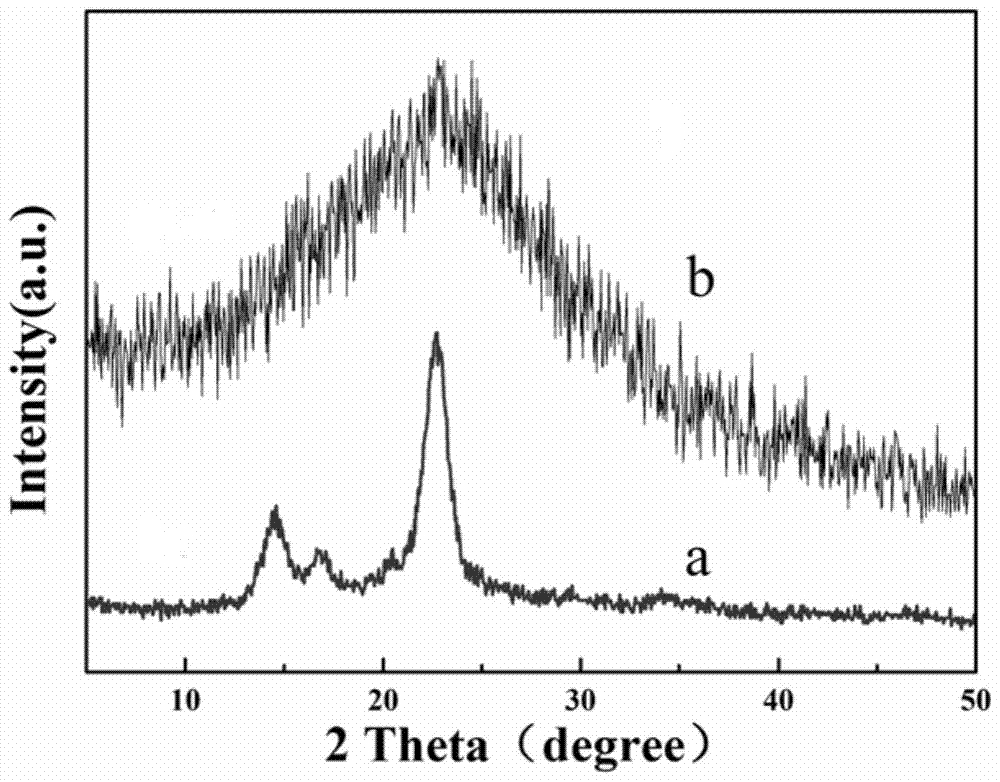
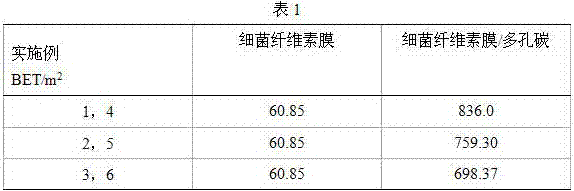
Examples
Embodiment 1
[0035] Step 1: Acetobacter xylinum is used for seed amplification, cultured on a shaking table, the culture temperature is 30°C, the speed of the shaker is 160 rpm, and the culture time is 36 hours;
[0036] Step 2: Add 10 g / L sodium carboxymethyl cellulose when preparing the fermentation broth; after the sodium carboxymethyl cellulose is completely dissolved, add 1 g / L calcium carbonate, sonicate for 60 minutes, and sterilize at 121°C for 20 minutes , cooled to room temperature;
[0037] Step 3: Acetobacter xylinum is inoculated with an inoculum of 8%, cultured after inoculation, and cultivated for 5 days;
[0038] Step 4: After the fermentation is over, use NaOH with a mass fraction of 3 g / L and H at 3 g / L 2 o 2 Water bath at 80°C for 3.0 hours to remove residual cells and fermentation broth;
[0039] Step 5: Soak the BC membrane with 20 g / L acetic acid for 24 h to remove the calcium carbonate embedded in the cellulose network;
[0040] Step 6: Rinse the BC membrane with...
Embodiment 2
[0042] The first step: Acetobacter xylinum is used for seed amplification, cultured on a shaker, the culture temperature is 29°C, the speed of the shaker is 160rpm, and the culture time is 36 hours;
[0043] Step 2: Add 10 g / L sodium carboxymethyl cellulose when preparing the fermentation broth; after the sodium carboxymethyl cellulose is completely dissolved, add 3 g / L calcium carbonate, sonicate for 20 minutes, and sterilize at 115°C for 25 minutes , cooled to room temperature;
[0044] Step 3: Acetobacter xylinum is inoculated with an inoculum of 8%, cultured after inoculation, and cultivated for 5 days;
[0045] Step 4: After the fermentation is over, use 4 g / L of NaOH and 4 g / L of H 2 o 2 Water bath at 85°C for 2.0 hours to remove residual cells and fermentation broth;
[0046] Step 5: Soak the BC membrane with 30 g / L acetic acid for 24 h to remove the calcium carbonate embedded in the cellulose network;
[0047] Step 6: Rinse the BC membrane with deionized water unti...
Embodiment 3
[0049] The first step: Acetobacter xylinum is used for seed amplification, cultured on a shaking table, the culture temperature is 31°C, the speed of the shaker is 160 rpm, and the culture time is 42 hours;
[0050] Step 2: Add 15 g / L sodium carboxymethyl cellulose when preparing the fermentation broth; after the sodium carboxymethyl cellulose is completely dissolved, add 4 g / L calcium carbonate, sterilize at 121°C for 15 minutes, and cool to room temperature;
[0051] The third step: Acetobacter xylinum is inoculated with 10% inoculation amount, and after inoculation, it is cultured statically and cultivated for 7 days;
[0052] Step 4: After the fermentation is over, use a NaOH solution with a mass fraction of 5 g / L and 5 g / L of H 2 o 2 Water bath at 75°C for 3.0 hours to remove residual cells and fermentation broth;
[0053] Step 5: Soak the BC membrane with 40 g / L acetic acid for 36 h to remove the calcium carbonate embedded in the cellulose network;
[0054] Step 6: R...
PUM
| Property | Measurement | Unit |
|---|---|---|
| pore size | aaaaa | aaaaa |
| pore size | aaaaa | aaaaa |
Abstract
Description
Claims
Application Information
 Login to View More