
Short-term traffic flow forecasting method based on three-layer K nearest neighbor
A technology of short-term traffic flow and prediction method, which is applied in the field of short-term traffic flow prediction based on three-layer K-nearest neighbors, which can solve the problems of uncertainty, complex traffic flow prediction, low stability, and complex algorithm.
Patent Information
- Authority / Receiving Office
- CN · China
- Patent Type
- Applications(China)
- Current Assignee / Owner
- Publication Date
- 2016-02-17
Smart Images
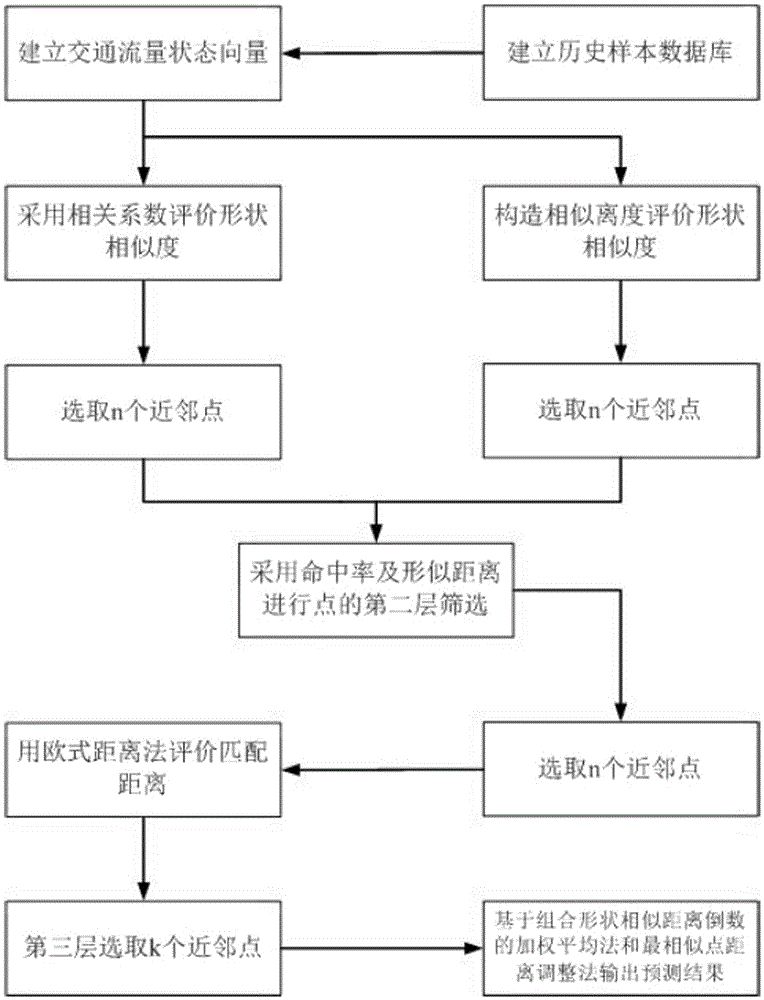
Figure 1 
Figure 2 
Figure 3
Abstract
Description
technical field
[0001] The present invention relates to a short-term traffic flow prediction method, and more specifically, to a short-term traffic flow prediction method based on three-layer K-nearest neighbors. Background technique
[0002] With the development of social economy and the continuous expansion of city scale, urban traffic problems are becoming more and more prominent. Intelligent transportation system is regarded as an important means to solve the problem of traffic congestion. With the advancement of relevant technologies in various fields of intelligent transportation, both traffic travelers and traffic managers are eager to obtain real-time and dynamic traffic operation status on the road. Real-time dynamic traffic allocation has become a key technology of intelligent transportation systems. Real-time dynamic traffic allocation needs to predict the traffic flow at the next decision-making time t+1 and several moments later at the time t when the control v...
Examples
Embodiment Construction
[0054] The present invention will be further described below in conjunction with the accompanying drawings and embodiments.
[0055] Such as figure 1 As shown, the flow chart of the short-term traffic flow prediction method based on the three-layer K-nearest neighbors of the present invention is provided, which is realized by the following steps:
[0056] a). Establish a historical sample database, and establish m historical traffic flow state vectors V of the road section to be predicted according to the historical traffic flow of the road section to be predicted h1 , V h2 ,...,V hm , forming a historical sample database, where the historical traffic flow state vector is shown in formula (1):
[0057] V hi =[v hi (t-l+1), v hi (t-l+2),...,v hi (t)](1)
[0058] In the formula, 1≤i≤m, m is the number of historical traffic flow state vectors, v hi (t-l+1), v hi (t-l+2),...,v hi (t) are the historical traffic flow state vector V hi In t-l+1, t-l+2,..., the traffic flo...