

Radar pulse repetition interval modulation recognition method based on multi-feature extraction
A technology of radar pulse and repetition interval, which is applied in the direction of reflection/re-radiation of radio waves, utilization of re-radiation, and measurement devices, etc., which can solve the problems of low recognition accuracy of PRI modulation methods of radar radiation sources, and few identifiable PRI modulation methods. , to achieve the effect of strong practical application value, high accuracy and good robustness
- Summary
- Abstract
- Description
- Claims
- Application Information
AI Technical Summary
Problems solved by technology
Method used
Image



Examples
specific Embodiment approach 1
[0031] Specific embodiment one: in conjunction with Fig. 1 and figure 2 To describe this embodiment,
[0032] The radar pulse repetition interval modulation identification method based on multi-feature extraction is characterized in that comprising the following steps:
[0033] Step 1: Measure the time of arrival TOA of the radar signal, perform a differential process on the time of arrival TOA sequence, and obtain the PRI sequence p(n) of the radar signal, n=0,1,2...N-1, where n is The serial number of the PRI, N is the length of the PRI sequence; PRI is the radar pulse repetition interval;
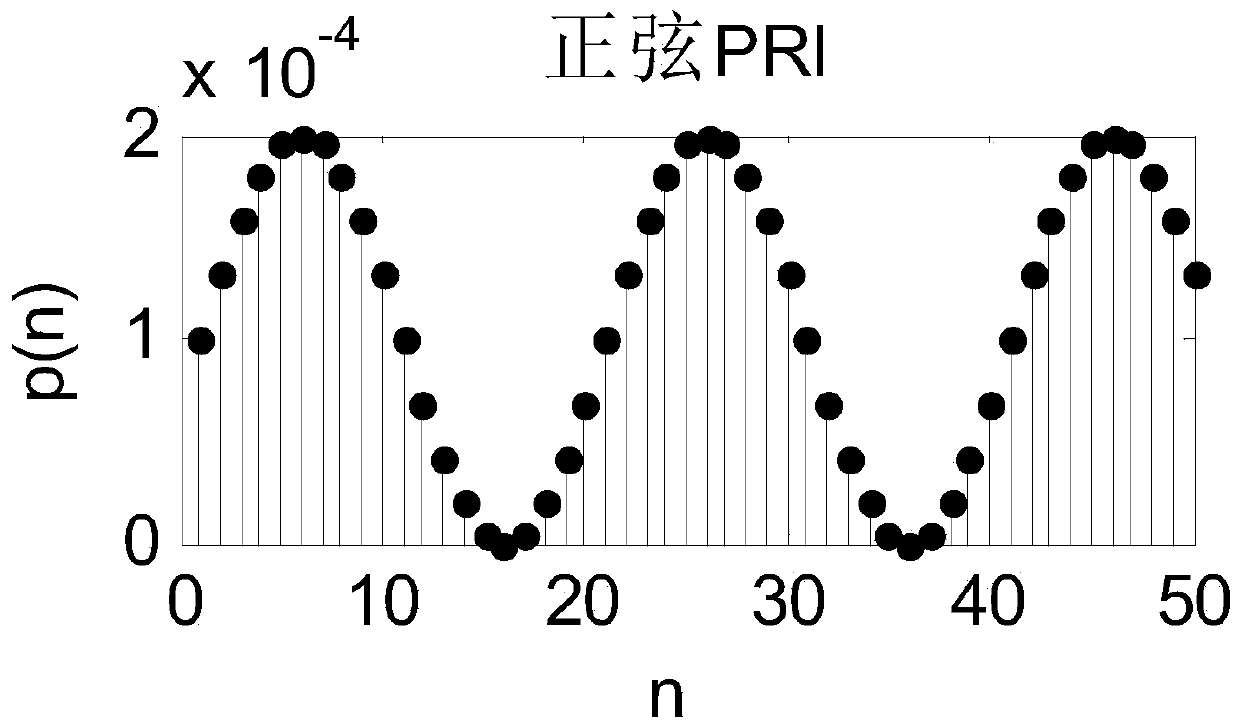
[0034] Step 2: According to the characteristics of the six modulation modes of the radar signal, including conventional PRI, staggered PRI, jitter PRI, slipping PRI, sinusoidal PRI and dwell and switch PRI, design the feature quantity for recognition:
[0035] The first characteristic quantity R 1 is the fundamental harmonic amplitude ratio;
[0036] The second characteristic quanti...
specific Embodiment approach 2
[0043] Specific implementation mode two: combination figure 2 To describe this embodiment,
[0044] The specific identification steps of Step 3 described in this embodiment are as follows:
[0045] Step 1: Press the PRI sequence of the radar signal obtained in step 1 to Make a judgment, where r 1 for R 1 Corresponding threshold value; when the result is 1, it is judged to be a sinusoidal PRI; otherwise it is judged to be an unidentified PRI sequence, and identification is continued;
[0046] Step 2: Press the unrecognized PRI sequence in step 1 Make a judgment, where r 21 and r 22 Respectively R 2 Corresponding threshold value; when the result is 1, it is judged to be a jitter PRI; otherwise it is judged to be an unidentified PRI sequence, and the identification is continued;
[0047]Step 3: Perform median filter processing with 3 points on the unrecognized PRI sequence in step 2, then perform pulse loss detection and compensation processing, and then press Make a...
specific Embodiment approach 3
[0053] The specific steps of pulse loss detection and compensation processing described in step 3 described in this embodiment are as follows:
[0054] The PRI value higher than 1.5 times of the average PRI is regarded as the wrong PRI value generated by the missing pulse, and the previous PRI value is taken as the correction value.
[0055] Other steps and parameters are the same as in the second embodiment.
PUM
 Login to View More
 Abstract
Description
Claims
Application Information
 Login to View More