
Potential energy cluster algorithm for automatically determining cluster center
An automatic determination and clustering algorithm technology, applied in the field of cluster analysis, can solve the problems of artificially setting the number of clusters and incomplete consideration of the allocation mechanism, and achieve good clustering effect, good clustering effect, and clustering accuracy high effect
- Summary
- Abstract
- Description
- Claims
- Application Information
AI Technical Summary
Problems solved by technology
Method used
Image

Examples
Embodiment Construction
[0042] In order to clarify the purpose, technical solutions and advantages of the present invention, the present invention will be further described in detail below in conjunction with specific embodiments and accompanying drawings.
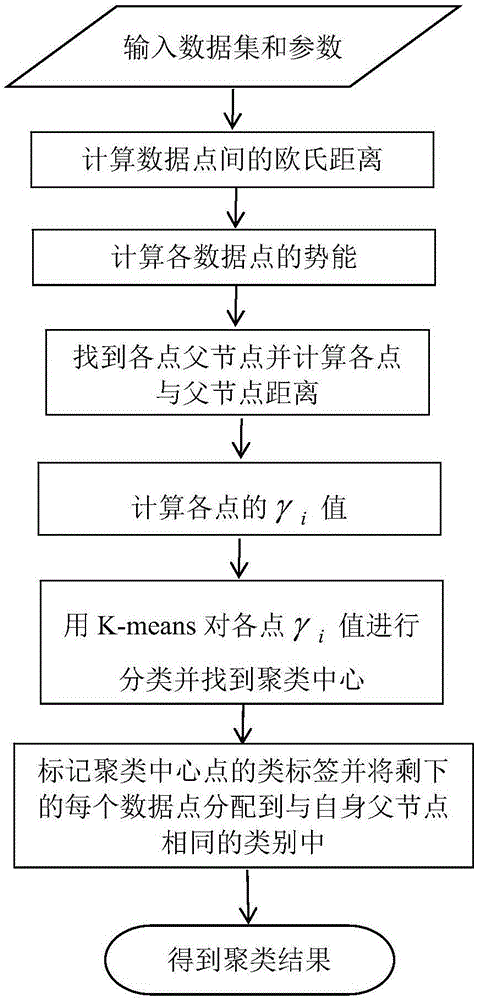
[0043] refer to figure 1 , the specific implementation process of the present invention comprises the following steps:
[0044] Step 1: first find the potential energy Φ of each data point i , where the potential energy Φ between every two points ij It is defined as follows:
[0045]
[0046] where r ij is the Euclidean distance between point i and point j, and δ is used to avoid the case where the denominator is zero. About δ:
[0047]
[0048] δ=mean(MinD i ) / S
[0049] where MinD i is the shortest distance from point i to other points, S is a scale factor, generally set to 10, and N is the number of data points. The potential energy Φ between every two points is calculated ij After that, the potential energy Φ of each point i ...
PUM
 Login to View More
 Abstract
Description
Claims
Application Information
 Login to View More