
Preparation method of microbial kelp degummed fermented feed and application thereof in stichopus japonicus culture
A fermented feed and microbial technology, applied in the field of preparation of low-cost and environment-friendly sea cucumber microbial degummed kelp fermented feed, to reduce damage, improve digestibility and utilization, and promote immunity
- Summary
- Abstract
- Description
- Claims
- Application Information
AI Technical Summary
Problems solved by technology
Method used
Image

Examples
Embodiment 1
[0020] Step 1: Pretreatment of feed ingredients, drying until the water content is not higher than 15%, and coarsely pulverizing to 100-200 mesh; among them, the feed ingredients are kelp meal, fish meal, sea mud, shell powder and compound vitamins and minerals.
[0021] Step 2: Weigh 5kg of kelp powder, 1kg of fish meal, 3kg of sea mud, 0.75kg of shell powder, 0.25kg of multivitamins and minerals;
[0022] Wherein, the compound vitamins and minerals have the same requirements as the basic feeds in the prior art for the added ingredients and quantity. A preferred way is provided here, the multivitamin and mineral components are (mg g -1 ): Thiamine hydrochloride 0.5, riboflavin 1.0, niacin 0.75, pyridoxine hydrochloride 1.5, B 12 0.05, calcium pantothenate 10, magnesium phosphate 50, choline chloride 200, vitamin K2, vitamin A acetate 0.6, vitamin E 10, α-cellulose 723.6; MgSO 4 -7H 2 O 100,ZnSO 4 -7H 2 O 3,CoCl 2 -6H 2 O 1,MnSO 4 -H 2 O 1,Al Cl 3 -6H 2 O 0.2, FeSO 4 -7H 2 O 30, CuC...
Embodiment 2
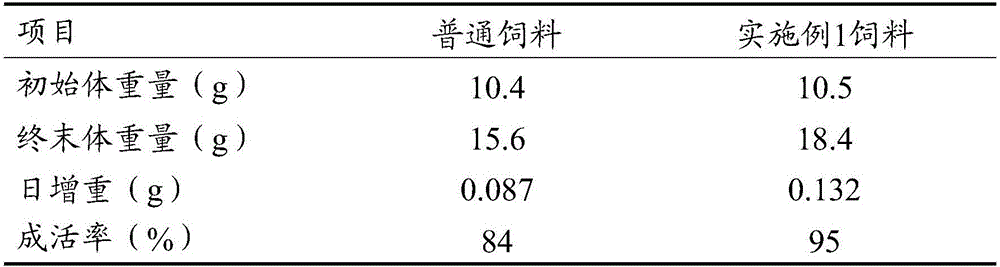
[0029] Healthy sea cucumbers of similar size were selected as experimental subjects. Investigate the difference between the fermented feed of the invention and the common sea cucumber feed on the growth performance of sea cucumbers. Among them, the common sea cucumber feed is produced by Dalian Sym Bioengineering Co., Ltd., and its components are 45% of Zostera powder, 25% of sea mud, 5% of fish meal, 20% of soybean meal, 2% of vitamins and minerals, and wheat Starch 3%. Before the start of the experiment, perform adaptive temporary breeding. All breeding tanks are aerated for 24 hours, using a flowing water system, protected from light, 30% of the breeding water body is replaced every day, and sewage is sucked and discharged once a week. During the entire experiment, the dissolved oxygen is ≥6mg / l, The water temperature is maintained at 16-18°C, the pH is 7.9-8.1, and the salinity is 30-32ppt. The above two kinds of feed were fed at a fixed time every day, and the feeding am...
PUM
 Login to View More
 Abstract
Description
Claims
Application Information
 Login to View More