
KNN-based (sodium potassium niobate-based) energy storage microcrystalline glass material with ultralow dielectric loss and preparation method
A technology of ultra-low dielectric and glass-ceramics, which is applied in the field of glass-ceramic materials, can solve the problems of high breakdown field strength and inability to manufacture, and achieve the effects of eliminating internal stress, fine internal grains, and simple experimental operations
- Summary
- Abstract
- Description
- Claims
- Application Information
AI Technical Summary
Problems solved by technology
Method used
Image

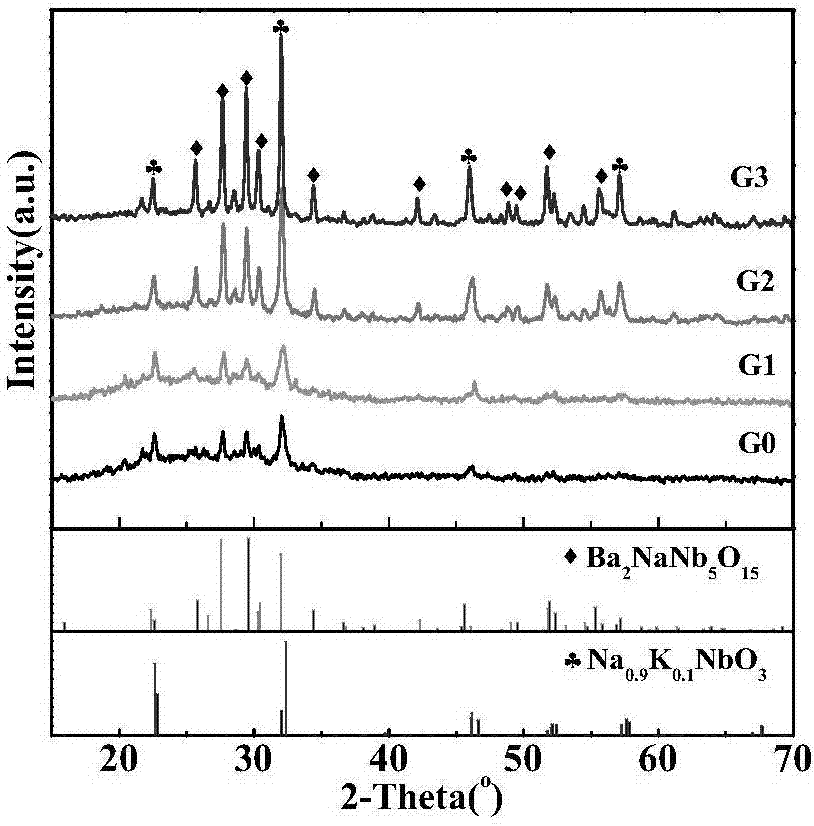
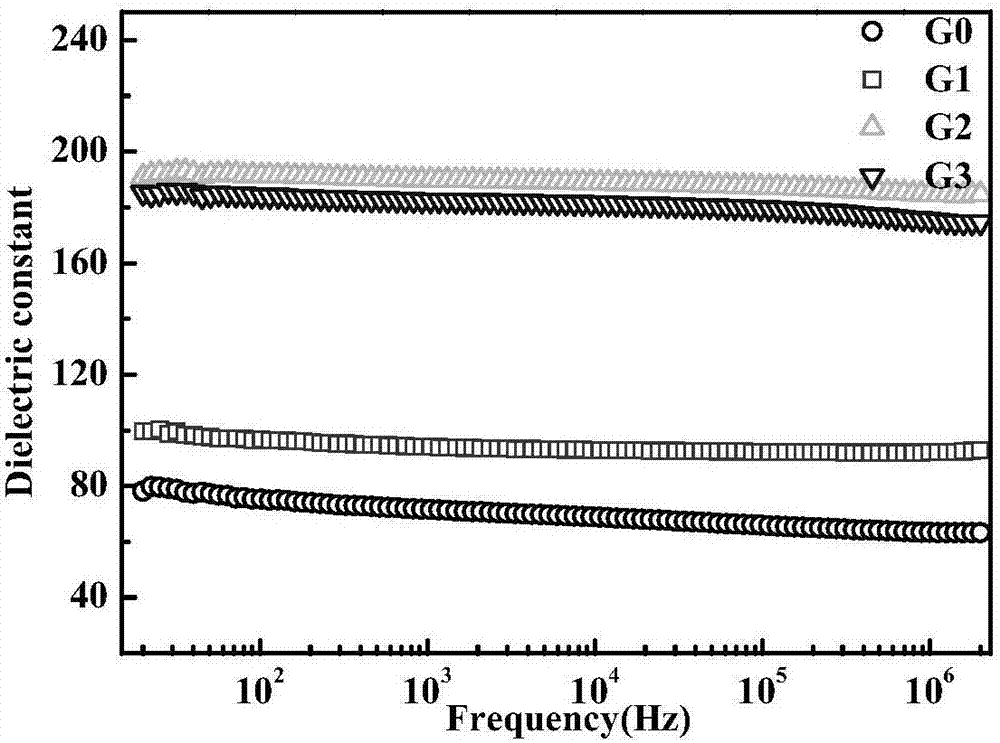
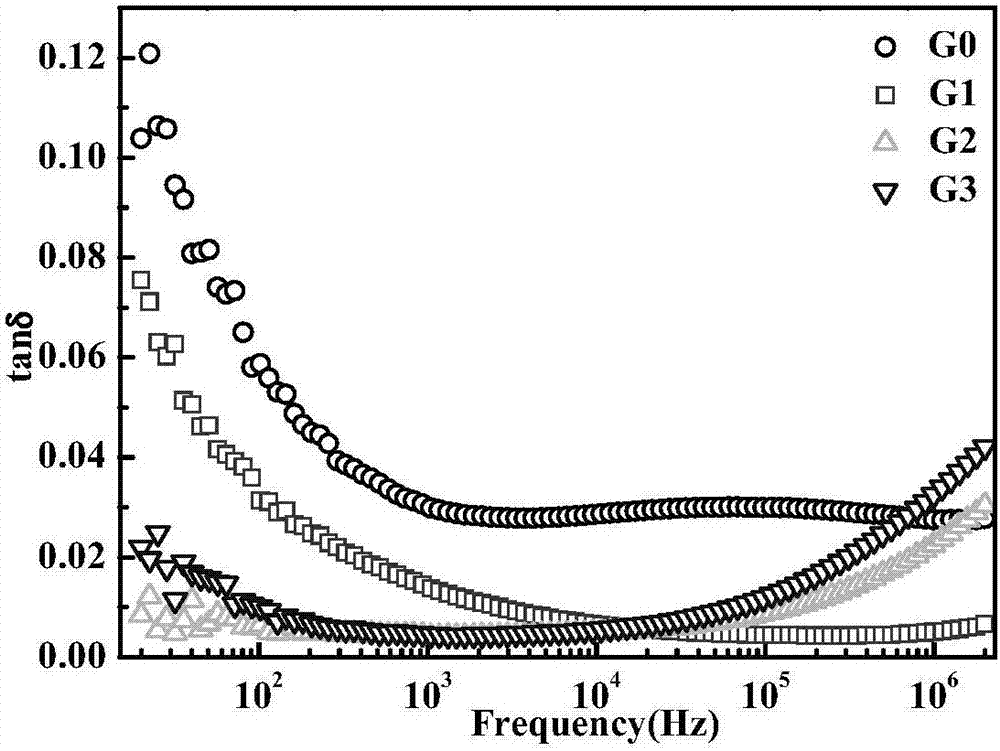
Examples
Embodiment 1
[0040] The preparation method of the glass-ceramic material of the present embodiment comprises the following steps:
[0041] 1) The KNN-based glass-ceramic material in this embodiment is 0.25:0.25:0.6:0.1:0.6:0.2 by the amount of substance, and K 2 CO 3 , Na 2 CO 3 , Nb 2 o 5 , BaCO 3 , SiO 2 , H 3 BO 3 and 0.2 mol% CeO 2 mix. At this time, in the crystal phase, K 2 CO 3 、Na 2 CO 3 , Nb 2 o 5 and BaCO 3 The molar ratio is (3-x): (3-x): 6: 2x, x = 0.5; SiO in the glass phase 2 and H 3 BO 3 The molar ratio is 3:1, and the glass phase accounts for 40% of the total crystal phase and glass phase.
[0042] 2) When heating the quartz crucible with the furnace from room temperature to 1100°C, start adding the mixture, then continue heating to 1350°C, and keep the temperature at 1350°C for 30 minutes to melt the mixture evenly to obtain a mixed molten material; put the mixed molten material on the copper plate After molding, put it into the furnace quickly and ann...
Embodiment 2
[0046] 1) The KNN-based glass-ceramic material in this embodiment is 0.2:0.2:0.6:0.2:0.6:0.2 by the amount of substance, get K 2 CO 3 , Na 2 CO 3 , Nb 2 o 5 , BaCO 3 , SiO 2 , H 3 BO 3 and 0.2 mol% CeO 2 mix. At this time, in the crystal phase, K 2 CO 3 、Na 2 CO 3 , Nb 2 o 5 and BaCO 3 The molar ratio is (3-x): (3-x): 6: 2x, x = 1; SiO in the glass phase 2 and H 3 BO 3 The molar ratio is 3:1, and the glass phase accounts for 40% of the total crystal phase and glass phase.
[0047] 2) When heating the quartz crucible with the furnace from room temperature to 1100°C, start adding the mixture, then continue heating to 1350°C, and keep the temperature at 1350°C for 30 minutes to melt the mixture evenly to obtain a mixed molten material; put the mixed molten material on the copper plate After molding, put it into the furnace quickly and anneal at 650°C for 7 hours to obtain the annealed glass;
[0048] 3) After holding at 850°C for 5h, cool down to room tempera...
Embodiment 3
[0051] 1) The KNN-based glass-ceramic material in this embodiment is 0.15:0.15:0.6:0.3:0.6:0.2 by the amount of substance, and K 2 CO 3 , Na 2 CO 3 , Nb 2 o 5 , BaCO 3 , SiO 2 , H 3 BO 3 and 0.2 mol% CeO 2 mix. At this time, in the crystal phase, K 2 CO 3 、Na 2 CO 3 , Nb 2 o 5 and BaCO 3 The molar ratio is (3-x): (3-x): 6: 2x, x = 1.5; SiO in the glass phase 2 and H 3 BO 3 The molar ratio is 3:1, and the glass phase accounts for 40% of the total crystal phase and glass phase.
[0052] 2) When heating the quartz crucible with the furnace from room temperature to 1100°C, start adding the mixture, then continue heating to 1350°C, and keep the temperature at 1350°C for 30 minutes to melt the mixture evenly to obtain a mixed molten material; put the mixed molten material on the copper plate After molding, put it into the furnace quickly and anneal at 600°C for 7 hours to obtain the annealed glass;
[0053] 3) After holding at 850°C for 5 hours, cool down to roo...
PUM
| Property | Measurement | Unit |
|---|---|---|
| thickness | aaaaa | aaaaa |
| dielectric loss | aaaaa | aaaaa |
Abstract
Description
Claims
Application Information
 Login to View More