
Image clustering method based on sparse orthogonal bigraph non-negative matrix factorization
A non-negative matrix decomposition and image clustering technology, which is applied in the field of image processing, can solve the problems of slow clustering speed and low image clustering accuracy, and achieve the effects of improving accuracy, speeding up image clustering speed, and enhancing exclusivity
- Summary
- Abstract
- Description
- Claims
- Application Information
AI Technical Summary
Problems solved by technology
Method used
Image

Examples
Embodiment Construction
[0042] The present invention will be further described in detail below in conjunction with the accompanying drawings and specific embodiments.
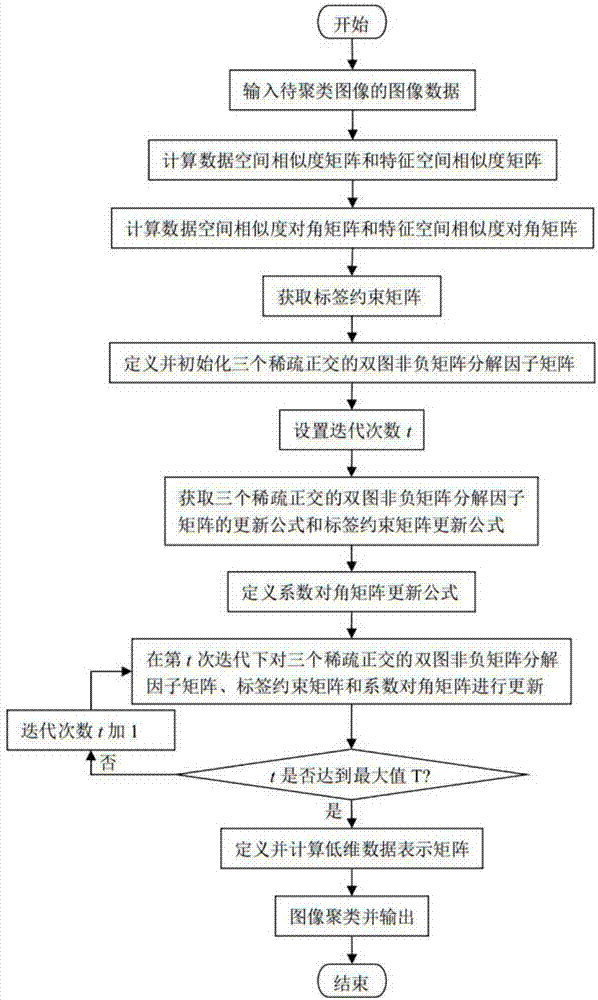
[0043] refer to figure 1 .The image clustering method based on sparse orthogonal dual-image non-negative matrix decomposition, comprising the following steps:
[0044] Step 1) Input the image data of the image to be clustered:
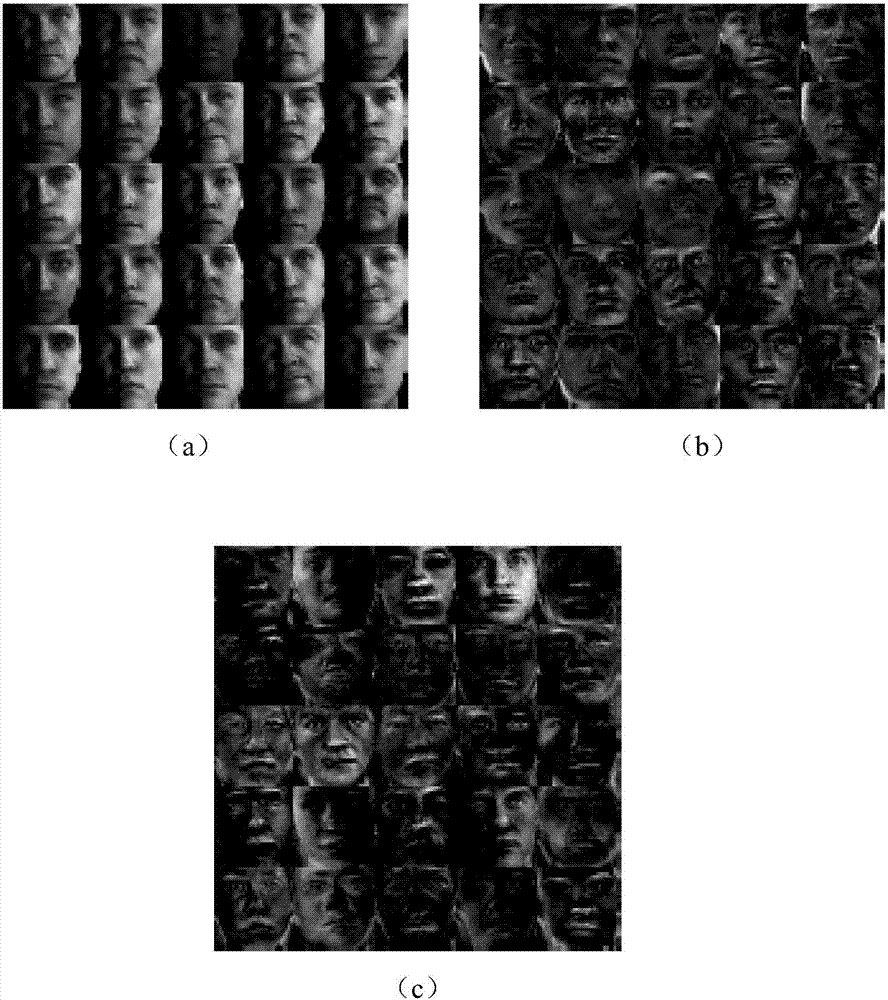
[0045] The image data set PIE contains 2856 images, with 68 people, and each person has 42 face images with 4 expressions under different lighting and lighting conditions. Each image contains 32×32 pixels / dimension. The image data input in this embodiment is 1050 images randomly selected from the image data set PIE, there are 25 types, each type has 42 different images, and 25 images such as image 3 (a) shown.
[0046] Step 2) Calculate the data space similarity matrix and feature space similarity matrix:
[0047] (2a) Calculate the Euclidean distance O between the data in the data space respectively S ...
PUM
 Login to View More
 Abstract
Description
Claims
Application Information
 Login to View More