Gait recognition system and method based on visual and tactile fusion

A gait recognition and tactile technology, applied in the field of human body identification, can solve various problems; plantar pressure analysis will also be affected by wearing shoes or not, affecting video data and other problems, so as to eliminate instability and analyze data accurately , The effect of accurate data sampling time

CN107578019AActive Publication Date: 2018-01-12HEBEI UNIV OF TECH
9 Cites 13 Cited by

Patent Information

Authority / Receiving Office
CN · China
Patent Type
Applications(China)
Current Assignee / Owner
Publication Date
2018-01-12

Smart Images

  • Figure 1
    Figure 1
  • Figure 2
    Figure 2
Patent Text Reader

Abstract

The invention discloses a gait recognition system and method based on visual and tactile fusion. The system comprises a Kinect skeleton tracking system, a plantar pressure test system, an upper computer data processing system, a photoelectric detection switch and an identity card recognition device; the Kinect skeleton tracking system, the plantar pressure test system, the photoelectric detectionswitch and the identity card recognition device are connected with the upper computer data processing system separately; the upper computer data processing system comprises a filter, a detection dataregister, a visual and tactile data fusion processor, a gait characteristic register, an input register, a matching register and an individual gait characteristic database. According to the method, the Kinect skeleton tracking system is adopted to collect visual data and the plantar pressure test system is adopted to collect plantar pressure tactile data, so that the visual sense and the plantar pressure tactile sense are combined, and the cardinal number of characteristic elements is increased; the instability of the visual data is reduced or even eliminated by utilizing the certainty of thetactile data, and therefore the gaits of the human body are quickly and accurately recognized.
Need to check novelty before this filing date? Find Prior Art

Description

technical field

[0001] The invention relates to human body identification technology, in particular to a visual-tactile fusion gait recognition system and a recognition method. Background technique

[0002] Gait recognition is an emerging biometric technology that aims to identify people through their walking posture. Compared with other biometric technologies, gait recognition has the advantages of non-contact, long-distance and difficult to camouflage. In the field of intelligent video surveillance, it has more advantages than face recognition.

[0003] Research by Professor Mark Nixon of the Department of Electronics and Computer Science at the University of Southampton in the United Kingdom has shown that everyone has a completely different walking posture, because people have different levels of muscle strength, tendon and bone length, bone density, visual sensitivity, coordination, and experience. Subtle differences in body weight, center of gravity, degree of muscle...

Examples

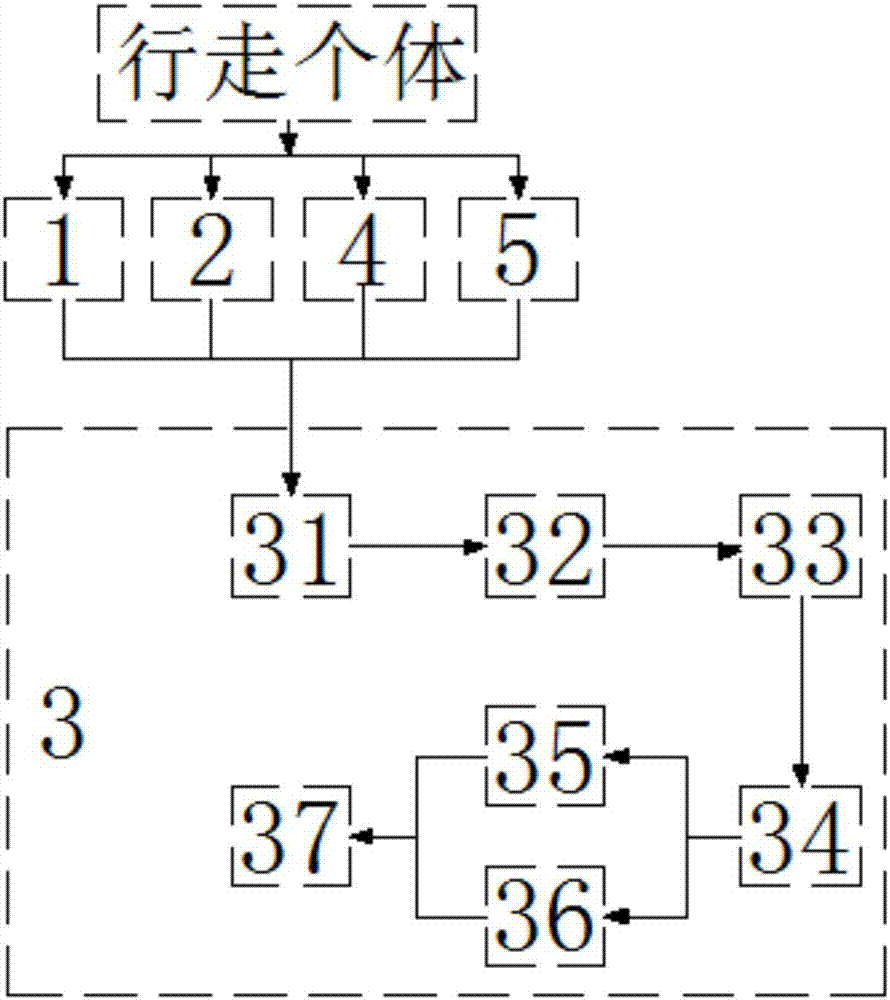
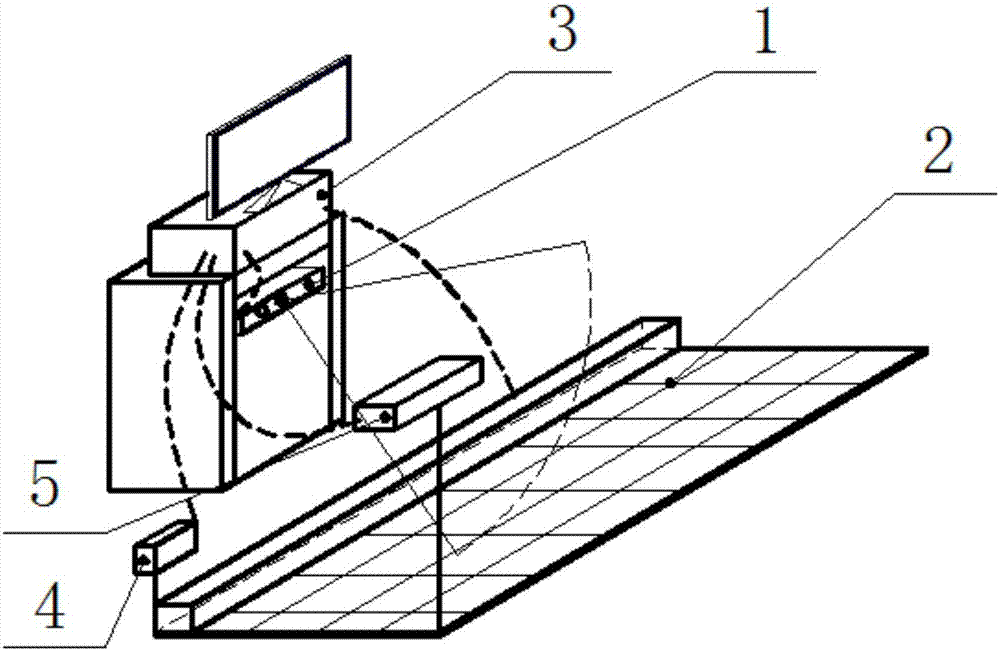
Embodiment Construction

[0026] Specific examples of the present invention are given below. The specific embodiments are only used to further describe the present invention in detail, and do not limit the protection scope of the claims of the present application.

[0027] The invention provides a gait recognition system (system for short, see Figure 1-2 ), it is characterized in that the system comprises Kinect bone tracking system 1, plantar pressure testing system 2, host computer data processing system 3, photoelectric detection switch 4 and ID card identification device 5; described Kinect bone tracking system 1, plantar pressure Test system 2, photoelectric detection switch 4 and ID card identification device 5 are all connected with host computer data processing system 3 through USB serial port line; Described photoelectric detection switch 4 is installed on the left side of the front end of plantar pressure testing system 2, 20 meters away from the ground. centimeter height; the ID card ident...