Whole-course analysis method for impact damage and residual intensity of sutured composite material

A composite material and impact damage technology, which is applied in the field of damage performance analysis of suture composite materials, impact damage and residual strength analysis of suture composite materials, can solve problems such as low engineering application prospects, little improvement in accuracy, and no consideration, etc. Achieve the effects of good scalability, high coherence, and improved accuracy

CN108427826AActive Publication Date: 2018-08-21NANJING UNIV OF AERONAUTICS & ASTRONAUTICS
7 Cites 22 Cited by

Patent Information

Authority / Receiving Office
CN · China
Patent Type
Applications(China)
Current Assignee / Owner
Publication Date
2018-08-21

Smart Images

  • Figure 1
    Figure 1
  • Figure 2
    Figure 2
  • Figure 3
    Figure 3
Patent Text Reader

Abstract

The invention discloses a whole-course analysis method for the impact damage and the residual intensity of a sutured composite material. The method comprises the following steps that: (1) carrying outtransient stress analysis on the sutured composite material under an impact load; (2) determining the impact damage criterion of the sutured composite material; (3) determining the mechanical property degeneration method of the impact damage of the sutured composite material; (4) carrying out the statics analysis of the sutured composite material; (5) determining the residual intensity damage criterion of the sutured composite material; (6) determining the material performance degeneration method of the sutured composite material; and (7) determining the structure failure criterion of the sutured composite material. The invention provides the whole-course analysis method for the impact damage and the residual intensity of the sutured composite material, practical situations, including thepractical damage type, the damage degree and the like, of the impacted composite material structure are considered, and in addition, accuracy fore predicting the residual intensity can be improved without observing the impact damage. The method disclosed by the invention is high in consistency, good in extensibility, high in prediction accuracy and has a considerable engineering application prospect.
Need to check novelty before this filing date? Find Prior Art

Description

Technical field:

[0001] The invention relates to a method for analyzing the damage performance of a suture composite material, in particular to a method for analyzing the impact damage and residual strength of a suture composite material throughout the whole process, and belongs to the technical field of composite material performance analysis. Background technique:

[0002] Composite structures are vulnerable to low-speed impact accidents such as tool drop and equipment impact during use, which will cause varying degrees of internal damage and affect their service safety. The degree of damage after impact and the remaining strength after impact can be used to accurately evaluate its subsequent service.

[0003] Due to its excellent interlaminar mechanical properties, seamed composites have been widely used in engineering, and the prediction analysis of their damage and residual strength after low-velocity impact has also attracted increasing attention of researchers. At pr...

Examples

Embodiment

[0110] Example: G0827 / QY9512 Seamed Composite Laminate Impact Damage and Residual Strength Analysis

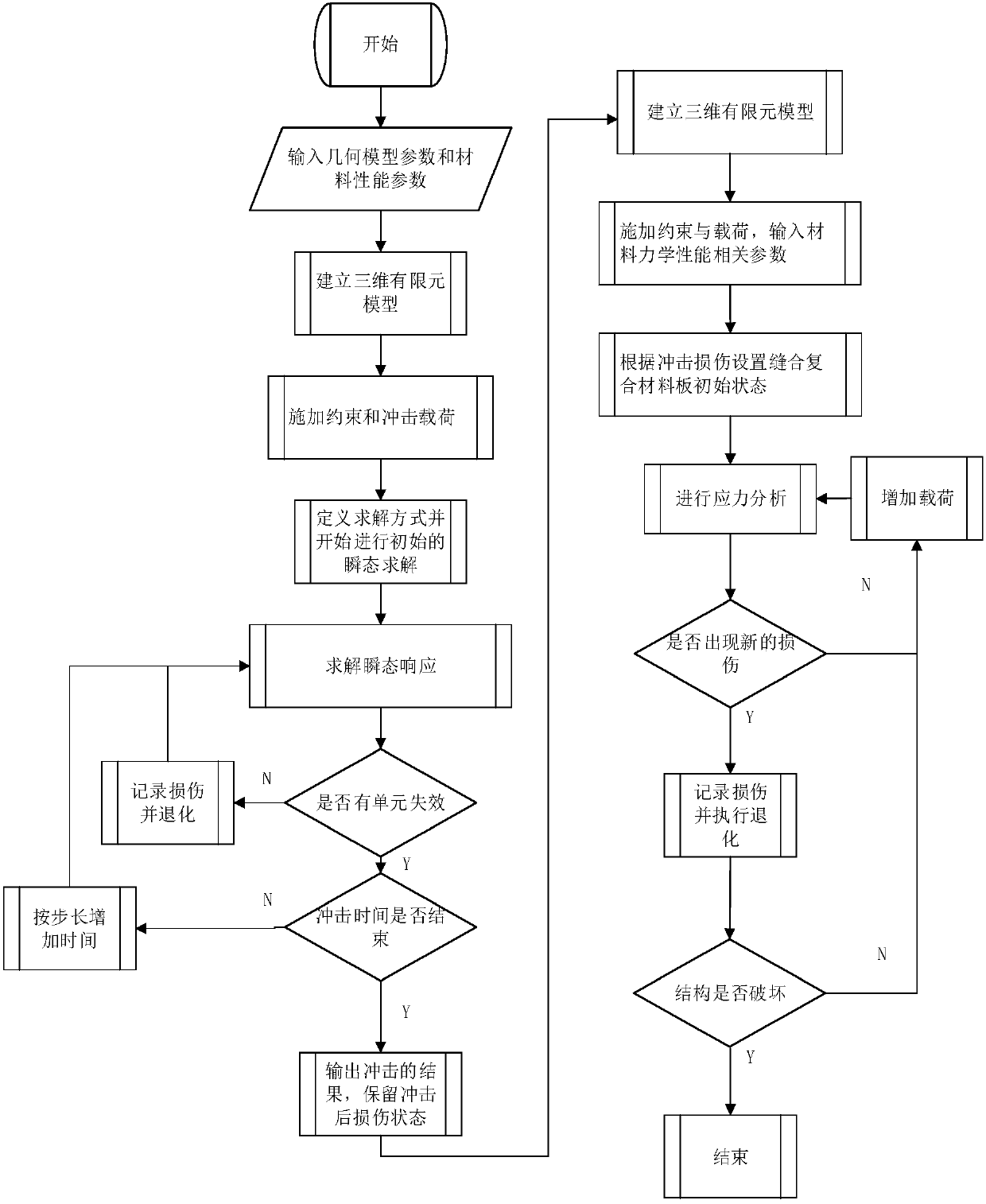
[0111] according to figure 1 The flow chart shown is a full-scale analysis of the impact damage and residual strength of G0827 / QY9512 stitched composite laminates, as follows:

[0112] (1) The geometric model parameters and material performance parameters of the impact process;

[0113] The stitching density of G0827 / QY9512 stitched composite laminates is 5mm×5mm; the stitching is kevlar29 (1500 denier); the stitching method is improved lock stitching, the stitching direction is 0°, and the thickness of each layer of the single-layer board is 0.15mm. The punch is a smooth ball punch with a diameter of 16mm and a hardness greater than 60HRC, and the weight of the punch is 5.5kg.

[0114] G0827 / QY9512 Mechanical properties of seamed composite laminates: longitudinal tensile modulus E 1 =128GPa; transverse tensile modulus E 2 =9.93GPa; normal tensile modulus E 3 =9.93GPa; in...