
Rectangular double-ridge-waveguide torsional transmission line
A double-ridged waveguide and transmission line technology, used in waveguides, waveguide-type devices, electrical components, etc., can solve the problems of complex matching circuit structure, narrow bandwidth, large volume, etc., and achieve obvious advantages and improve the effect of modeling optimization and calculation efficiency.
- Summary
- Abstract
- Description
- Claims
- Application Information
AI Technical Summary
Problems solved by technology
Method used
Image

Examples
Embodiment 1
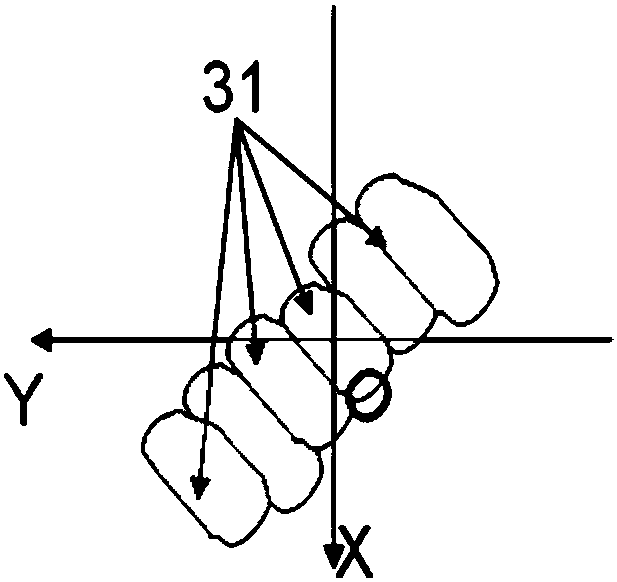
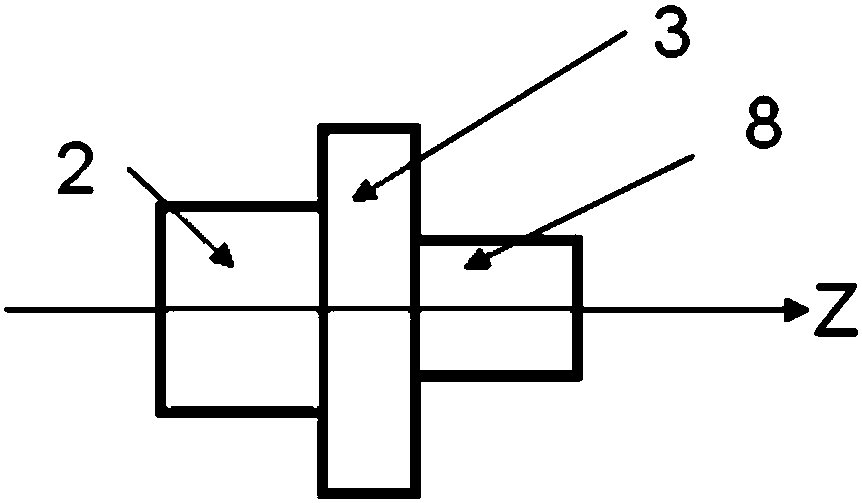
[0030] Such as Figure 1a , Figure 1b and figure 2 shown.
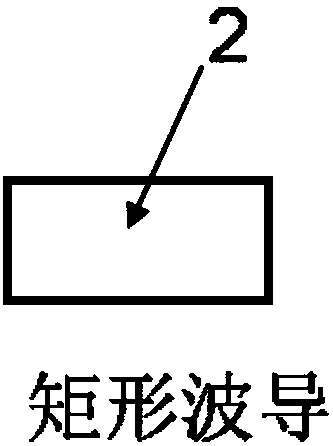
[0031] A rectangular double ridge waveguide twisted transmission line, including an input transmission line 2 and an output transmission line 8 sequentially connected along the Z direction, and an electromagnetic channel 3; the two ends of the electromagnetic channel 3 are respectively a plane A and a plane A parallel to each other A part of B; the input transmission line 2 and the output transmission line 8 respectively communicate with one of the two end faces of the electromagnetic channel 3; the electromagnetic channel 3 is formed by a branch.
[0032] The input transmission line 2 and the output transmission line 8 are the same transmission line; the cross-sectional shape of the output transmission line 8 perpendicular to the Z axis and the cross-sectional shape of the input transmission line 2 perpendicular to the Z axis are rotated 90 degrees around the Z axis same.
[0033] The input transmission line 2 a...
Embodiment 2
[0036] Such as Figure 1a , Figure 1b and image 3 shown.
[0037] The main difference between this implementation example and implementation example 1 is that the input transmission line 2 and the output transmission line 8 are the same double-ridge rectangular waveguide.
Embodiment 3
[0039] Such as Figure 4 and 5 shown.
[0040] Further specific realization of this implementation example and implementation example 3. The input transmission line 2 and the output transmission line 8 are the same double-ridge rectangular waveguide.
[0041] The cross-sectional shape of the output transmission line 8 perpendicular to the Z-axis is the same as the cross-sectional shape of the input transmission line 2 perpendicular to the Z-axis after being rotated 90 degrees around the Z-axis.
[0042] The electromagnetic channel 3 is formed by a branch. The branch is composed of 17 rectangular through holes communicating with each other through one side thereof. The electromagnetic channel 3 is rotated by 45 degrees around the Z axis.
[0043] The double-ridge rectangular waveguide has a width of 7.7 mm and a height of 3.3 mm. The metal ridge width is 1.93mm. The gap between the tops of the metal ridges is 0.61 mm. Using an electromagnetic channel with a length of on...
PUM
 Login to View More
 Abstract
Description
Claims
Application Information
 Login to View More