

Airborne radar space-time adaptive dimensionality reduction processing method
A space-time adaptive, airborne radar technology, applied in the radar field, can solve problems such as poor real-time performance, high computational complexity, and many training samples, and achieve the effects of improving capability, reducing computational load, and reducing performance loss.
- Summary
- Abstract
- Description
- Claims
- Application Information
AI Technical Summary
Problems solved by technology
Method used
Image



Examples
Embodiment Construction
[0036] Describe in further detail below in conjunction with accompanying drawing and embodiment:
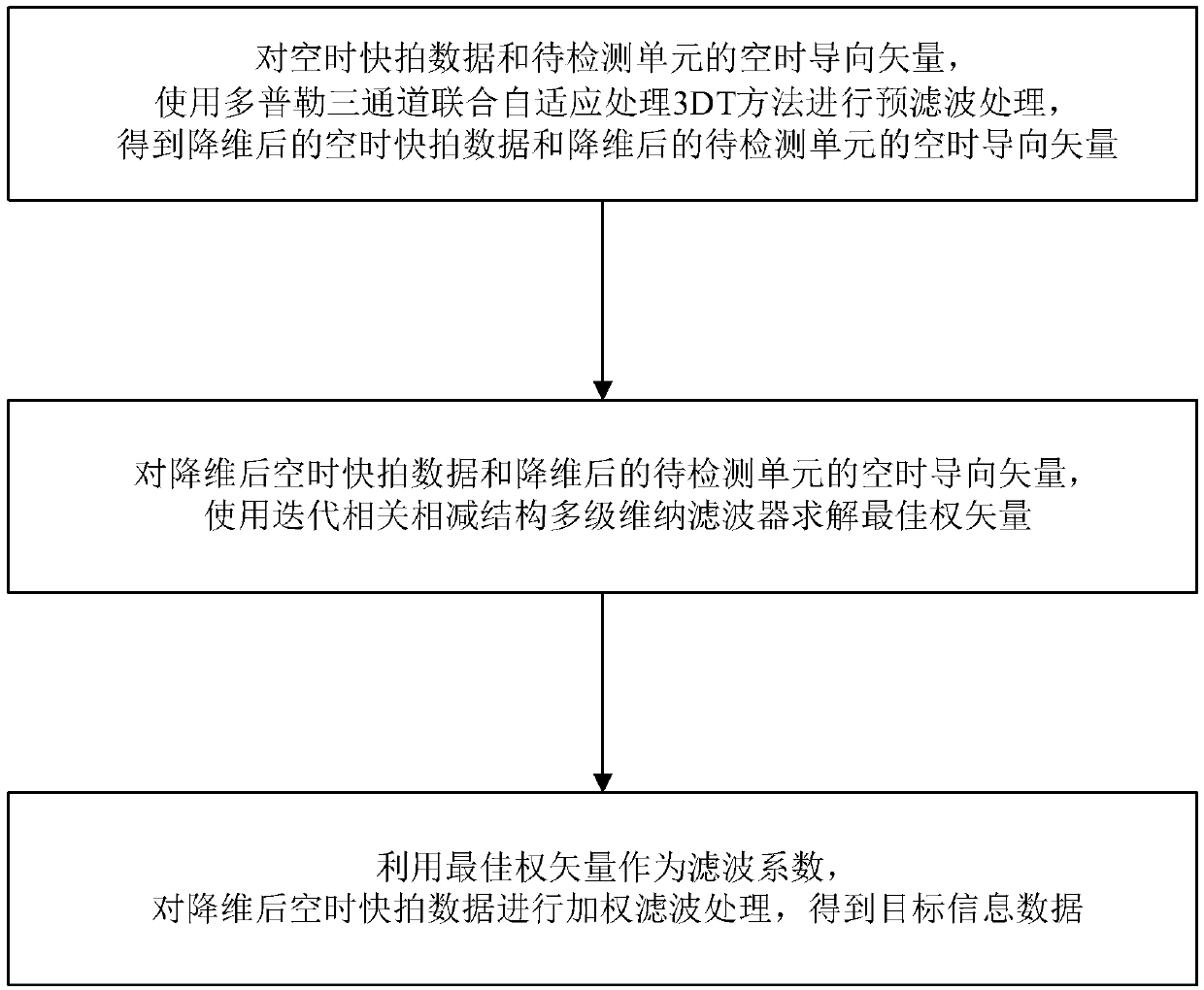
[0037] refer to figure 1 , the implementation steps of the present invention are as follows:
[0038] Step 1: Pre-filter the space-time snapshot data x received by the airborne radar system and the space-time steering vector s of the unit to be detected, using the Doppler three-channel joint adaptive processing 3DT method to obtain the reduced dimension Space Time Snapshot Data x r and the space-time steering vector s of the unit to be detected after dimensionality reduction r .
[0039] refer to figure 2 , the specific implementation of this step is as follows:
[0040] (1a) Obtain the space-time snapshot data x received by the airborne radar system and the space-time steering vector s of the unit to be detected, where x is an NM×6N-dimensional matrix, s is an NM×1-dimensional matrix, and N is the airborne radar The number of array units distributed equally in the system,...
PUM
 Login to View More
 Abstract
Description
Claims
Application Information
 Login to View More