Preparation method of biological ceramic slurry used for photocuring three-dimensional printing
A technology of bioceramics and three-dimensional printing, applied in the direction of additive processing, etc., can solve the problems of incomplete curing, low strength, large shrinkage rate, etc., and achieve the effect of controllable degradation rate, smooth surface and overall compactness
- Summary
- Abstract
- Description
- Claims
- Application Information
AI Technical Summary
Problems solved by technology
Method used
Image

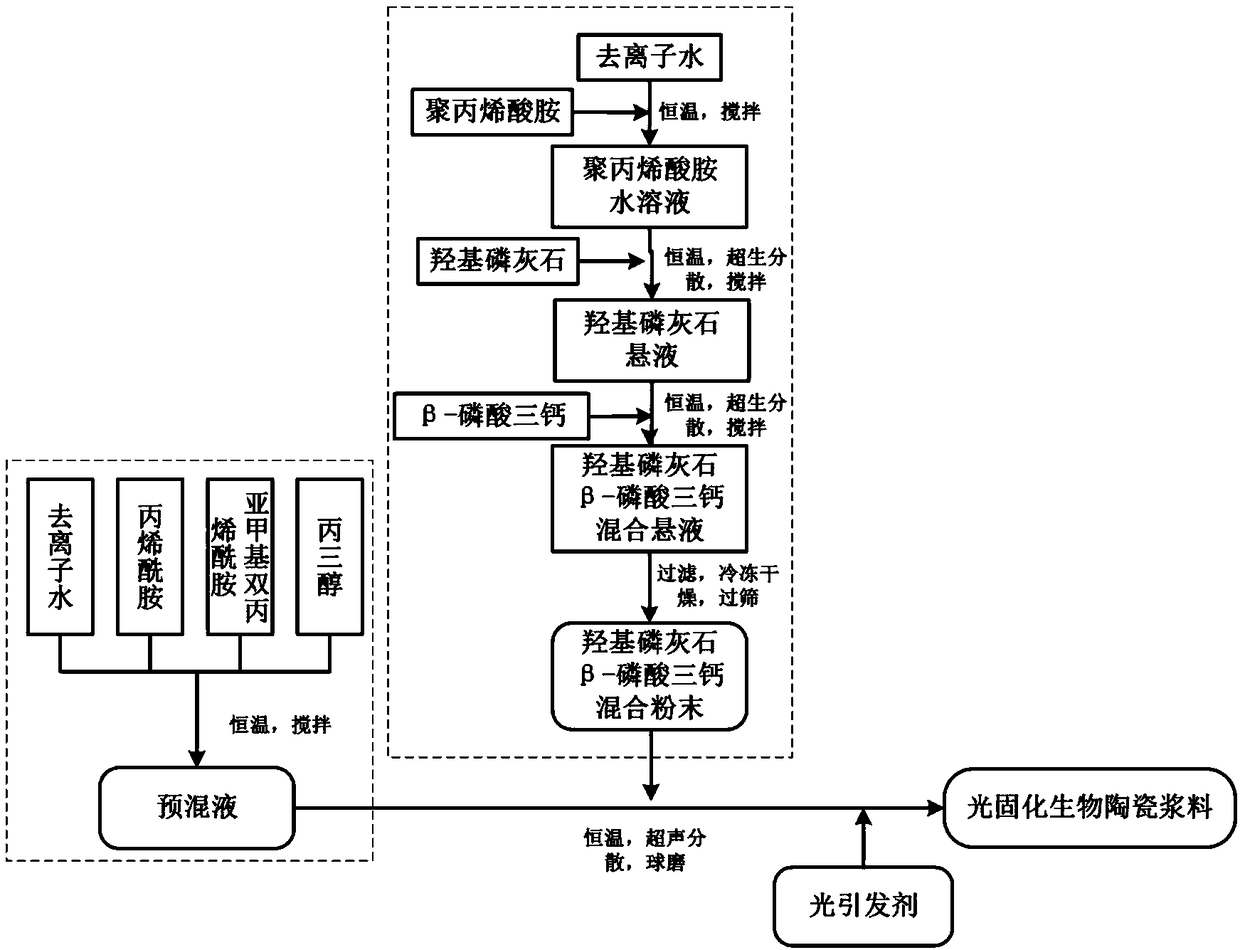


Examples
Embodiment 1-4
[0038] Composition of bioceramic slurry: 56wt% of premix liquid, 42.5wt% of surface modified bioceramic powder and 1.5wt% of photoinitiator.
[0039] (1) Weigh deionized water, acrylamide, methylenebisacrylamide, and glycerol according to the contents shown in Table 1, mix them at a temperature of 40°C, and use a stirrer to stir at a rate of 500 rpm for 10 minutes , to obtain the premix.
[0040](2) Take polyacrylamide by content shown in table 1, hydroxyapatite ceramic powder, β-tricalcium phosphate ceramic powder, the mass ratio of polyacrylamide and deionized water is 1:1000, described hydroxyapatite The particle size of stone ceramic powder and β-tricalcium phosphate ceramic powder is between 500nm-10um. At a temperature of 45° C., and using a stirrer, slowly add the weighed polyacrylamine into deionized water, and stir at a rate of 500 rpm for 10 minutes to obtain an aqueous solution of polyacrylamine. Then, under the 1500W power and 20KHz frequency of the ultrasonic di...
Embodiment 5-7
[0049] In this embodiment, the composition of the bioceramic slurry is screened. The composition of the bioceramic slurry is shown in Table 3. The preparation method of the bioceramic slurry is the same as in Example 1. The composition of the premix and the component content of each component, The composition of the bioceramic powder and the content of each component are the same as those in Example 1. The performance parameters of the prepared bioceramic slurry and the performance parameters of the bioceramic sample printed with the photocured three-dimensional printing of the bioceramic slurry are shown in Table 4. Show. The manufacturing conditions of this bioceramic sample are the same as in Example 1.
[0050] table 3
[0051]
[0052] Table 4
[0053]
Embodiment 8-9
[0055] The preparation method of the bioceramic slurry is the same as in Example 1, the composition of the premix and the content of each component, the composition of the surface-modified bioceramic powder and the content of each component are the same as in Example 1, wherein, Example 8 The quality of the surface-modified bioceramic powders of and 9 accounted for 30wt% and 70wt% of the total mass of the bioceramic slurry respectively, and the sum of other components accounted for 70% and 30% respectively, specifically as shown in Table 5, the prepared bioceramic slurry The performance parameters of the material and the performance parameters of the bioceramic samples printed with the photocured three-dimensional printing of the bioceramic slurry are shown in Table 5. The manufacturing conditions of this bioceramic sample are the same as in Example 1.
[0056] table 5
[0057]
PUM
| Property | Measurement | Unit |
|---|---|---|
| Particle size | aaaaa | aaaaa |
| Viscosity | aaaaa | aaaaa |
Abstract
Description
Claims
Application Information
 Login to View More
PatSnap Eureka turns technology decisions into work you can execute. Powered by our Innovation Knowledge Graph, it runs expert workflows across engineering, life sciences, materials and intellectual property. Get your review-ready output in minutes.


