Wireless communication device and wireless communication method
A wireless communication device and antenna technology, applied in wireless communication, transmission path sub-channel allocation, allocation standards, etc., can solve problems such as inter-terminal interference, inability to receive downlink signals correctly, and system throughput reduction.
- Summary
- Abstract
- Description
- Claims
- Application Information
AI Technical Summary
Problems solved by technology
Method used
Image



Examples
no. 1 Embodiment approach
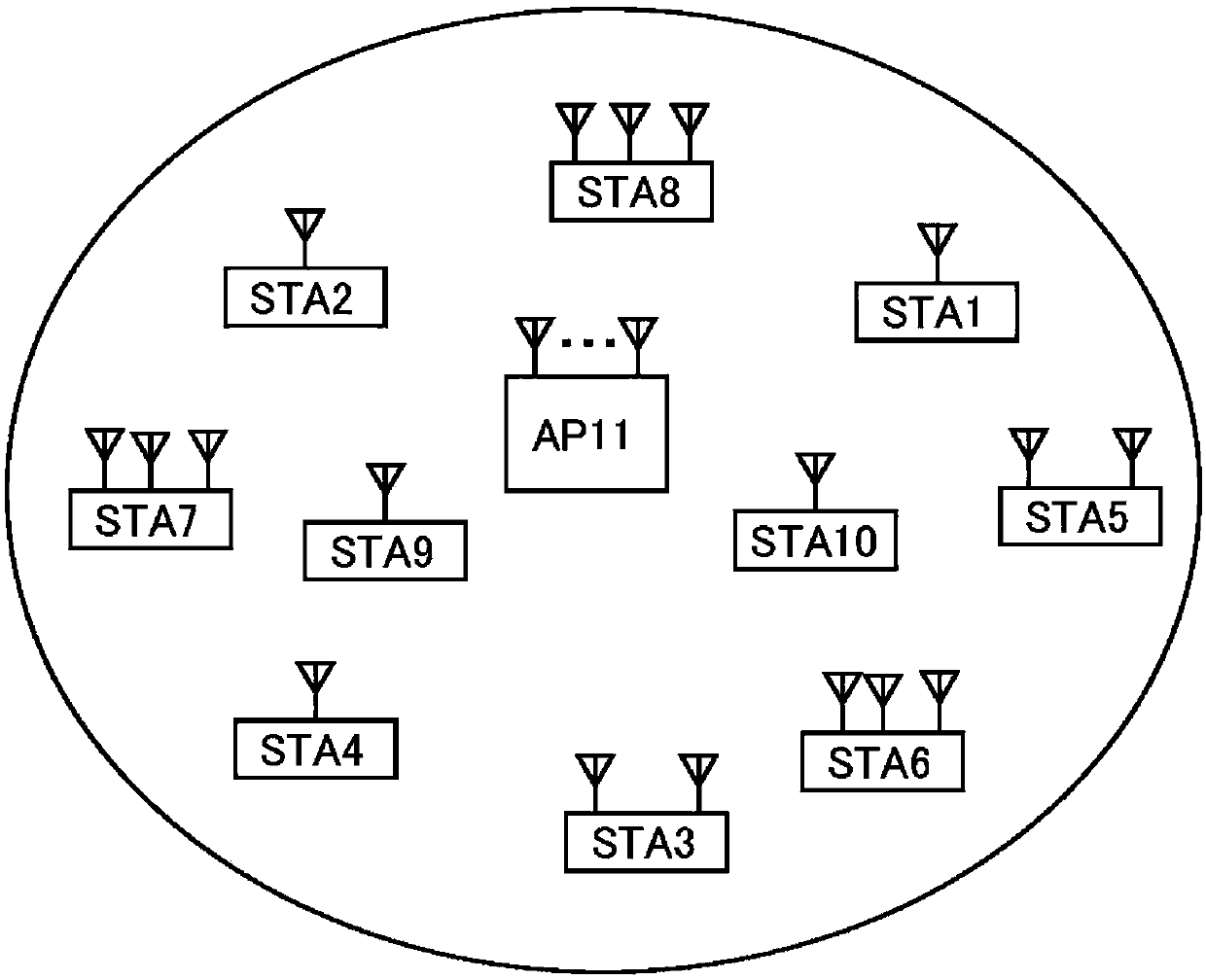
[0085] figure 1The radio communication system of this embodiment is shown. This wireless communication system includes an access point (AP) 11 as a base station and a plurality of wireless terminals (hereinafter referred to as terminals or stations) 1, 2, 3, 4, 5, 6, 7, 8, 9, 10. Wireless LAN (Local Area Network, local area network). In the wireless LAN, communication based on CSMA / CA (Carrier Sense Multiple Access / Collision Avoidance, Carrier Sense Multiple Access / Collision Avoidance) is performed.
[0086] Since the AP 11 also has a function as a terminal, it can be said to be one form of a terminal, but it is different from the terminals 1 to 10 in that it has a relay function and the like. The AP 11 and the terminals 1 to 10 are configured to communicate in accordance with the IEEE 802.11 standard, but may be configured to communicate in accordance with other communication methods. Also, for simplicity, in figure 1 In , only 10 terminals other than APs are described, b...
no. 2 Embodiment approach
[0183] In the sequence of the first embodiment, the terminal 1 operates as a Full Duplex initiator, but this embodiment shows an example of a sequence in which the AP 11 operates as a Full Duplex initiator.
[0184] Figure 12 An example of the frame sequence of the Full Duplex communication in this embodiment is shown in . Descriptions similar to those of the first embodiment are appropriately omitted. As a premise, it is assumed that the path loss P from terminal 1 to terminal 2 is measured in advance Loss(STA1→STA2) and the path loss P from terminal 2 to terminal 1 Loss(STA2→STA1) , store the information indicating the path loss in the buffers of the terminal 1 and the terminal 2 respectively.
[0185] When deciding to perform Full Duplex communication with Terminal 1 and Terminal 2 , AP 11 broadcasts FD-RTS frame 61 . That is, the RA of the FD-RTS frame 61 is a broadcast address. In the Control field of the FD-RTS frame 61, as an example, flag information indicating t...
no. 3 Embodiment approach
[0200] Figure 14 An example of the frame sequence of the Full Duplex communication in this embodiment is shown in . and in the second embodiment Figure 12 The difference in the sequence is that the AP 11 acquires information on uplink transmission requests from a terminal and information on path losses from other terminals in the terminal using random access-based UL-OFDMA. In UL-OFDMA based on random access, among multiple resource units (RUs) specified by the AP 11 through the trigger frame, multiple terminals use the randomly selected RUs respectively, and after a certain period of time from the reception of the trigger frame , sending frames simultaneously. The sequence after the action of sending the FD trigger frame 63 to Terminal 1 and Terminal 2 is due to the Figure 12 The same, so the description is omitted.
[0201] The AP 11 transmits a random access trigger frame (TF-R) 71 based on the access right to the wireless medium acquired through carrier sense and ra...
PUM
 Login to View More
 Abstract
Description
Claims
Application Information
 Login to View More