
Precipitation pattern identification method based on information of attenuation and polarization of microwave links
A microwave link and polarization information technology, applied in neural learning methods, rainfall/precipitation gauges, biological neural network models, etc., can solve problems such as poor spatial representation and difficulty in finding analytical solutions for nonlinear integral equations, and achieve Accurate identification, avoiding the raindrop spectrum inversion process, and reducing the effect of error and uncertainty
Patent Information
- Authority / Receiving Office
- CN · China
- Patent Type
- Applications(China)
- Current Assignee / Owner
- Publication Date
- 2019-04-05
Smart Images
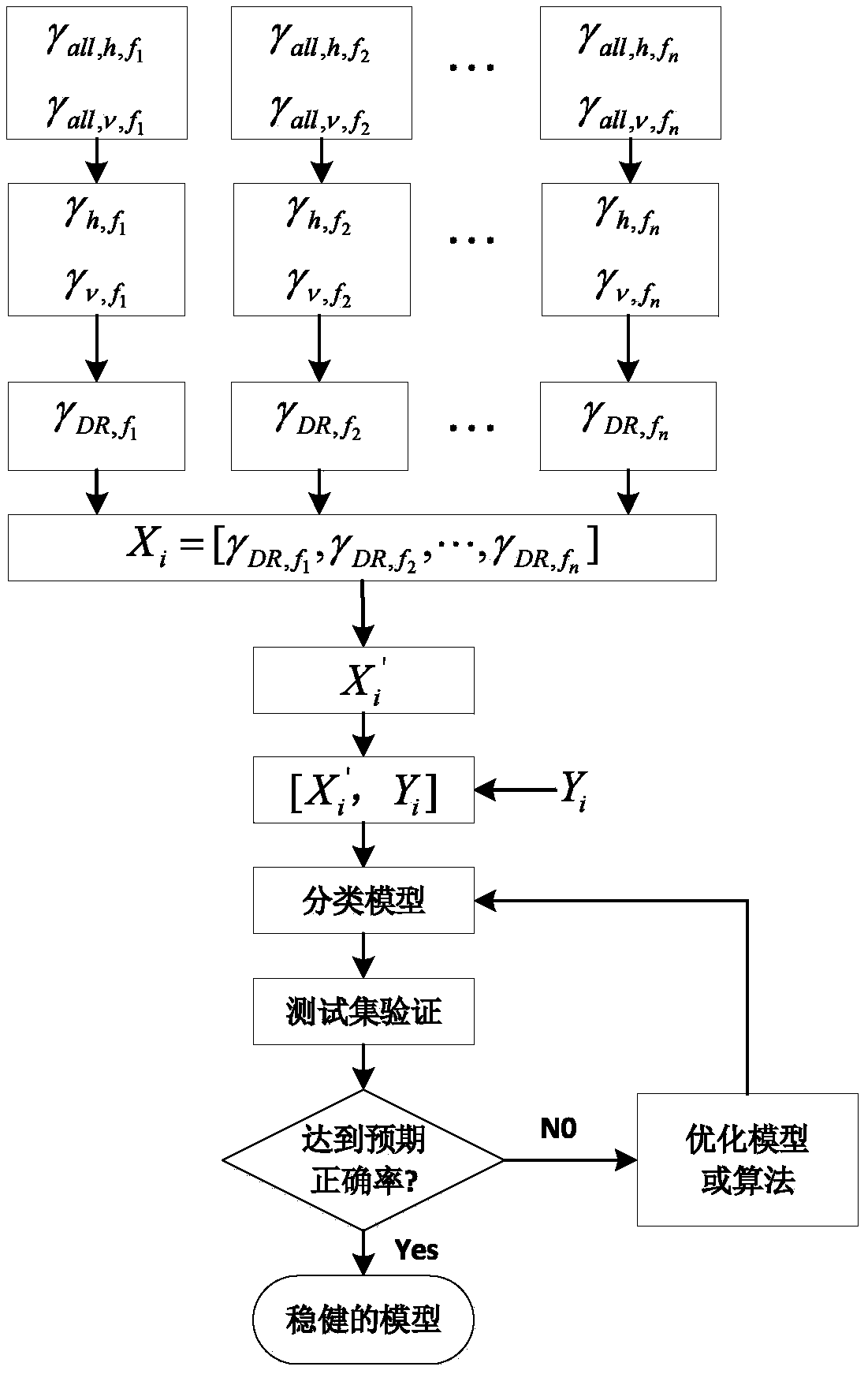
Figure 1 
Figure 2 
Figure 3
Abstract
Description
technical field
[0001] The invention relates to the field of ground meteorological detection, in particular to a method for identifying rainfall types based on microwave link attenuation and polarization information. Background technique
[0002] Rainfall is a very important weather phenomenon in the atmosphere, which has an important impact on production and life, transportation, and military activities. Different rainfall types reflect the phase, shape, and scale distribution of rainfall particles, involving processes such as soil erosion, atmospheric particle deposition, and the interaction between rainfall and electromagnetic waves. Since different types of rainfall have different formation mechanisms and their microphysical characteristics are quite different, it is of great significance to distinguish rainfall types. At present, the identification of rainfall type is mainly based on the change law of rainfall intensity, weather radar volume scan data, dual polarizatio...
Examples
Embodiment Construction
[0027] The present invention will be further described below in conjunction with the accompanying drawings.
[0028] figure 1 It is the working flow chart of the rainfall type identification method based on the microwave link attenuation and polarization information in the present invention; the present invention uses the rain-induced attenuation characteristic quantity of the dual-frequency or multi-frequency microwave link as the input feature, and establishes the rainfall classification algorithm through the machine learning classification algorithm. The classification model mainly includes the following steps:
[0029] 1. Using multi-frequency microwave links to obtain differential attenuation characteristic quantities
[0030] (1) Select dual-polarized microwave links with three frequencies of 35GHz, 28GHz and 8GHz, as shown in Table 1.
[0031] Table 1
[0032]
[0033] (2) Measure the transmit power P corresponding to the above six links t,α,f and received power ...