Check patentability & draft patents in minutes with Patsnap Eureka AI!

Pyrophosphorolysis activated fluorescence to measure PAP amplification of nucleic acid

A pyrophosphorylation and activation technology, applied in the field of molecular biology, can solve the problem of inability to identify multiple template amplification and other problems

Inactive Publication Date: 2020-05-19
丁少峰 +1
View PDF12 Cites 2 Cited by
  • Summary
  • Abstract
  • Description
  • Claims
  • Application Information

AI Technical Summary

Problems solved by technology

However, its main disadvantage is non-specific binding to any double-stranded DNA, such as primer dimers, which also emit non-specific fluorescence.
In addition, it does not recognize the amplification of multiple templates in the same reaction

Method used

the structure of the environmentally friendly knitted fabric provided by the present invention; figure 2 Flow chart of the yarn wrapping machine for environmentally friendly knitted fabrics and storage devices; image 3 Is the parameter map of the yarn covering machine
View more

Image

Smart Image Click on the blue labels to locate them in the text.
Viewing Examples
Smart Image
  • Pyrophosphorolysis activated fluorescence to measure PAP amplification of nucleic acid
  • Pyrophosphorolysis activated fluorescence to measure PAP amplification of nucleic acid
  • Pyrophosphorolysis activated fluorescence to measure PAP amplification of nucleic acid

Examples

Experimental program
Comparison scheme
Effect test

example 1

[0138] Example 1: Materials and methods

[0139] Preparation of primers

[0140] The 3'ddCMP blocking primer used was chemically synthesized in the 3'-5' direction by Integrated DNA Technologies and purified by HPLC.

[0141] The 3'ddAMP, ddTMP and ddGMP blocking primers are synthesized by adding ddATP, ddTTP and ddGTP to the 3'end of the deoxy-oligonucleotide by terminal transferase (Liu and Sommer, 2000; Liu and Sommer, 2002).

[0142] The primers with single labeling (FAM or HEX) at the 5'end or internal region are chemically synthesized along the 3'-5' direction by Integrated DNA Technologies, and purified by HPLC.

[0143] Rhodamine dye-labeled dideoxynucleotide analogs or blockers, TAMRA-ddATP, TAMRA-ddUTP, TAMRA-ddGTP and TAMRA-ddCTP, purchased from PerkinElmer Life Sciences, in which the quenching group TAMRA is covalently linked to The base of the dideoxydeoxynucleotide of the primer. Then they are added to the 3'end of the single-labeled primers by terminal transferase to sy...

example 2

[0154] Example 2: Single and multiple PAP testing of GNAS and HIV genes

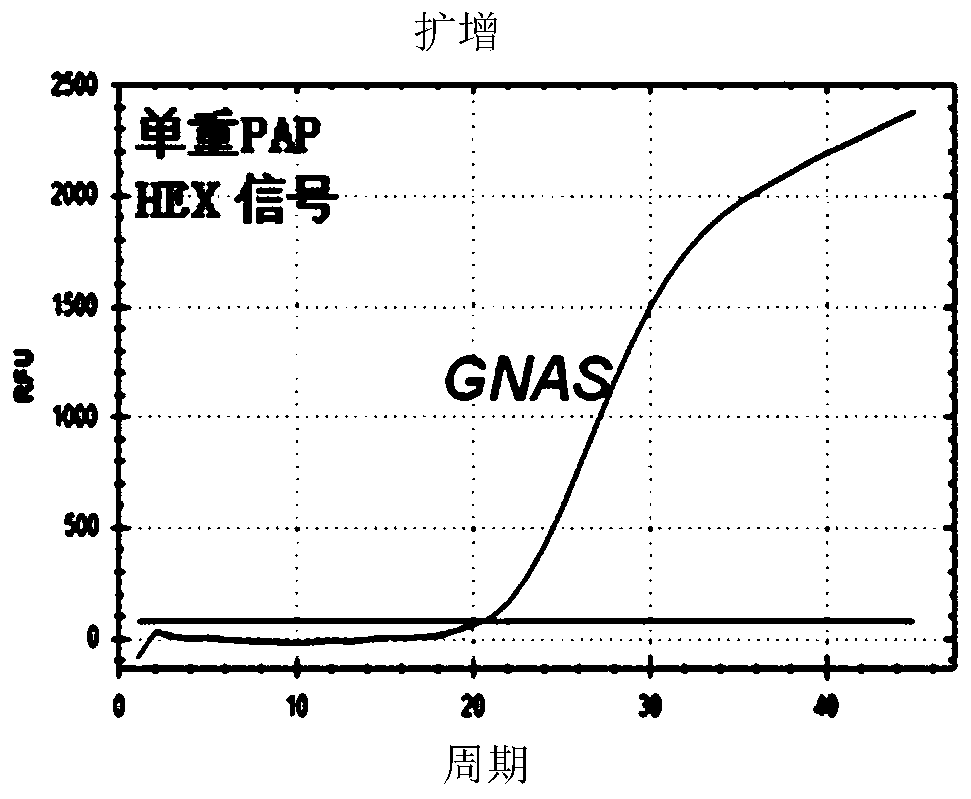
[0155] Single-plex and multiple PAP tests of GNAS and HIV genes are used to demonstrate how pyrophosphorylation-activated fluorescence works.

[0156] The GNAS and HIV genes were selected as targets and controls. Because HIV-1 virus DNA can be integrated into the human genome, the use of blood leukocyte genomic DNA for testing has become a medical requirement.

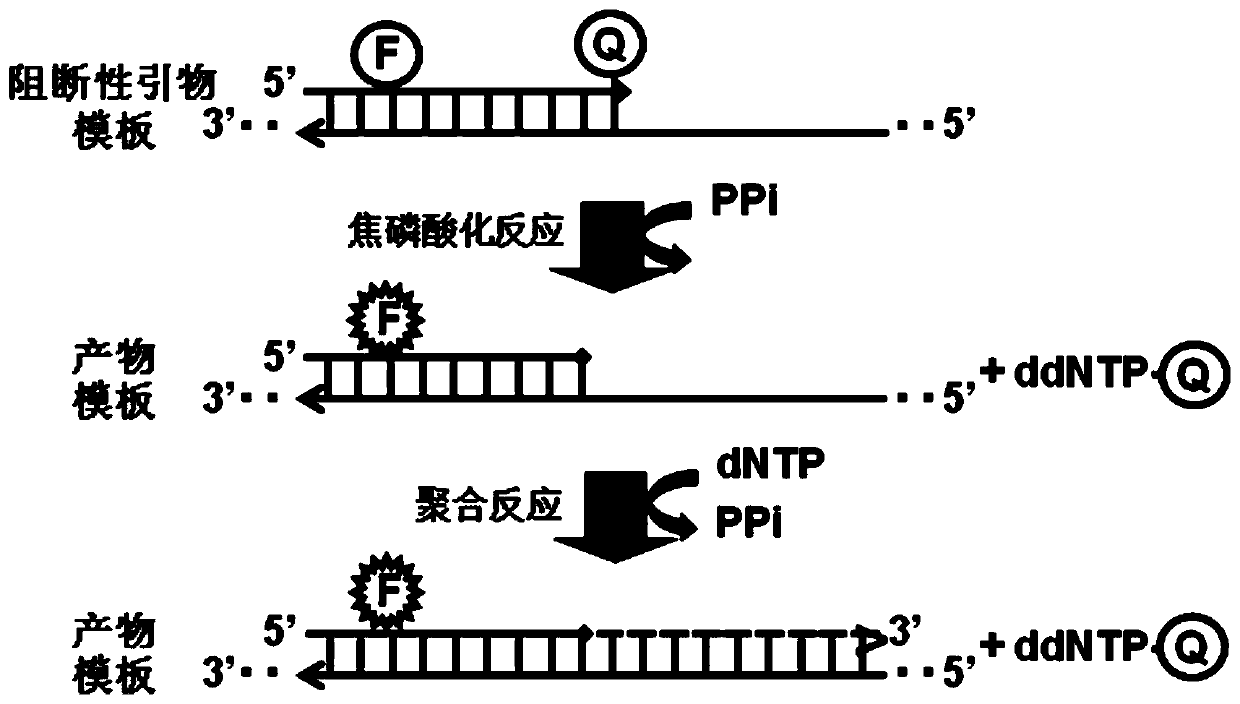
[0157] A single-plex PAP detects the GNAS gene using a forward fluorophore-quencher double-labeled blocking primer (SEQ ID 1) and a reverse blocking primer (SEQ ID 2) (Table 2). Fluorophore-quenching group double-labeled blocking primer (SEQ ID 1) with a HEX fluorophore covalently linked to the 5'end dAMP of the primer and a covalent bond to the 3'end ddCMP The TAMRA quencher on the group. When the GNAS gene was amplified from 100,000 copies of human wild-type genomic DNA (i.e., 330ng), a HEX fluorescence signal was generated, and the number of Ct 20...

example 3

[0167] Example 3: Single and multiple delayed PAP detection of GNAS and HIV genes

[0168] Delayed PAP was invented by introducing artificial mutations into the 3'region of the blocking primer, which can delay product accumulation to a later time or cycle during PAP amplification (US Patent Application No. 62687325). Pyrophosphorylation activated fluorescence was further confirmed in this delayed PAP test.

[0169] A single delayed PAP detects the GNAS gene using a forward fluorophore-quenching group double-labeled blocking primer (SEQ ID 1) (Table 2) and a 5th nucleotide from the 3'end There is a reverse M1 blocking primer with artificial G to T mutation (SEQ ID 6) (Table 3). Another single delayed PAP detects the GNAS gene using a forward fluorophore-quenching group double-labeled blocking primer (SEQ ID 1) and an introduction at the 3rd nucleotide from the 3'end A reverse M2 blocking primer with C to A worker mutation (SEQ ID 7) (Table 3). When using 100,000 copies of human w...

the structure of the environmentally friendly knitted fabric provided by the present invention; figure 2 Flow chart of the yarn wrapping machine for environmentally friendly knitted fabrics and storage devices; image 3 Is the parameter map of the yarn covering machine
Login to View More

PUM

No PUM Login to View More

Abstract

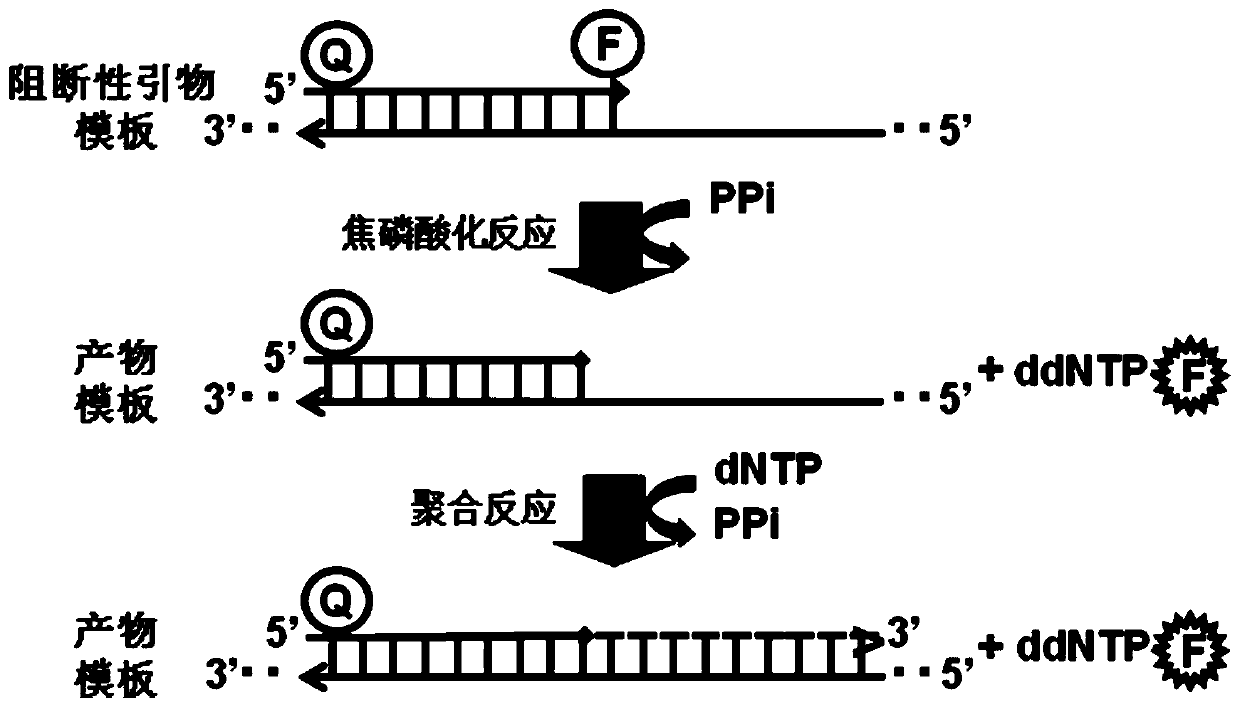
The invention relates to a new fluorescence detection method of pyrophosphorolysis activated fluorescence to measure PAP amplification of nucleic acid. A fluorophore-quencher dual-attached blocked primer is used for PAP which has a fluorophore attached to a nucleotide in the internal region or at the 5' end and a quencher attached to a blocked nucleotide at the 3' end. Multiple fluorophore-quencher dual-labeled blocked primers are also used for multiplex PAP, which are attached with different fluorophores to distinguish multiple templates in a resaction.

Description

[0001] Sequence Listing [0002] This application also submits the sequence list. Technical field [0003] The present invention relates to the field of molecular biology, in particular to the nucleic acid amplification of Pyrophosphorolysis activated polymerization (PAP). Background technique [0004] Pyrophosphorylation Activated Polymerization (PAP) [0005] Pyrophosphorolysis activated polymerization (PAP) is a nucleic acid amplification method (Liu and Sommer) that uses 3'-end blocking primers and uses DNA polymerase to catalyze the pyrophosphorylation reaction in series coupled polymerization. , 2000; Liu and Sommer, 2004b). The primers are blocked by non-extensible nucleotides (3'-end blockers) such as dideoxynucleotides at the 3'end, so they cannot be directly extended by DNA polymerase. When the 3'-end blocking primer hybridizes to its complementary DNA template, DNA polymerase can remove the 3'-end blocking agent from the 3'-end blocking primer in the presence of pyrophos...

Claims

the structure of the environmentally friendly knitted fabric provided by the present invention; figure 2 Flow chart of the yarn wrapping machine for environmentally friendly knitted fabrics and storage devices; image 3 Is the parameter map of the yarn covering machine
Login to View More

Application Information

Patent Timeline
no application Login to View More
Patent Type & Authority Applications(China)
IPC IPC(8): C12Q1/6844C12N15/11
CPCC12Q1/6844C12Q2525/186C12Q2563/107C12Q2537/143C12Q1/6853C12Q1/703C12Q2565/101C12Q2565/301G01N21/76
Inventor 丁少峰刘强
Owner 丁少峰
Features
  • R&D
  • Intellectual Property
  • Life Sciences
  • Materials
  • Tech Scout
Why Patsnap Eureka
  • Unparalleled Data Quality
  • Higher Quality Content
  • 60% Fewer Hallucinations
Social media
Patsnap Eureka Blog
Learn More