
Application of glutaminase inhibitor in preparation of medicine for treating psoriasis
A technology of glutaminase and inhibitors, applied in the field of medicine, can solve the problems of small psoriasis drugs lacking side effects, and the treatment effect is not completely satisfactory.
- Summary
- Abstract
- Description
- Claims
- Application Information
AI Technical Summary
Problems solved by technology
Method used
Image

Examples
Embodiment 1CB-839
[0044] Example 1 CB-839 inhibits the uptake and metabolism of keratinocyte glutamine
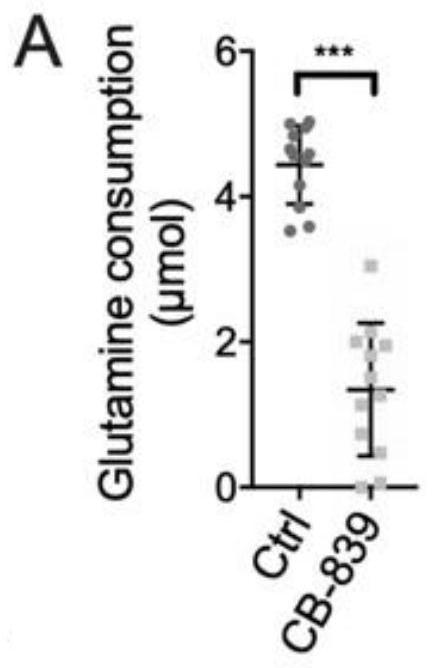
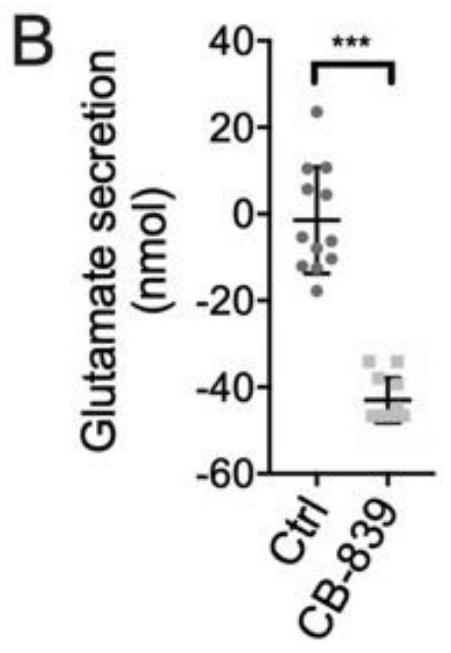
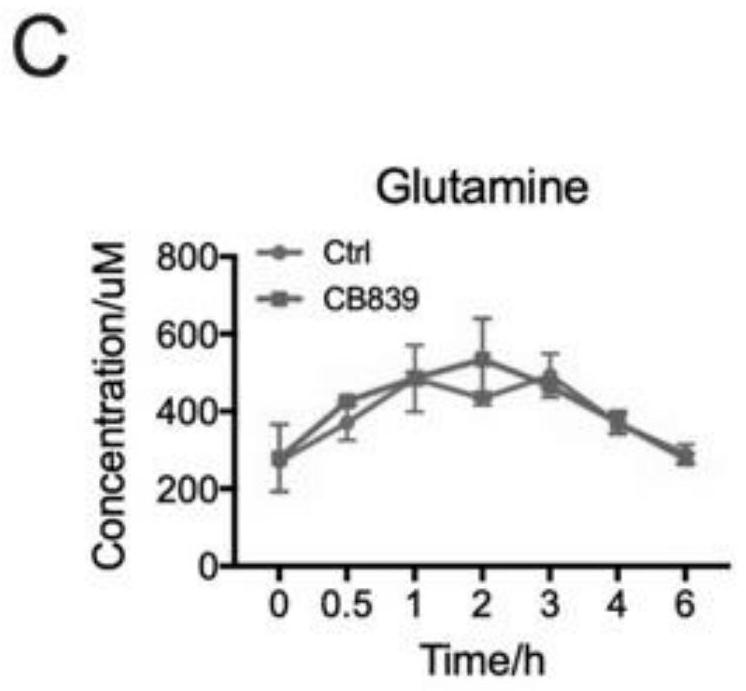
[0045] Add 10 μM CB-839 (CB-839 group) and equal volume of DMSO (Ctrl group) to the culture medium of keratinocyte HaCaT cells respectively, after 12 hours of intervention, collect the cell culture medium, and use the method of targeted metabolomics Detect the contents of glutamine (glutamine) and glutamic acid (glutamate) in the collected cell culture fluid, and by comparing with fresh culture fluid, calculate the amount of glutamine (ie glutamine) taken up by cells under different intervention conditions. consumption of amide) and the amount of glutamic acid secreted into the cell culture medium (i.e. the secretion of glutamic acid), the results are as follows Figure 1-2 shown. Depend on Figure 1-2 The results showed that CB-839 can significantly inhibit the uptake of glutamine by keratinocytes (P<0.001), and reduce the amount of glutamic acid secreted by keratinocytes into the culture...
Embodiment 2
[0048] Example 2 CB-839 inhibits miR-31-induced mitochondrial respiration of keratinocytes
[0049] Oxygen consumption rate (OCR) is the oxygen consumption rate of cells, which is an indicator of mitochondrial respiration capacity. Oxygen consumption detection principle: The value displayed before adding oligo represents the basic oxygen consumption of cells, including mitochondrial oxidative phosphorylation and proton leakage oxygen consumption, that is, after protons pass through the mitochondrial membrane to form potential energy through the respiratory chain, a part Proton reflux can form ATP by ATP synthase, which converts potential energy into energy in ATP. A portion passes through the mitochondrial membrane but is only oxidized, and the potential energy is converted into heat, but not used to synthesize ATP. Oligo is an ATP synthase inhibitor. The reduced oxygen consumption after adding this drug represents the oxygen consumption used by the body for ATP synthesis, an...
Embodiment 3
[0052] Example 3 Western Blotting Experiment of CB-839 Inhibiting the mTOR Pathway Induced by miR-31
[0053] Western Blotting experiments can detect the expression of the target protein. 24 hours after HaCaT cells were transfected with control miRNAmimic or miR-31mimic, they were intervened with DMSO and 10 μM CB-839; among them, those who were given DMSO intervention 24 hours after transfection with control miRNAmimic were recorded as the Ctrl-mimic group, and those transfected with miR-31mimic for 24 hours The miR-31mimic group was given after DMSO intervention, the CB839 group was given 10 μM CB-839 intervention 24 hours after transfection of control miRNA mimic, and the miR-31mimic group was given 10 μM CB-839 intervention 24 hours after miR-31mimic transfection. -31+CB839 group. In addition, HaCaT cells were transfected with control siRNA (ThermoFisher Scientific, AM4635) and GS-siRNA (ThermoFisher Scientific, AM16708) 24 hours after each intervention with DMSO as a con...
PUM
 Login to View More
 Abstract
Description
Claims
Application Information
 Login to View More