
Sample classification method of distributed privacy protection logistic regression model based on hybrid protocol
A logistic regression model, privacy protection technology, applied in the field of network and information security
Patent Information
- Authority / Receiving Office
- CN · China
- Current Assignee / Owner
- Publication Date
- 2020-10-30
Smart Images
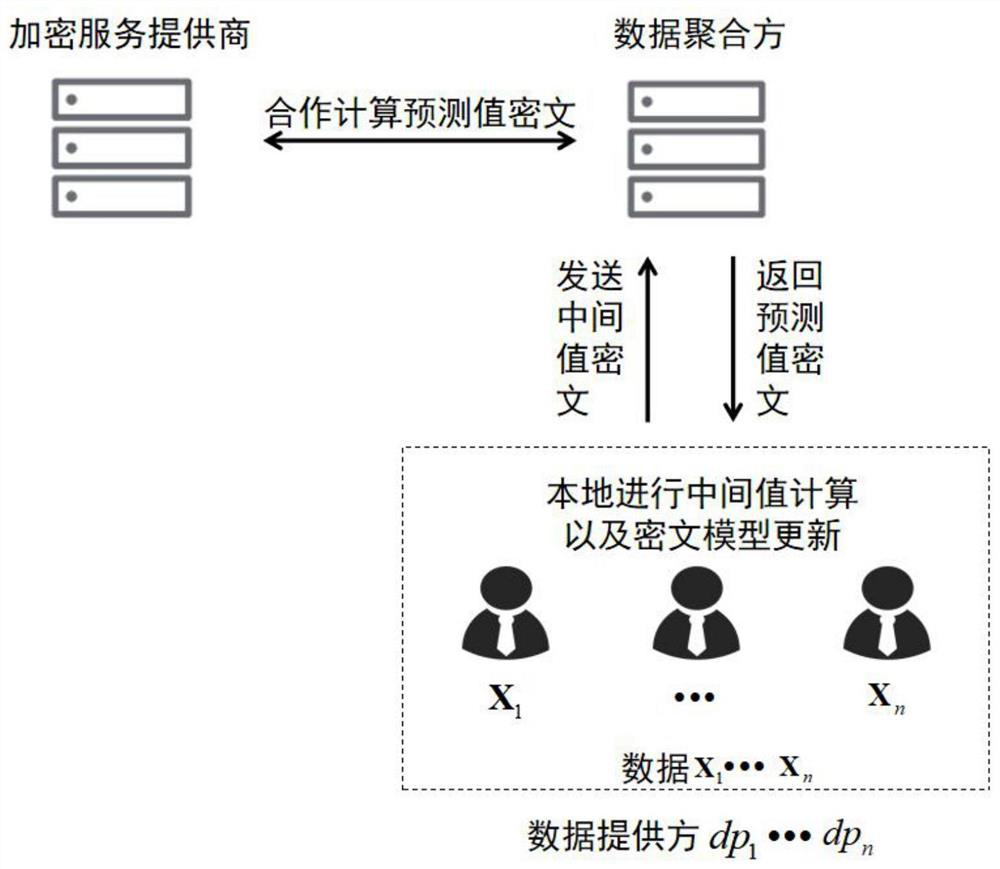
Figure 1 
Figure 2 
Figure 3
Abstract
Description
technical field
[0001] The invention belongs to the field of network and information security, and specifically relates to a sample classification method of a distributed privacy protection logic regression model based on a hybrid protocol. Background technique
[0002] In recent years, machine learning techniques have been increasingly used in practice to generate prediction or classification models to solve specific prediction and classification tasks. With the development of big data, a large amount of data has been generated. These data provide a larger-scale training data set for the training process of the prediction model or classification model to obtain better prediction or classification results. However, these data are often held by different sites. Due to the restrictions of laws and regulations or their own interests, these sites hope to jointly carry out data mining tasks without disclosing their own private data. For example, multiple institutions each have ...
Examples
Embodiment Construction
[0041] In this example, if figure 1 As shown, a sample classification method of a distributed privacy-preserving logistic regression model based on a hybrid protocol is applied to n data providers {dp 1 ,dp 2 ,...,dp i ,...,dp n}, in a network scenario composed of an encryption service provider and a data aggregator; among them, dp i Indicates the i-th data provider; and the i-th data provider dp i holds the training dataset X i ,and x ikj Indicates the i-th data provider dp i The j-th feature data in the k-th training sample held; then the training data sets held by all data providers are recorded as {X 1 ,X 2 ,...,X i ,...,X n ,Y}; Among them, Y represents the label data, which is held by the data aggregator, and has: the y k Indicates the label value corresponding to the kth sample; i=1,2,...,n; j=1,2,...,t; k=1,2,...,m;
[0042] Assume that there are two data providers dp 1 and dp 2 , use their own private data to jointly perform the classification task o...