
Non-invasive fire hydrant water pressure detection method based on time-delay accumulation of multiple ultrasonic signals
A technology of ultrasonic signal and water pressure detection, which is applied in the direction of fluid pressure measurement, sound wave re-radiation, and measurement devices using acoustic methods. It can solve the problems of low measurement accuracy and unstable measurement results, and achieve low price and low cost. The effect of performance requirements
- Summary
- Abstract
- Description
- Claims
- Application Information
AI Technical Summary
Problems solved by technology
Method used
Image

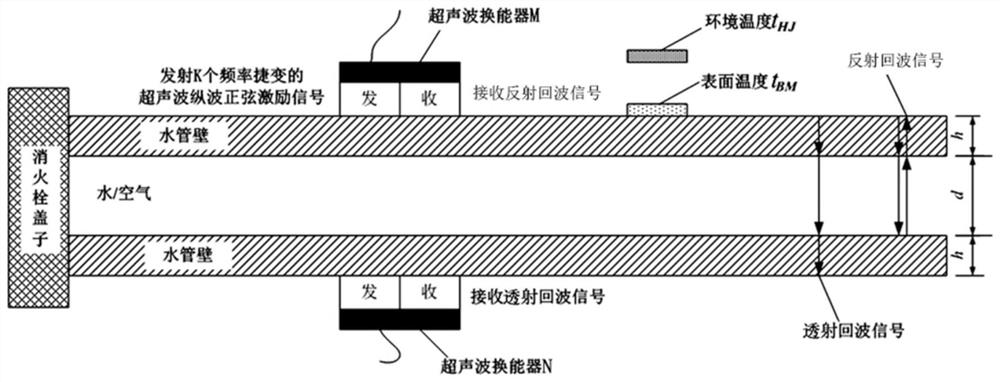
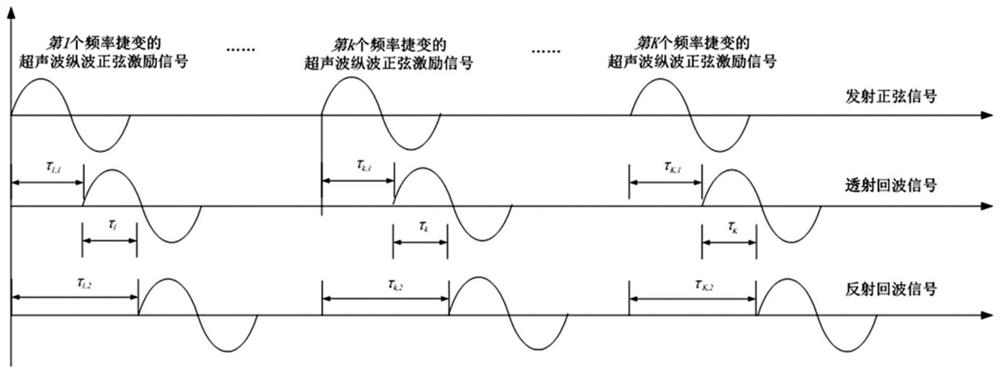
Examples
Embodiment 1
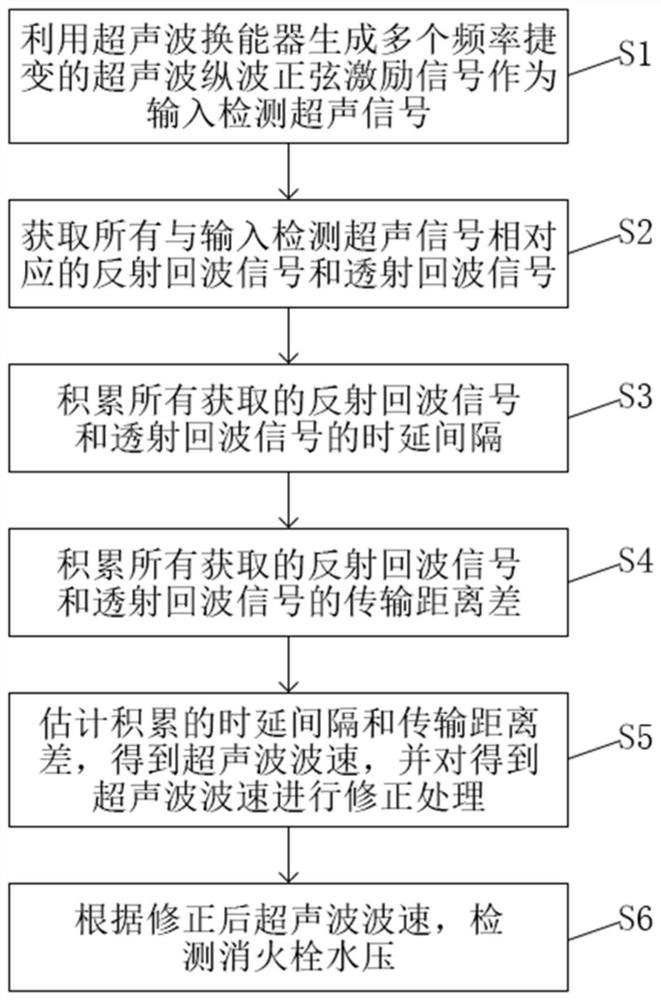
[0072] This embodiment provides a non-invasive fire hydrant water pressure detection method based on the time-delay accumulation of multiple ultrasonic signals, such as figure 1 shown, including:
[0073] S1. Using the ultrasonic transducer to generate multiple frequency-agile ultrasonic longitudinal wave sinusoidal excitation signals as input to detect ultrasonic signals;
[0074] S2. Obtain all reflected echo signals and transmitted echo signals corresponding to the input detection ultrasonic signal;
[0075] S3. Accumulating time delay intervals of all acquired reflected echo signals and transmitted echo signals;
[0076] S4. Accumulate the transmission distance difference between all acquired reflected echo signals and transmitted echo signals;
[0077] S5. Estimate the accumulated delay interval and transmission distance difference to obtain the ultrasonic wave velocity, and correct the obtained ultrasonic wave velocity;
[0078] S6. According to the corrected ultrason...
PUM
| Property | Measurement | Unit |
|---|---|---|
| Resonant frequency | aaaaa | aaaaa |
Abstract
Description
Claims
Application Information
 Login to View More