

Distributed storage method and system, storage medium and information data processing terminal
A technology for distributed storage and processing terminals, which is applied in distributed storage technology and blockchain application fields, and can solve problems such as blockchain storage performance limitations
- Summary
- Abstract
- Description
- Claims
- Application Information
AI Technical Summary
Problems solved by technology
Method used
Image



Examples
Embodiment 1
[0062] In the distributed storage system provided by the embodiment of the present invention, all nodes are both nodes of the blockchain system and nodes of the distributed storage system, and all blocks on the blockchain system only store hash values and Merkle hashes. tree, and the rest of the data are all stored on the distributed storage system. This system solves the problem of the actual storage performance limitation of the blockchain system, and also adds an incentive mechanism to the distributed storage system, realizing data collaboration on and off the chain. In this system, a maximum of 264 nodes is supported by default, so there is no need to consider the issue of horizontal expansion of nodes.
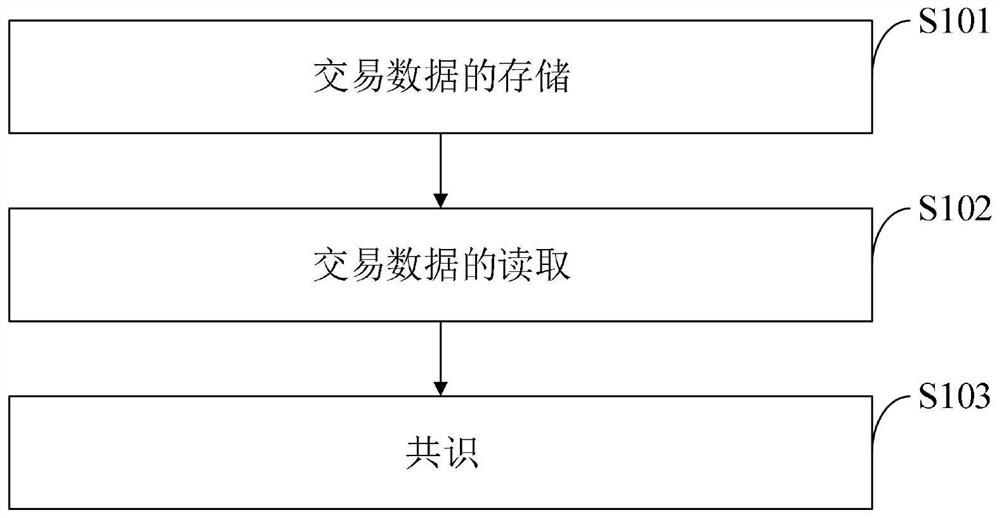
[0063] During the consensus process, the complete block data is generated as the miner nodes package the data, and is stored by the storage nodes and read when needed. Therefore, the solution of the present invention mainly consists of three parts: consensus, data stor...
Embodiment 2
[0083] User Alice needs to store a piece of data in the distributed storage system, so he sends a transaction and pays the fee, then the system packages the transaction and saves the data. Three days later, if Alice needs to read the data, the entire data is read from the system, and the data remains intact during this period.
[0084] Assumption: The hash value of the transaction data is 1ddabe There are four nodes in the system, the IDs are 2aed12, 115add, 5e123a, 42e341, and the k value of this transaction is 2.
[0085] The following is the process of data storage:
[0086] Step 1: Alice sends this transaction, and the system selects miner nodes according to the consensus process, and packages the transaction;
[0087] Step 2: The miner node calculates the hash value of the data and obtains the result 1ddabe. According to the result, the two nodes whose IDs are 2aed12 and 115add become the storage nodes of the data;
[0088] Step 3: The miner node sends data to the 115ad...
Embodiment 3
[0097] Embodiment 3, if Alice and Bob want to conduct a transaction on the blockchain, they send the transaction content to the transaction pool and wait for the nodes to process it. Nodes A, B, and C on the existing three blockchains need to determine the packager and distributor of the next stage of data through the consensus process.
[0098] Step 1: Each node discloses its own credit value, assuming that they are a, b, and c respectively, and the total credit value of the system (a+b+c) can be obtained. At this point, each node generates its own random number r. There are no rules for generating random numbers, and each node can design its own.
[0099] Step 2: Each node calculates whether its own random number r satisfies the formula. Assuming that A is satisfied, but B and C are not, A needs to send its own random number to B and C for verification.
[0100] Step 3: B and C verify whether A's random number satisfies the formula, and confirm after the verification is c...
PUM
 Login to View More
 Abstract
Description
Claims
Application Information
 Login to View More