Unlock instant, AI-driven research and patent intelligence for your innovation.

Semi-supervised fault classification method based on weighted feature alignment auto-encoder

An autoencoder and fault classification technology, applied in neural learning methods, instruments, biological neural network models, etc., can solve problems such as performance degradation of semi-supervised algorithms, drift of working conditions, and different distributions, so as to improve the generalization ability and The effect of classification performance, reducing performance degradation, and improving robustness

Active Publication Date: 2021-08-06
ZHEJIANG UNIV
View PDF2 Cites 3 Cited by
  • Summary
  • Abstract
  • Description
  • Claims
  • Application Information

AI Technical Summary

Problems solved by technology

However, this assumption has its limitations. The data collected by industrial processes often contain a lot of noise and abnormal points, and the drift of working conditions may occur. Labeled data are often manually screened and marked by experts in the process field. , while the unlabeled samples have not been screened, therefore, it is very likely that there will be abnormal data in the unlabeled data that are different from the distribution of the labeled data
When the distribution of unlabeled data is not consistent with that of labeled data, the performance of semi-supervised algorithms will drop, even lower than that of supervised algorithms that only use labeled data for training.

Method used

the structure of the environmentally friendly knitted fabric provided by the present invention; figure 2 Flow chart of the yarn wrapping machine for environmentally friendly knitted fabrics and storage devices; image 3 Is the parameter map of the yarn covering machine
View more

Image

Smart Image Click on the blue labels to locate them in the text.
Viewing Examples
Smart Image
  • Semi-supervised fault classification method based on weighted feature alignment auto-encoder
  • Semi-supervised fault classification method based on weighted feature alignment auto-encoder
  • Semi-supervised fault classification method based on weighted feature alignment auto-encoder

Examples

Experimental program
Comparison scheme
Effect test

Embodiment Construction

[0043] The present invention will be described in detail below with reference to the accompanying drawings and preferred embodiments, and the purpose and effect of the present invention will become clearer. It should be understood that the specific embodiments described here are only used to explain the present invention and are not intended to limit the present invention.

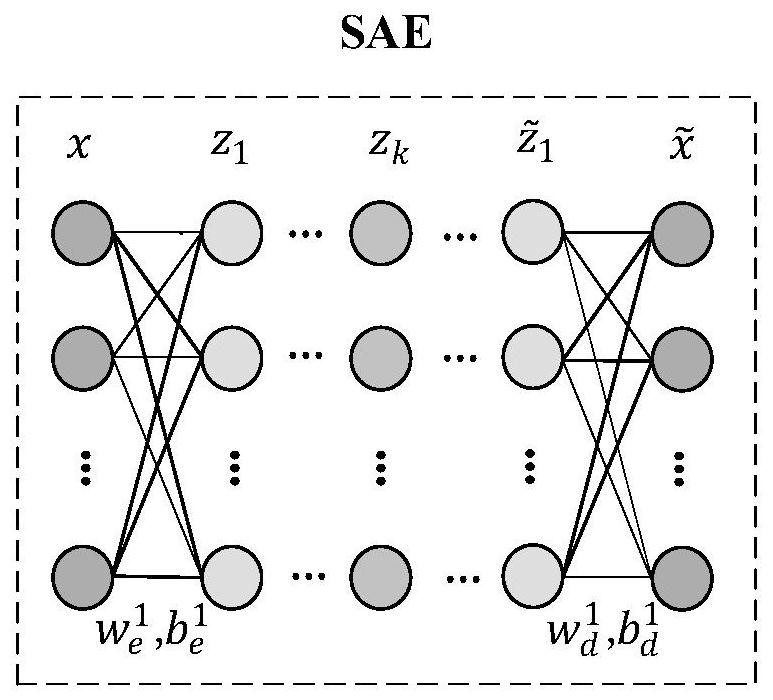
[0044] The semi-supervised fault classification method based on the weighted feature alignment autoencoder of the present invention first uses labeled data to perform reconstruction pre-training on the stacked autoencoder, and estimates the probability density distribution of the reconstruction error. Then, the weights of the unlabeled samples are calculated according to the probability density function of the training data reconstruction error. Furthermore, using the labeled sample set, unlabeled sample set and corresponding weights, a semi-supervised classification model based on the weighted feature alig...

the structure of the environmentally friendly knitted fabric provided by the present invention; figure 2 Flow chart of the yarn wrapping machine for environmentally friendly knitted fabrics and storage devices; image 3 Is the parameter map of the yarn covering machine
Login to View More

PUM

No PUM Login to View More

Abstract

The invention discloses a semi-supervised fault classification method based on a weighted feature alignment auto-encoder, and the method comprises the steps: carrying out the reconstruction pre-training of a stacked auto-encoder through employing labeled data, and estimating the probability density distribution of a reconstruction error; then, according to the probability density function of the training data reconstruction error, calculating the weight of the unlabeled sample; and furthermore, constructing a semi-supervised classification model based on a weighted feature alignment auto-encoder by using a labeled sample set, an unlabeled sample set and corresponding weights. The weighted feature alignment auto-encoder classification model designs a cross entropy training loss function based on a weighted Sinkhorn distance, and the function enables the model to use label data and label-free data at the same time in a fine tuning stage, so that not only can deep mining of data information be realized, but also the generalization ability of the network model can be improved. Meanwhile, due to the introduction of a weighting strategy, the robustness of the model is remarkably improved.

Description

technical field [0001] The invention belongs to the field of industrial process control, in particular to a semi-supervised fault classification method based on weighted feature alignment autoencoders. Background technique [0002] Modern industrial processes are developing toward large scale and complexity. How to ensure the safety of the production process is one of the key issues that need to be solved in the field of industrial process control. Fault diagnosis is a key technology to ensure the safe operation of industrial processes, and it is of great significance to improve product quality and production efficiency. Fault classification is a part of fault diagnosis. By learning from historical fault information, automatic identification and judgment of fault types can be realized, thereby helping production personnel to quickly locate and repair faults and avoid further losses caused by faults. With the continuous development and progress of modern measurement methods...

Claims

the structure of the environmentally friendly knitted fabric provided by the present invention; figure 2 Flow chart of the yarn wrapping machine for environmentally friendly knitted fabrics and storage devices; image 3 Is the parameter map of the yarn covering machine
Login to View More

Application Information

Patent Timeline
no application Login to View More
IPC IPC(8): G06K9/62G06N3/04G06N3/08
CPCG06N3/08G06N3/045G06F18/2321G06F18/241G06F18/214
Inventor 张新民张宏毅
Owner ZHEJIANG UNIV
Features
  • R&D
  • Intellectual Property
  • Life Sciences
  • Materials
  • Tech Scout
Why Patsnap Eureka
  • Unparalleled Data Quality
  • Higher Quality Content
  • 60% Fewer Hallucinations
Social media
Patsnap Eureka Blog
Learn More